


University of Utah scientists invent spintronic organic LED
A group of physicists from the University of Utah (EU) have invented an organic spintronic LED that promises to be brighter, cheaper and more environmentally friendly than the types of LEDs currently used in television and computer screens, lightning, traffic lights and numerous electronic devices.
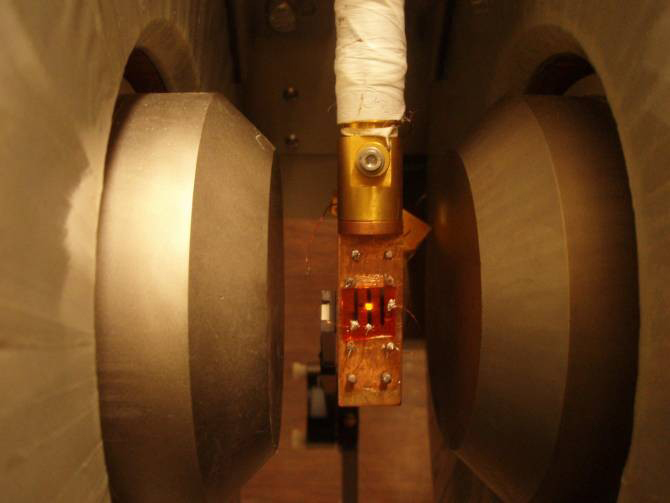
Scientists at the University of Utah have developed an organic spintronic LED, a new generation of OLEDs different from conventional organic LEDs that can lead to brighter display devices, cheap and ecologically friendly. The team led by Valy Vardeny has already manufactured a prototype of the new type of LED, which produces an orange color. Vardeny hopes that within two years it will be possible to use the new technology to produce red and blue LEDs., and that in the end white organic spintronic LEDs can be created. However, It could be five years before the new LEDs hit the market, because now these operate only at temperatures that do not exceed 33 degrees Celsius below zero (28 degrees Fahrenheit below zero), and must be improved so that they can operate at higher temperatures, like the normal ones inside homes and in other environments.
The OLEDs (Organic LEDs, or organic light-emitting diodes) existing ones can each produce a certain color of light, such as red, green and blue, depending on the semiconductors used. A crucial advantage of the new spintronic OLEDs is that, in the future, a single device could produce different colors, controlled by changes in the magnetic field. Besides, Devices that use organic semiconductors are usually less expensive and produce less toxic waste than conventional silicon semiconductors..
Ramparts of the Varden, professor at the University of Utah, has developed this OLED prototype together with Tho D. Nguyen, assistant researcher and physics professor, y with Eitan Ehrenfreund, physicist at the Haifa Institute of Technology in Israel. “It is a completely different technology”, Vardeny declared to the publication Science. "These new organic LEDs can be brighter than regular organic LEDs."
Did you like this article?
Subscribe to our NEWSLETTER and you won't miss anything.
Related articles
 The University of Arizona entrusts Riedel with its intercommunication
 Barco powers the XR laboratory at the University of South Westphalia
 The University of Manchester trusts EM Acoustics with its sound
 Dante boosts learning at Beijing university
 Extron Provides AV Technology to Utah Tech University
 Q-SYS provides AV solution to the University of Hertfordshire
 The Renkus-Heinz sound welcomes new students at the University of Utah
 CERN chooses Matrox Monarch to reproduce and record the latest scientific findings
 The Void breaks the barriers between the physical and virtual world to create an amusement park in Utah
 They invent an innovative laser camera that sees behind corners
 UC3M scientists develop a prototype to apply augmented virtuality to e-learning
 IEC in the Science Park of the University of Valencia
 Arthur Holm at Kuwait University
 Vitelsa at the Public University of Navarra