


LuminAR, a new system that turns any surface into a touch screen
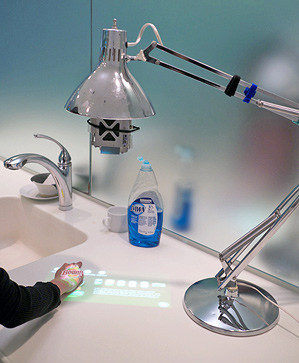
Los investigadores del MIT Media Lab (Instituto de Tecnología de Massachusetts, EU) han desarrollado LuminAR, un sistema que sustituye la bombilla de una lámpara por un sistema mucho más avanzado y complicado que convierte cualquier superficie en una pantalla táctil interactiva. El sistema proyecta imágenes interactivas en la superficie y es capaz de detectar cuando el dedo de una persona toca los objetos dentro de las imágenes proyectadas.

Nathan Linder, un estudiante del MIT Media Lab, cree que un ajuste en el interior de un casquillo de bombilla, junto con una cámara y un proyector, podrían proporcionar un nuevo y revolucionario tipo de interfaz convirtiendo cualquier mesa o escritorio en una pantalla táctil simple. El dispositivo LuminAR, creado por Linder y sus colegas del Media Lab, puede proyectar imágenes interactivas sobre una superficie, detectando cuando el dedo o la mano de una persona apunta a un elemento dentro de esas imágenes. Linder describe el LuminAR como un sistema de realidad aumentada, porque las imágenes y las interfaces de la proyección pueden alterar la función de una superficie u objeto.
El sistema de Linder utiliza una cámara, un proyector, y software para reconocer objetos e imágenes proyectadas sobre o alrededor de ellos, y también para funcionar como un escáner. Se conecta a Internet a través de Wi-Fi. Algunas capacidades del prototipo, como el reconocimiento de objetos, se basan en parte en el software que se ejecuta en un servidor remoto en la nube.
LuminAR podría ser utilizado para crear una pantalla adicional en una superficie, tal vez para mostrar información relacionada con una tarea en la mano. También se puede utilizar para hacer una foto de un objeto, o de documentos impresos, tales como una revista. Un usuario puede enviar por e-mail esa foto a un contacto mediante la interacción con la interfaz proyectada del LuminAR.
 Aplicaciones prácticas
“Estoy muy emocionado por la forma en que podría ser utilizado por los ingenieros y diseñadores”, ha señalado Linder, que considera que podría ser útil para cualquier profesión creativa que a menudo implica trabajar con papel y otros objetos tangibles, así como computadoras.
LuminAR podría tener usos más allá del escritorio o entorno de oficina. Una demostración para ilustrar el uso de uno de estos dispositivos incluye una maqueta de una tienda de electrónica, donde el dispositivo proyecta etiquetas de precios junto a las cámaras en una mesa, así como botones que podrían ser utilizados para acceder a más información sobre el producto. Linder también ha tratado de usarlo para video-llamadas de estilo Skype, con una proyección de vídeo de la persona que llama en la pared al lado del escritorio donde se ubica la lámpara de pie.
El prototipo está construido en torno a un procesador Snapdragon de Qualcomm, de uso común en los teléfonos inteligentes y las tablets. Linder y sus colegas están experimentando con un sistema operativo personalizado basado en Linux y una versión modificada del sistema operativo móvil Android de Google. Los primeros prototipos de LuminAR incluían un brazo motorizado para la lámpara, pero los investigadores se centran actualmente en la versión con sólo el casquillo de la lámpara. Ese diseño reduce los costes y la complejidad, y también hace que la tecnología sea más fácil de adoptar, asegura Linder. “Tiene un coste de adopción cero. Sólo hay que cambiar la bombilla de la lámpara”.
[youtube]http://www.youtube.com/watch?v=XV5V-dQW8CI[/youtube]
Did you like this article?
Subscribe to our NEWSLETTER and you won't miss anything.
Related articles
 Ipevo IS-01 turns any flat surface into an interactive whiteboard
 Philips Screeneo turns any surface into a projection screen of up to 100 inches
Sony Ultra Short Throw Project turns any surface into a 4K screen
Philips Screeneo turns any surface into a projection screen of up to 100 inches
Sony Ultra Short Throw Project turns any surface into a 4K screen
 Any surface can become a virtual touch screen
An innovative discovery from the University of Washington makes any screen touchable
Any surface can become a virtual touch screen
An innovative discovery from the University of Washington makes any screen touchable
 TeslaTouch, touch technology based on electrovibration to create unimaginable sensations on any surface
 Smart's LightRaise 60wi projector turns any surface into a touch screen
 Purdue University creates a system that detects touch and hand gestures on any surface
 Disney develops technology that turns any surface into touch
 Depalol iPlayer turns any screen into interactive
 Ubi turns any wall into a 3D screen thanks to Kinect
 Penvue transforms any flat surface into an interactive screen
 Microsoft creates an innovative projector capable of turning any surface into a touch screen
 Epson EB-455Wi and EB-465i or how to turn any surface into an interactive screen