

Toshiba predicts that HDD storage will continue to be key in this 2026
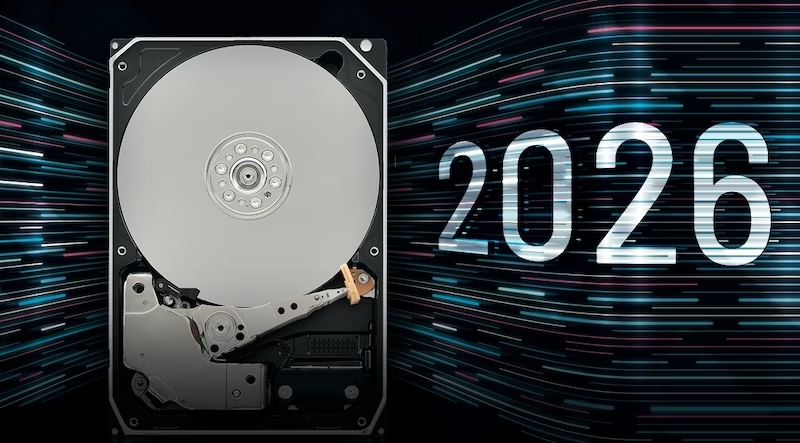
Toshiba underlines the strategic role that hard drives will continue to play (HDD) as the backbone of cost-effective large-scale storage in 2026. Generative AI, the expansion of cloud environments, Internet of Things (IoT) and advanced video surveillance will continue to drive demand for scalable storage solutions, efficient and reliable.
Global storage demand will double until reaching almost 20.000 Exabytes one 2029, according to IDC. This growth is largely driven by AI workloads., that generate enormous volumes of data that must be stored, analyzed and retained over the long term for regulatory and business reasons. In this scenario, HDDs will continue to be the most cost-efficient option per Terabyte for online storage, bulk backup and archiving.
The video surveillance It is one of the sectors in which storage needs are transforming most rapidly. The rise of AI-based video analysis, along with continuous recording in high resolution, requires solutions capable of offering high capacity, Sustained performance and maximum reliability in operating environments 24/7. In response to these demands, Toshiba recently launched the S300 AI hard drives, designed for intelligent video surveillance systems.
HDD y SSD, complementary technologies
Toshiba emphasizes that, in data centers, HDD y SSD, far from being exclusive technologies, They fulfill differentiated functions. While the SSD provides speed and low latency for processing-intensive tasks, los HDDs allow large volumes of data to be stored sustainably and economically viable. In AI applications, For example, SSDs are key in training and analysis, and HDDs to store historical data and large datasets.
In this scenario, and according to TrendForce, Shortage of nearline hard drives has led to delivery times ranging from weeks to a year. Y, although some providers consider the use of SSD, especially QLC SSD, for cold data, HDDs are still essential.
Along with continuous innovation, Toshiba emphasizes that the SAS/SATA HDD format standardization of 3,5 inches remains a key factor for the industry, as it protects existing investments and facilitates integration into already deployed infrastructures. In fact, Gartner predicts that in 2026 HDDs will represent the 68% of the total capacity supplied, mainly nearline hard drives 3,5 inches and high capacity, adapted to the requirements of data centers and the cloud.
As for the innovations, Toshiba highlights the introduction of multi-actuator discs, NVMe or Ethernet interfaces for HDD and staggered magnetic recording (SMR), although they have not yet achieved widespread adoption.
The company continues to invest in R&D to offer higher capacity drives, energy efficiency and reliability. A recent milestone is the verification of the stacking technology 12 discos, combining microwave-assisted magnetic recording (MAMR) and will allow 40TB HDD in the format 3,5 inches for 2027. These innovations are supported by the use of glass dishes and filling with helium., which improves mechanical stability and reduces energy consumption. To achieve even greater capabilities, Toshiba is also investigating the integration of stacking. 12 Next-generation drives with heat-assisted magnetic recording (HAMMER).
Sustainability and energy efficiency
Sustainability will be a central axis in the evolution of storage in the coming years. As the number of data centers grows, The need to reduce its environmental impact is also growing. In this sense, High-capacity HDDs allow reducing energy consumption per Terabyte stored, an increasingly relevant metric for operators.
Toshiba notes that current HDD models consume between 9 y 10 watts, regardless of ability. As this increases, consumption per Terabyte drops from 1W/TB on 10TB drives to less than 0.4W/TB on 24TB drives, and future generations are expected to further reduce this ratio. To achieve, Toshiba uses helium-filled discs, reducing friction and energy consumption.
Toshiba HDD Innovation Lab
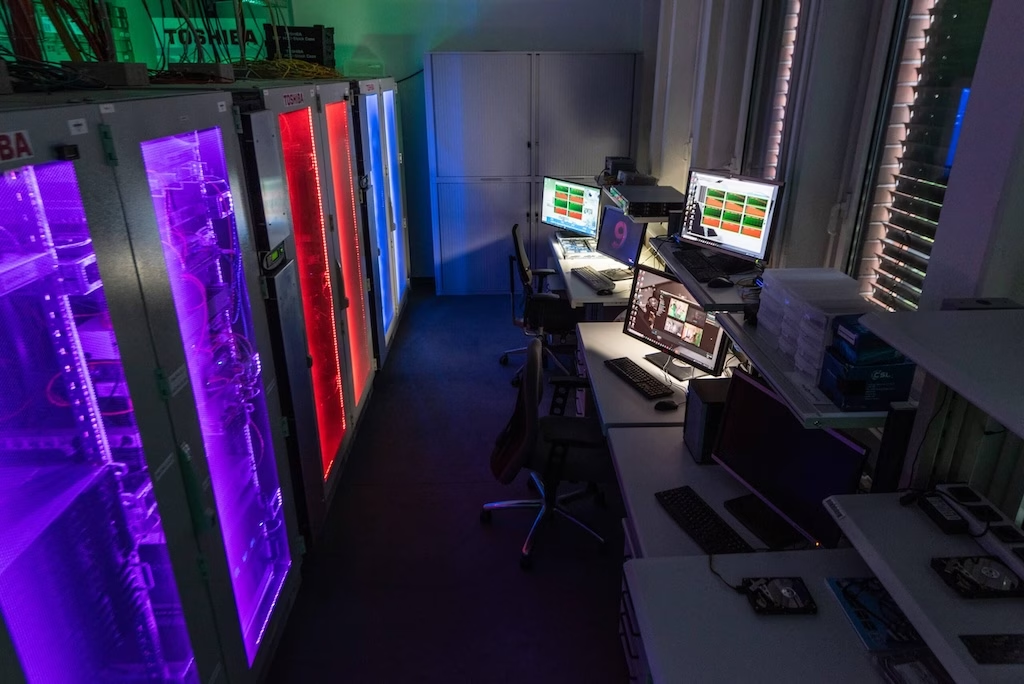
The sustainability imperative, added to increasingly complex architectures and growing demand, make expert guidance essential and in 2026, he HDD Innovation Laboratory from Toshiba in Düsseldorf (Germany), offering benchmarking and energy analysis services to help optimize configurations that deliver maximum performance and efficiency, will be a key resource for the company's clients and partners.
Rainer W. Why?, Senior Director HDD Business Development at Toshiba Electronics Europe, “evaluation and optimization of HDD configurations for SAN, NAS and video surveillance applications will be crucial for organizations to maximize performance, energy consumption and reliability”. Kaese adds that, “The HDD Innovation Lab enables customers to make informed decisions and implement storage solutions tailored to their needs with the expected increase in data center construction and the increasing complexity of storage environments, downtown expansion is a highly probable possibility”.
Did you like this article?
Subscribe to our NEWSLETTER and you won't miss anything.
Related articles
 Toshiba will take IBC 2025 a storage system 1,4 PB
 Avixa foresees growth in the AV integration sector of the 3,9% in 2030
 WHEREAS 2026 will continue to focus on the development and promotion of emerging companies
 Media storage: key European directives in the face of the rise of cyberattacks
 Toshiba takes IBC 2023 a Petabyte-scale multimedia storage solution
 Pervasive Technologies predicts that AI will center business processes
 Sharp plans to increase 500% its screen business in Europe
 Ingram Micro will remain operational to provide technological products and services to critical sectors
 Tech Data markets Toshiba's internal storage offering
 The Barcelona Virtual Reality Market foresees the attendance of 2.500 personas
 B-Tech positively values your attendance at ISE 2018 and predicts that this will be a good year for the industry
 LG will continue betting on CES 2017 Las Vegas for UHD image quality
Qmatic Spain plans to increase a 27% your turnover this year
LG will continue betting on CES 2017 Las Vegas for UHD image quality
Qmatic Spain plans to increase a 27% your turnover this year
 CES 2014 will gather 3.200 exhibitors and foresees the attendance of 150.000 visitors