


Two 'virtual police officers' will facilitate communication between citizens and the Municipal Police in Pamplona
El sistema de ‘policía virtual’, puesto en marcha por Indra, consta de un kiosco con un pulsador, un interfono, una cámara ergonómica y otra panorámica de videovigilancia que ofrece una visión más amplia de la zona. A esos dos elementos se unen la red de comunicación y grabaciones de imagen y sonido mediante fibra óptica y el CCTV del Ayuntamiento.
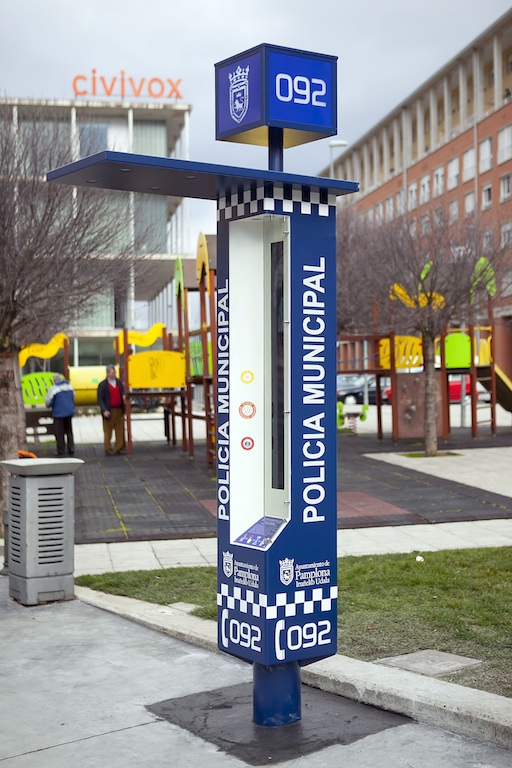 El Ayuntamiento de Pamplona ha puesto en marcha dos puestos de ‘policía virtual’ en la plaza Sanduzelai en el barrio de San Jorge y en la plaza Alfredo Floristán en el barrio de la Milagrosa. Se trata de dos dispositivos que facilitan la comunicación entre la Policía Municipal y los ciudadanos que, a través de esos puestos, podrán alertar de situaciones de peligro y otros sucesos reseñables.
El sistema de ‘policía virtual’ consta de un kiosco de 2,8 meters high, blanco y azul, con un pulsador, un interfono y una cámara ergonómica que se ajusta a la altura del ciudadano demandante. A esa cámara se une otra panorámica de videovigilancia situada en las inmediaciones del puesto para tener una visión más amplia de la zona.
A esos dos elementos se unen la red de comunicación y grabaciones de imagen y sonido mediante fibra óptica y el CCTV del Ayuntamiento y, finally, el Centro de Coordinación Operativa de la Policía Municipal (CECO) con presencia permanente y atención inmediata de la llamada mediante alarmas habilitadas al efecto.
Una vez puesto en marcha el sistema, tanto bajo la petición de un ciudadano como a iniciativa de un agente en una situación determinada, las cámaras visualizarán la zona para poder tomar entonces las decisiones oportunas y reaccionar con mayor conocimiento de causa ante el hecho concreto.
Esta martes el alcalde de Pamplona, Enrique Maya, el concejal delegado de Seguridad Ciudadana, Ignacio Polo, el director de Seguridad Ciudadana, Alberto Margallo, y el jefe de la Policía Municipal, Simón Santamaría, han realizado una demostración de este nuevo sistema de comunicación entre los ciudadanos y la policía municipal en el ‘policía virtual’ ubicado en la plaza Sanduzelai. Por el momento se han instalado dos puestos en dos zonas de la ciudad donde conviven tanto menores como jóvenes y mayores disfrutando de su tiempo de ocio. Cabe la posibilidad de habilitar en otros lugares de interés puntos de conexión y realizar el traslado temporal de los kioscos.
Sencillo funcionamiento
El funcionamiento del sistema es sencillo y muy intuitivo. Besides, los pasos a seguir se encuentran impresos en el propio kiosco junto a la pantalla, tanto en castellano como en euskera.
El ciudadano que quiera comunicarse con la Policía Municipal deberá situarse frente a la pantalla que tiene el kiosco y accionar el pulsador de llamada. Then, el kiosco se ilumina y la Policía Municipal recibe en el CECOP una alarma acústico-luminosa instantánea, al mismo tiempo que visualiza tanto las imágenes del propio kiosco como las que ofrece la cámara panorámica ubicada en la zona.
Recibida la llamada, se inicia la conversación bidireccional entre el ciudadano y el policía. La Policía Municipal, a la vista de las imágenes que ve y de la información que le suministra el comunicante, tomará las decisiones oportunas, pudiendo atenderse la solicitud de forma remota o enviar una patrulla. Una vez concluida la conversación, se apagará la luz del kiosco. Durante todo este proceso se grabará tanto la imagen como el sonido de la comunicación establecida entre policía y ciudadano.
Sin coste para el Ayuntamiento
Los ‘policías virtuales’, valorados en 82.323,54 euros, no han supuesto coste alguno para el Ayuntamiento de Pamplona. Su colocación forma parte de las mejoras presentadas en su momento por la empresa Indra Sistemas, adjudicataria del contrato de mantenimiento y montaje de instalaciones semafóricas en la ciudad.
Estos kioscos se unen a otros que la Policía Municipal tiene a disposición y al servicio de los ciudadanos para establecer cauces de comunicación de incidencias en la ciudad.
Did you like this article?
Subscribe to our NEWSLETTER and you won't miss anything.
Related articles
 Riedel une espacios y profesionales en Baluarte/NICDO en Pamplona
 Isastur relies on Lifesize solutions for its communication between headquarters
 Essae opts for TixeoFusion to strengthen communication and collaboration between its teams
 Bilbao improves communication with its citizens with new urban digital media
 Lalín promotes communication with its citizens through digital media
 Maine and Loire improves communication with its citizens thanks to digital signage
 Partteam provides interactivity between citizens and smart cities with YPortal
 Lumens VC-A50PN incorporates NDI technology for IP communication between video devices
 The Municipal Housing Company of Madrid manages citizen care with Qmatic
 Synology updates its collaboration tools to boost communication between teams
Digital Samba OnSync 5.0 optimizes communication between participants
Synology updates its collaboration tools to boost communication between teams
Digital Samba OnSync 5.0 optimizes communication between participants
 Jung: hotel display to facilitate communication between guests and staff
 Mitsubishi DLP cubes improve communication between management centers in Kazakhstan
 El sistema ABC System se actualiza para agilizar a los ciudadanos el cruce de fronteras en aeropuertos