


Digital Mirror reflects the interior of our body in real time at the Museum of Arts and Crafts in Paris
Technology, Animated medical images and the Kinect system are part of the creative experiment carried out at the Museum of Arts and Crafts in Paris by researcher Xavier Maître with Digital Mirror, that reflects the inside of the visitors' body, whose organs are shown moving in real time, which has not left anyone indifferent.
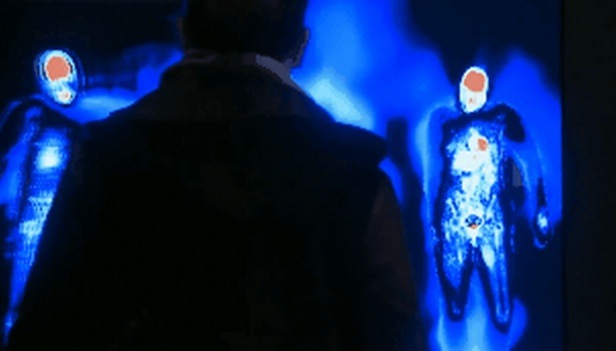
The reflection we get when we see ourselves in a mirror generates all kinds of reactions; If instead of our image what we see is the inside of our body, as if from a bone x-ray, organs,…in motion it will be, the answer is more than surprising.
This has been the objective of the experiment carried out by Xavier Maître, medical imaging researcher at the University of Paris South, with Digital Mirror at the Museé des Arts et Metiers in Paris (Museum of Arts and Crafts); a digital mirror that reflected the inside of the visitors' body, who were shocked to see themselves reflected in such a way. Yes ok, The objective was not so much to surprise as to show the medical images naturally and bring this reality closer to the public..
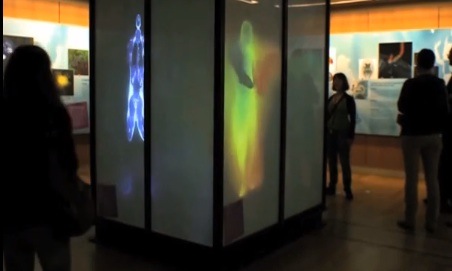 To achieve this digital technological and simulation effect, the system has been used Microsoft Kinect integrated into 65” vertical digital screens, with cameras to detect the position of the body and project animated x-rays stored in a database on this digital mirror that follow the movements of visitors in real time.
Previously, and with the consent of anonymous people, For this experiment, a good number of medical images and scans had been made., con PET, X-rays and MRI, to create a database of high resolution images of the inside of the human body, including bones and organs, according to information provided by New Scientist (deputy video).
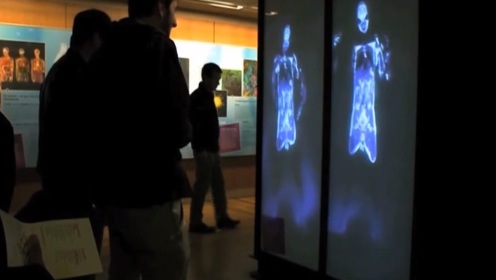 Digital Mirror uses an algorithm and proprietary software developed by researchers at this university to identify gender and show the inside of the male or female body.. These animated medical images use graphical processing cards to track the movement of visitors' bodies in real time, showing up to twenty-four different joints, including knees, elbows, dolls.
Visitors' reactions to Digital Mirror have been very useful for Maître's research, speaking to New Scientist, whose objective is to prepare patients emotionally before surgery and help them better understand their ailments not in front of a static image but by visualizing it in their own body..
Digital Mirror was recently presented at the Human-Computer Interaction conference, held at the end of last April in Toronto (Canada), with great success and with the forecast of going further in the real perception of the human body with the dynamic visualization of the heart and lungs in real time.
[youtube]http://youtu.be/BXkXMVleqqc[/youtube]
Did you like this article?
Subscribe to our NEWSLETTER and you won't miss anything.
Related articles
 Arec KS-CC1: transcription and translation in real time at events
 Optoma OMS: real-time and remote monitoring for AV devices
 Virtualware develops a real-time clinical case simulator
 AdderLink XDIP: digital KVM over IP extender that guarantees high image quality and real-time control
 Interactive bar counter with real-time alcohol measurement system
 Mobile Engagement transforms the Museum of the Royal Academy of Fine Arts of San Fernando
 Animotion offers a show that fuses art in Edinburgh, music and digital technology in real time
 ‘Mirror’: a gigantic Led mirror that responds to real-time changes in the city of Seattle
 Real-time visualization with digital signage of London subsoil drilling
 Aurasma augments the real world with real-time web updates
 They create a melee telepresence robot
 Cubensis and Ballantine's propose us to discover the music that we carry inside us
 Informative signage on the trading floor in real time
 Samsung NET-i Ware 1.33, real-time recording of up to 64 HD cameras