


EasyJet uses augmented reality and drones to guarantee the safety and operability of its fleet
Drone technology and augmented reality are going to be the technologies used by the airline EasyJet to inspect its fleet and detect possible breakdowns, At the same time, it will allow you to improve remote assistance from the control center when the planes are far from the base..
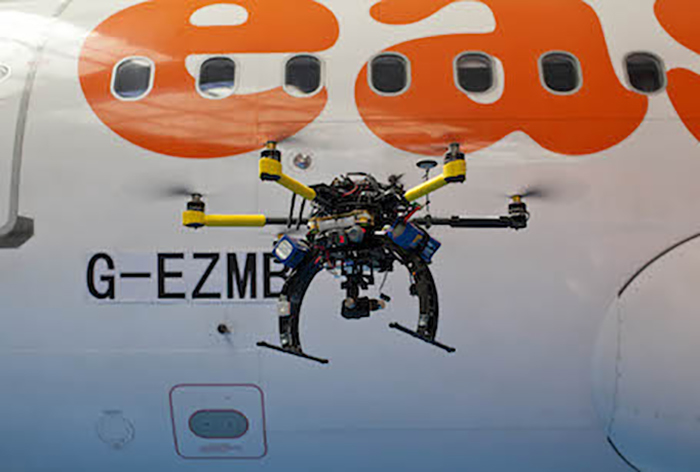
EasyJet, UK's largest airline, has announced that it is going to bet on new technologies and innovation to remain in the low-cost segment and increase the productivity and safety of its aircraft.. With this objective, it is studying introducing drones in the inspections of its Airbus A319 and A320 fleet made up of 220 airplanes. In addition, will also use augmented reality to detect, in the shortest time possible, appliance breakdowns.
“The advantage that these technologies give us is threefold. On the one hand, the release of our engineering team who can dedicate themselves to other more qualified tasks, allowing to reduce costs and, therefore, our rates, while helping us minimize delays. Finally, “These techniques will guarantee us greater security.”, explica Carolyn McCall, CEO of the airline.
Easyjet is working with companies Coptercraft y Bristol Robotics Laboratory so that they adapt existing technology and that drones can be used to inspect their fleet. The drones are programmed to explore and evaluate the Airbus and detect possible failures. These unmanned aircraft are currently under development with the aim of introducing them in the coming months and having them fully operational at the beginning of 2015.
““Unmanned aircraft technology will allow us to carry out work such as fleet inspection that can take more than a day in a couple of hours and to do it with greater precision.”, comments Ian Davies, Head of Engineering at EasyJet.
 Augmented reality with Epson and Vuzix
Together with drones, EasyJet is studying the implementation of virtual reality and is doing it with companies Epson y Vuzix. Through this technology and using augmented reality glasses, the engineering team can see the same thing as the pilots inside the plane. In this way, EasyJet can remotely diagnose technical problems and breakdowns suffered by aircraft.
This technology will be especially useful when the plane is at the most remote airports in its network.. The airline flies to 138 airports, some as far away as Sharm el Sheikh (Egypt) and Tel Aviv (Israel). At the moment, Engineers and pilots when they have a problem have to send the photos by email and call the Operations Control Center by phone (OCC) from EasyJet, to try to resolve the incident.
EasyJet is also testing the technology Visions y XO Eye for streaming video transmission between the engineer and the OCC and from here it will be possible to provide engineers and pilots with real-time information and provide them with technical assistance. For this, it is being tested with a device that is placed on the head and allows it to work with it in 'hands-free' mode..
“Augmented reality is key for Easyjet as it will help reduce the time an aircraft is inactive, allowing to more clearly diagnose technical problems that may occur hundreds of kilometers away. With augmented reality glasses, Pilots and engineers will be able to transmit live images and data to our control center”, aclara Ian Davies.
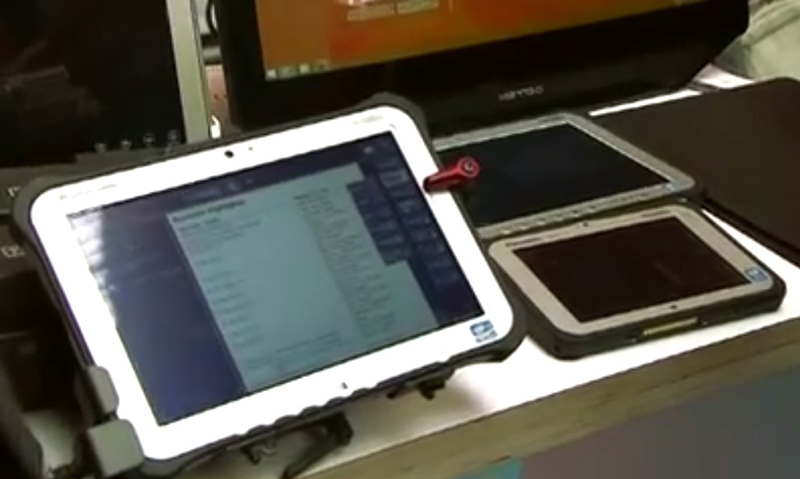 Panasonic Toughpads
Just like Iberia did with the iPad, EasyJet has opted for mobile terminals to introduce them into the cabins and allow pilots easier navigation. The option of this airline company has been the Touchpad of Panasonic. These devices will replace laptops and navigation charts and will allow us to move towards a 'paperless environment' .
The reduction in the use of paper on board will result in lower fuel costs, which the company has valued at around 500.000 dollars a year. Every kilo of weight eliminated inside airplanes represents a saving of around 20.000 dollars a year.
Likewise, e-paper technology is being used’ of Sony to eradicate printed forms in the cabin, since with this system they can be saved in a central database that can be accessed from the planes.
EasyJet is also working with Output42 to develop custom applications so engineers can perform day-to-day tasks more efficiently, as a tool to help them identify and replace damaged fan blades.
[youtube]https://www.youtube.com/watch?v=6rpyhkfKuNk[/youtube]
Did you like this article?
Subscribe to our NEWSLETTER and you won't miss anything.
Related articles
 Real Zaragoza uses augmented reality for fans to interact with players
 AA-Arena relies on DAS Audio to guarantee entertainment and security in the complex
 Augmented reality and drone control mark the prominence of Epson at IFA 2018
 Indra will show at Smart City Expo 2014 the potential of augmented reality and its commitment to security
Delta installs video wall at Bengaluru Traffic Management Center to ensure road safety
Indra will show at Smart City Expo 2014 the potential of augmented reality and its commitment to security
Delta installs video wall at Bengaluru Traffic Management Center to ensure road safety
 Mediclinic uses Axis cameras to improve patient safety and protect the healthcare facility
See-Through leverages augmented reality to ensure driver safety
Mediclinic uses Axis cameras to improve patient safety and protect the healthcare facility
See-Through leverages augmented reality to ensure driver safety
 Metaio develops an interactive and hands-free manual with augmented reality for cars with Google Glass
Nokia JobLens uses augmented reality to search for jobs
Metaio develops an interactive and hands-free manual with augmented reality for cars with Google Glass
Nokia JobLens uses augmented reality to search for jobs
 Ford uses the 3D Cave augmented reality program to project its cars
 Schneider Electric applies the Aenor regulations to its iMSU permanent overvoltage coils to guarantee safety
 A professor at the University of La Laguna uses augmented reality to teach pathological anatomy
 Adidas uses augmented reality to present the new Scotland national team shirt
 Chanel uses augmented reality applications to promote its new watch collection