

TiMax integra control de audio de terceros en su software SoundHub 6.11
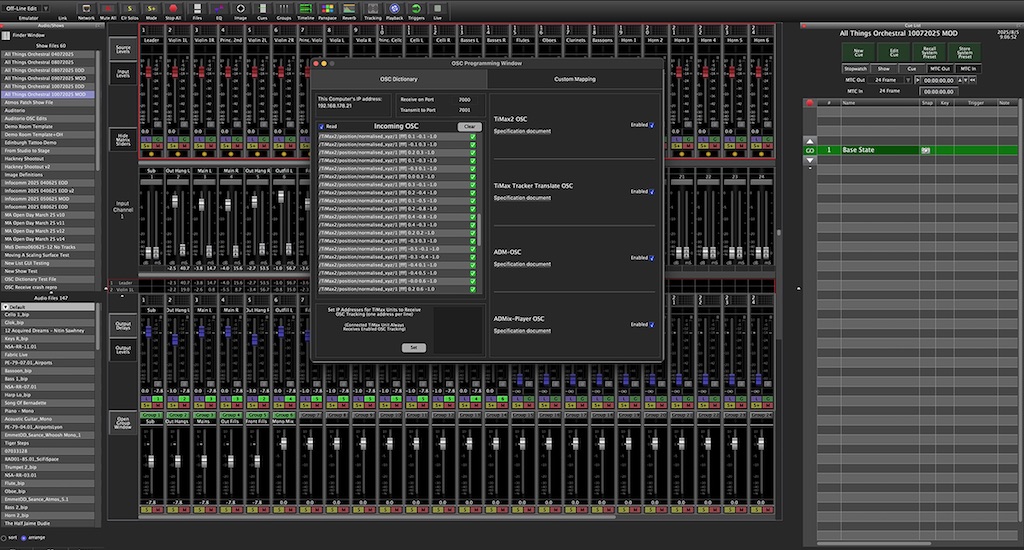
Además de un diccionario bidireccional y compatibilidad con el estándar ADM-OSC, el especialista en audio espacial TiMax incorpora en SoundHub 6.11 la operativa con soluciones de control de terceros, como QLab, Space Controller y Nuendo.
La integración que TiMax ha realizado en la versión 6.11 de su software SoundHub se ha presentado en la reciente edición de la feria Plasa 2025, así como durante las jornadas de puertas abiertas de la compañía.
TiMax SoundHub 6.11 ahora es compatible con diversos diccionarios OSC, lo que permite una operativa inmediata con numerosas soluciones de control de terceros, as QLab, Space Controller (Sound Particles) y Nuendo (Steinberg).
Un nuevo diccionario de SoundHub ha permitido integraciones avanzadas y personalizadas con consolas SSL, Atlas Show Control y Grapes 3D Audio Control, así como una mejora entre con la versión 1.3 de TiMax panLab, presentada simultáneamente.
Solid State Logic (SSL) ha integrado soporte OSC para TiMax SoundHub con sus últimas actualizaciones de software para las plataformas de consola System T y SSL Live.
How do you explain, Berny Carpenter, director de producto de SSL, “la estrecha integración con TiMax SoundHub no solo permite visualizar y controlar la información posicional clave X/Y/ Z de las fuentes de este software desde nuestras consolas, sino controlar sus parámetros de ruta individuales y funciones únicas, lo que permite a los usuarios configurar, visualizar y gestionar fácilmente su sistema desde cualquier lugar”.
La plataforma de software Atlas Show Control, diseñada para programar, sincronizar y automatizar eventos en vivo complejos, offers a control preciso en tiempo real sobre los sistemas de audio, video, iluminación y seguimiento, por lo que ha sido una opción natural para la interoperabilidad con TiMax SoundHub.
El diseñador de sonido Gareth Fry utiliza ambos sistemas. “La comunicación entre Atlas y TiMax agiliza enormemente la configuración de ambos programas, ya que nos permite programar en un entorno consistente y familiar en múltiples espectáculos, independientemente del motor de espacialización que utilicemos”.
La integración alineada entre TiMax y terceros dependía del reconocimiento mutuo de coordenadas referenciadas. Mientras que SoundHub define las posiciones de los objetos utilizando coordenadas reales, medidas en metros o pies, algunos controladores de terceros utilizan coordenadas “normalizadas”, que generalmente oscilan entre -1 y 1.
Gracias a la función de escalado de superficies, recientemente presentada, TiMax SoundHub soluciona cualquier problema para los usuarios al convertir fácilmente las coordenadas normalizadas al espacio de coordenadas absoluto.
Reconocido por su accesibilidad y flexibilidad, era importante extender esta misma filosofía del software a las integraciones con soluciones de control de terceros. For this reason, además de ser compatible con diversos diccionarios OSC, los mensajes entrantes pueden asignarse manualmente a comandos de TiMax SoundHub.
Como apunta Dan Higgott, responsable de producto y software de TiMax, “con mi experiencia en espectáculos espaciales, me quedó claro que una integración fluida en el flujo de trabajo creativo es fundamental para el éxito continuo de SoundHub. Nos complace enormemente que SSL, Atlas y Grapes 3D apoyen esta implementación y estamos deseando colaborar con otras empresas”.
Did you like this article?
Subscribe to our NEWSLETTER and you won't miss anything.
Related articles
 Audio-Technica ATUC-50 se integra con el software Quorum de Ross Video
 TiMax amplía las capacidades de SoundHub con la función Scaling Surfaces
 Martin P3 supports integration of third-party 3D visualization software
 Samsung integra sus pantallas Led con el software de Vū Technologies
 Martin Audio y TiMax dan vida al festival de luz y sonido en Westfield London
 TiMax panLab optimizes spatial audio designs
 TiMax SoundHub aporta audio inmersivo al Museo de Historia de Polonia
 TiMax will show its most innovative immersive audio solutions at InfoComm
 TiMax SoundHub aporta audio inmersivo en ‘Rock me Amadeus’
 Vestel Visual integra sus pantallas SoC con el software de Telelogos
 Nureva admite el seguimiento de cámaras de terceros con una API de audio
 Nureva incorpora seguimiento de cámaras de terceros a su API de audio
 Sony integra el software de control de Kramer en sus pantallas 4K
 El software de TeamViewer se integra en la plataforma AiR de Atheer