


Pharaonic technology: The Grand Egyptian Museum dazzles the world with an immersive show

The Grand Egyptian Museum (GEM) opens with an unprecedented technological deployment that combined digital art, mapping 3D, cutting-edge drones and lighting effects, in an event that set a new standard for cultural ceremonies globally.
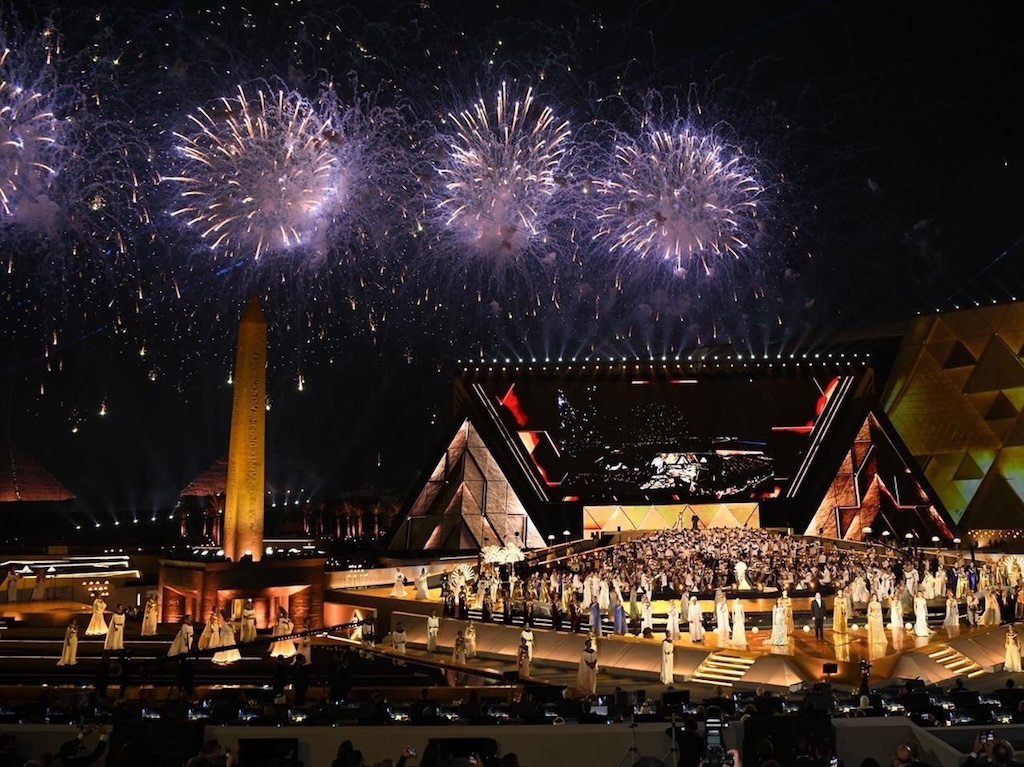
Located next to the Giza pyramids, the new museum, the largest in the world dedicated to a single civilization, has been presented not only as a container of the past, but as a masterpiece of technological innovation applied to heritage narrative. The opening ceremony, produced by the British agency Muse Creative and the Egyptian agency Art D’Égypte, transformed the museum esplanade into a canvas of 28.000 square meters of mapped projections, where history and modernity intertwined with surgical precision.
 The creative concept behind the opening ceremony sought to reflect the Egyptian duality of tradition and modernity. It featured a show mapping 3D large scale that used more than 200 laser projectors. Among other systems, were used 130 projectors Titan 37 000 WUXGA of Digital Projection. The projectors were connected with forty servidores Dataton Watchpax 60 with more than 160 video outputs, generating almost 180 million pixels, with managed images and “sewn” by ten Barco Event Master E2 processors which ensured perfect synchronization on all projection surfaces.
Along with the projection, a total of 5.000 drones illuminated the sky of Giza forming iconic figures such as Tutankhamun's mask, the gods Isis and Osiris, and the pyramids floating in light. Each sequence was programmed using real-time rendering software, which allowed the aerial animation to be choreographed with live music and dynamic visual effects.
A living glass wall
The spectacle was not only limited to the sky since the facade of the GEM, composed of glass triangles inspired by pyramids, became a living architectural screen with anamorphic projections and volumetric content that gave the illusion that the walls were breathing, opening to reveal scenes of the Nile, Animated hieroglyphics and digital recreations of ancient temples.
The technical design included a system of AI controlled DMX lighting, capable of adjusting color temperature and saturation in real time according to the musical rhythm and the audience's reaction. In parallel, a set of transparent LED screens displayed historical data and infographics about the museum's pieces, creating an interactive narrative between art and technology. For this reason, along with pharaonic references, performances by Olympic athletes and young Egyptian artists were included, recorded with robotic cameras and FPV drones that were broadcast live to millions of viewers on international networks and platforms.
The production also integrated a system of 360° surround audio, designed to distribute sound among the audience using position sensors, offering an immersive acoustic experience unprecedented in an event of this scale in Africa.
With this opening, Egypt sent a clear message to the world and its ancient past can be told with the tools of the future.
Did you like this article?
Subscribe to our NEWSLETTER and you won't miss anything.
Related articles
 Sphere will celebrate its first anniversary on 4 July with an immersive show
 Leyard Europe dazzles on the high seas aboard the Artexplorer museum ship
 The Zukan Museum offers an immersive journey into the natural world with Genelec
 Stella: immersive light show, projection and sound in the Cathedral of Burgos
 ‘Otherworld’ offers a fantasy world, holography and large-scale immersive art
 The Led settles in the world of entertainment with Claypaky, ETC and Ayrton
 The Yper Museum fuses technology and history to offer an immersive journey to the Middle Ages
 Ocubo and AV Stumpfl turn the history of Lisbon into an immersive show
 The Great Egyptian Museum trusts Acciona Producciones y Diseño with its museographic execution
 TeamLab bordeless: a digital museum without borders that merges technology and art on a large scale
 Sharp dazzles Amsterdam RAI with the world's first 85” 8K commercial monitor
 The Czech Rudolfinum auditorium serves as the stage for the world's longest immersive videomapping
 Christie's technology turned the opening ceremony of the Swimming World Cup 2013 in a great audiovisual show
 Con Dataton Watchout, Allison Customer Experience center offers immersive multi-screen show