





Towards real interoperability in 'AV over IP'

On this platform, Steven Cogels, Global Director of Business Development de PlexusAV (Sencore), analyzes the current situation of AV over IP with special focus on the emergence of IPMX, an open environment that seeks to position itself as a key alternative in the ProAV world.
The professional audiovisual sector has been navigating the associated challenges to IP-based workflows. Although the OFF over IP has contributed a Remarkable flexibility and scalability, has also introduced complexity, especially with the proliferation of proprietary platforms who don't always communicate well with each other. The result is a fragmented landscape where integrators and end users are often forced to stay within single-vendor ecosystems to ensure compatibility..
There is no doubt that this context has driven innovation. Many solutions offer excellent performance, low latency and high quality media transport. However, the Interoperability remains a concern recurrent, especially as projects grow and organizations seek the freedom to combine technologies without compromising reliability. Increasingly, the conversation is no longer just about adopting IP, but in ensuring that work smoothly in diverse environments.
Standards that lay the foundation
In 2017, The broadcast world began to widely adopt the family of standards SMPTE ST 2110, developed by SMPTE. These specifications quickly became a mainstay of IP-based media production., supported by complementary control frameworks from organizations such as CLOTHING.
On the whole, These standards define how the video, the audio, the metadata, timing and signals control circulate through the networks. Their success in demanding broadcast environments has proven that they are robust, reliable and capable of supporting large-scale deployments.
However, the flows of broadcast work and audiovisual installations professionals do not always share the same requirements. AV integrators often need easier deployment, Greater cross-device compatibility and faster integration with commercial AV hardware. That gap generated demand for an approach more tailored to the Pro AV environment..
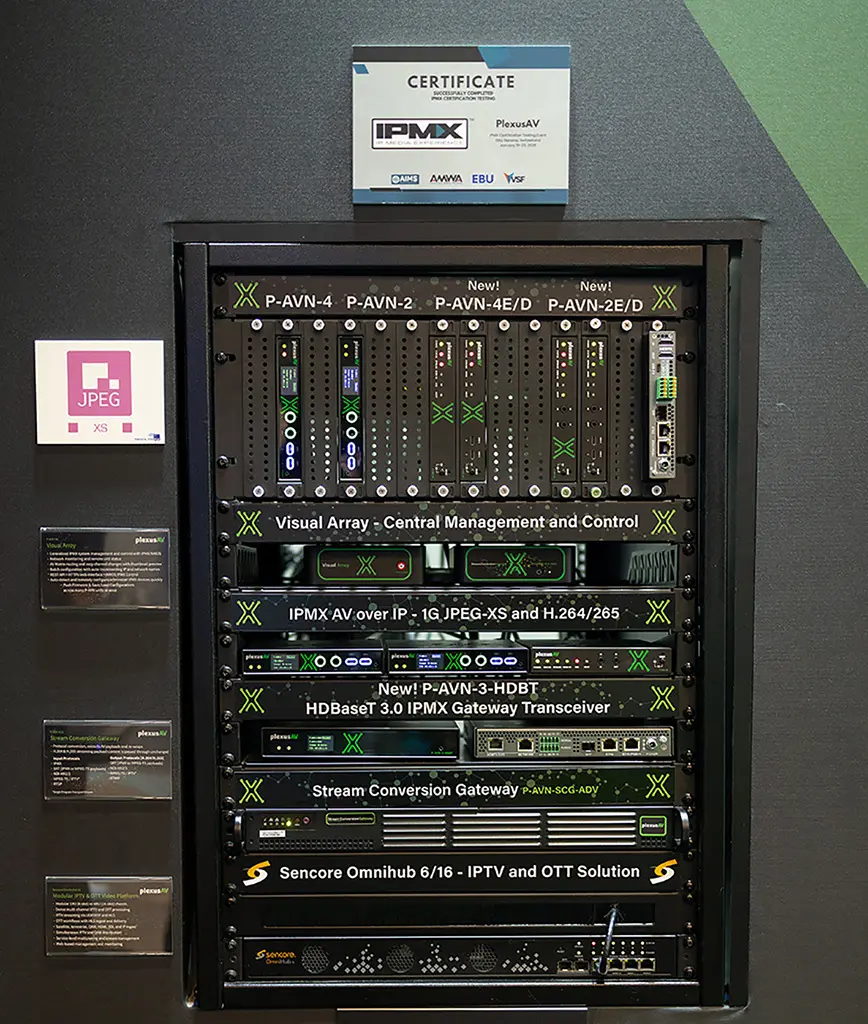
A good example of how standards are moving from theory to real application is the recent IPMX Product Testing and Certification Event held at the headquarters of the European Broadcasting Union (EBU) in Geneva. Numerous products from different manufacturers obtained certification, confirming your compliance with recognized transportation requirements, control and interoperability. This type of validation provides confidence to both integrators and end users that standards-based solutions will work together in practice, not just on paper. As the ecosystem matures, New certifications are expected to reinforce progress towards deployments of OFF over IP truly interoperable.
The emergence of IPMX
Based on the same technical foundations as SMPTE ST 2110 y NMOS, IPMX adapts these proven technologies to better fit the professional audiovisual applications.
Your goal is clear: allow the High-quality, low-latency media transport over IP networks, maintaining at the same time opening, interoperability and flexibility. Instead of reinventing the wheel, IPMX expands consolidated broadcast standards towards environments such as corporate AV, higher education, live events and business facilities.
By relying on already consolidated specifications, the industry you don't need to start from scratch. The basic tools have already been tested in real production scenarios.
Break free from closed ecosystems
One of the main advantages of IPMX is its ability to reduce dependence on proprietary ecosystems. When solutions are built on open standards, Manufacturers can develop products that integrate more naturally with each other.
For integrators, This translates into greater freedom.. They can select the most suitable components for each project –cameras, screens, control systems or processing hardware – without worrying about compatibility barriers. Decision making refocuses on the performance, cost efficiency and suitability for application, rather than dependence on a specific supplier.
Equally important is the possibility of connect existing infrastructure with emerging technologies. Many organizations do not start from scratch; They have previous AV investments that continue to add value. Standards-based platforms must be able to link these environments with modern IP workflows, instead of forcing total replacements.
A relevant cultural change is also observed. Integrators increasingly expect the flexibility to design systems based on customer needs, not from the manufacturers' ecosystems. Open standards support this approach by eliminate traditional barriers and promote a strategy based on the selection of the best solutions for each function.
Designed for flexibility and continuity
From the technical point of view, IPMX is designed to support compressed and uncompressed media on a wide variety of network infrastructures. Its current capabilities include high quality formats like 4K60 with full color fidelity over standard networks, with the possibility of scale up to 8K and beyond when infrastructure allows.
Support for multiple network speeds—from 1G to 100G—makes the technology adaptable to both modest installations and large enterprise deployments.. Additional features such as HDMI compatibility, HDCP support, device discovery mechanisms and modern compression options contribute to seamless integration into existing AV workflows.
Another relevant advance is the accessibility. He OFF over IP Standards-based is no longer limited to flagship or Tier-1 level projects. As solutions become more cost-efficient and simpler to implement, corporate environments, educational, Healthcare and smaller scale businesses can benefit from interoperable infrastructure that was previously reserved for large deployments.
Ultimately, the goal is not just performance, but also the ease of integration and use. Integrators need powerful solutions, but not unnecessarily complex.
A more open path to the future
The transition towards a OFF over IP standards-driven reflects a greater maturity of the sector. Beyond competing solely through proprietary technologies, Manufacturers increasingly recognize the value of interoperability and shared frameworks. Organizations like the AIMS Alliance play a key role in promoting knowledge, testing initiatives and collaboration around open standards.
For end users, this translates into systems easier to expand, maintain and prepare for the future. For integrators, reduces risks and simplifies design decisions. For manufacturers, creates an environment where innovation can thrive without sacrificing compatibility.
He OFF over IP is consolidating as the backbone of modern audiovisual infrastructure. The real opportunity now is to ensure that spine remains open, flexible and able to evolve alongside the workflows of the future, responding to both current needs and those to come.
Steven Cogels
Global Director of Business Development de PlexusAV (Sencore)

Did you like this article?
Subscribe to our NEWSLETTER and you won't miss anything.
Related articles
 NanoLumens and Barco highlight the interoperability of their products at InfoComm
 Virtualware offers full interoperability between virtual and mixed reality in Viroo 2.4
 Crestron Expands DM NVX Platform to Deliver Greater Flexibility and Interoperability
 Sennheiser offers complete interoperability in unified communications with Unify Circuit
 Crestron Mercury begins its deployment to solve interoperability in meeting rooms
 Polycom video conferencing recognized for its open standards interoperability
 D&b expands the functionalities and interoperability of its solutions for fixed installations
 The new IAdea players combine the flexibility of HTML5 and the interoperability of SMIL
 Aurasma augments the real world with real-time web updates
 HDS presents an interoperability system to manage a digital hospital
 Polycom advances universal interoperability of telepresence systems
 Full interoperability in telepresence with the Polycom UC Intelligent Core solution
 Sony moves towards 3D in home environments
 Telepresence Interoperability Protocol: collaboration between different systems