


An American university installs 21 pantallas ePaper Philips Tables
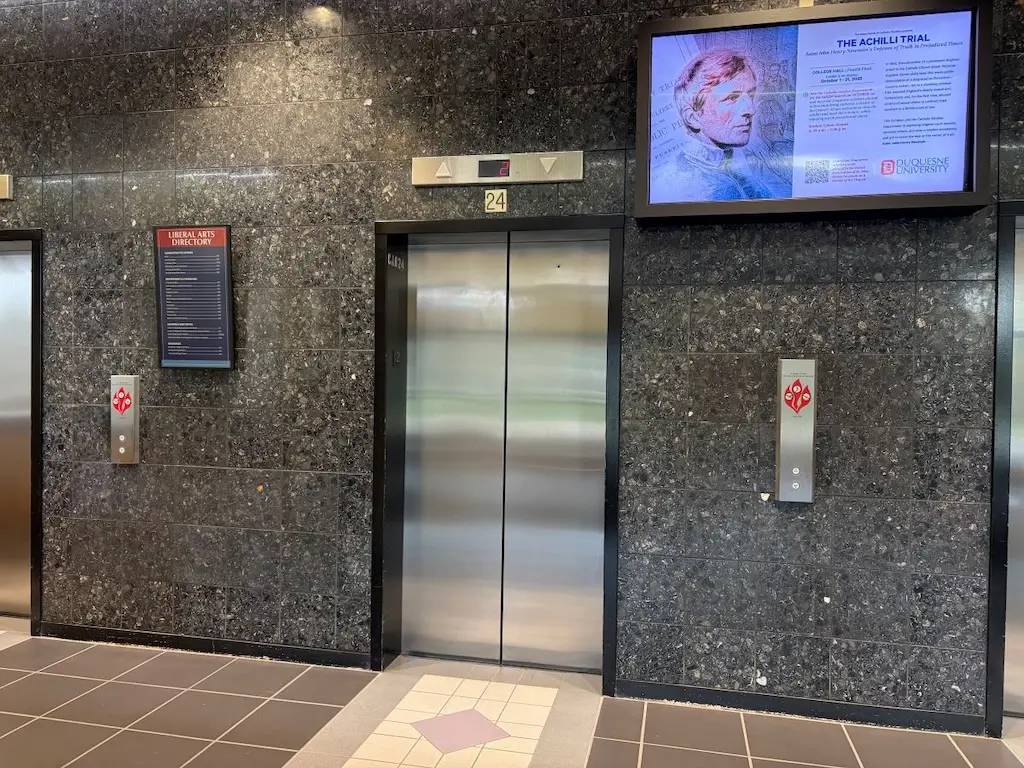
Duquesne University, based in Pittsburgh (one of the main Catholic universities in the country) resort to PPDS to take advantage of the sustainable and economic benefits of its innovative Philips Tableaux e-paper displays “zero consumption”.
Founded in 1887, Duquesne is among the 15 % of the best educational institutions in the United States. This private Catholic university in Pittsburgh, ranked among the best in its category, welcomes 8.000 students of 80 countries and has more than 3.000 members among the teaching and administrative staff.
As the university continues to experience exponential growth, both in attractiveness and size, its picturesque campus 198 300 m2 with views of downtown Pittsburgh continues to evolve, and the university pays increasing attention to providing students with the latest technologies both inside and outside the classrooms.
In line with the United Nations Sustainable Development Goals and its commitment to sustainable ecology (which recently earned them inclusion in Princeton Review's List of Green Universities), The team researched the global ePaper market and turned to PPDS to take advantage of the opportunities offered by this technology and replace obsolete paper directories used throughout campus.
After completing the in-depth analysis, Philips Tableaux e-paper displays were selected as the top choice to achieve the team's ambitions, installing a total of 21 32” units 5150 y 25” 4050 by Philips Tables installed in classrooms, study areas and hallways.
As with other Philips Tableaux e-paper display installations, Philips Tableaux range provides Duquesne University with incredible levels of flexibility and adaptability, Interchangeable for a wide range of uses: from signage and safety notices to cafe menus and event information, among many others. This includes areas with limited power supplies.
Lightweight and totally portable, Philips Tableaux models used on campus are capable of displaying full-color images for days, weeks, months or even years without consuming a single kilowatt of energy, requiring only a small amount of electricity (0,0025 kWh for model 25 inches) during content changes.
Immediate advantages
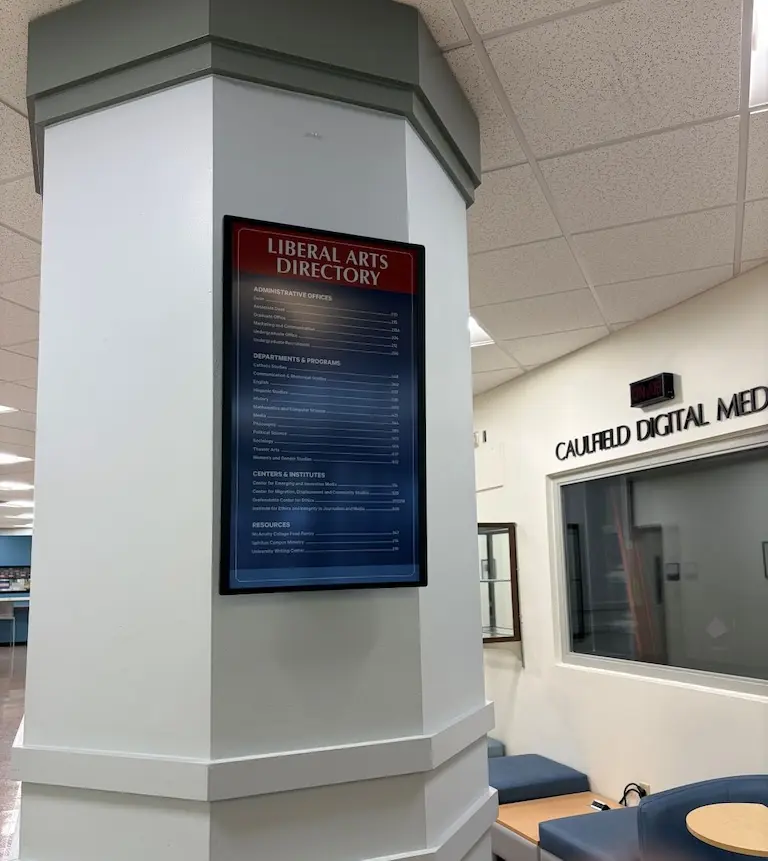 Philips Tableaux displays, that work with a SoC Android, they can managed and updated remotely through a content management system or remote screen management, as Philips Wave, o, as chosen by the Duquesne team, Content can be updated manually via USB drive.
The project has been considered a great success, and a second phase of implementation is planned that will include Philips Tableaux screens in other buildings on campus, like the Faculty of Nursing, the Faculty of Humanities and the Faculty of Medicine.
Lauren Turin, Director of Classroom Technologies at Duquesne University, comments that “we have eliminated the need for complicated installation and are saving on the cost of paper, impression and time. Therefore, the cost per department is more economical in the long term. When our directories need an update, we use a USB memory with the content and an extension cable for power. The time it takes to update the directory is less than the time it takes to walk to the building”.
PPDS Education Director, Patrick VanTreese, adds that “now that sustainability is a priority issue for both companies and education, ePaper has become a real turning point, opening new opportunities to reduce waste, save costs and create new forms of communication. We are delighted to have supported Duquesne University, helping them realize their ambitions with our Philips Tableaux range”.
Did you like this article?
Subscribe to our NEWSLETTER and you won't miss anything.
Related articles
 The Pasteur Institute reduces its carbon footprint with Philips ePaper signage
 The Beeld Museum & Geluid is committed to sustainability with Philips Tableaux ePaper screens
 The Nenuphar restaurant replaces the paper in its menu with Philips Tableaux
 EET revolutionizes digital signage with Philips Tableaux ePaper displays
 PPDS boosts sustainable displays with ePaper Philips Tableaux 4150 of 13″
 PPDS and Deutsche Telekom boost the DOOH market with Philips Tableaux ePaper
 PPDS offers size and sustainability in the new Philips Tableaux 32” ePaper
 PPDS brings the power of Philips professional displays to Oral Roberts University
 PPDS and Grassfish boost the retail sales experience with Philips Tableaux
 PPDS and Telelogos bring content and device management to Philips Tableaux
 West Alabama University installs three Led screens from Watchfire Signs
 E Ink and Artec Design deploy ePaper screens at Estonia's largest university
 Philips PDS installs its digital signage and 4K Pro TV screens at Harlequins rugby stadium
 US FDA gives green light to Philips EchoNavigator for heart interventions