


The AVP production company, based in Singapore, Find in Sennheiser Spectera the perfect ally for complex RF environments
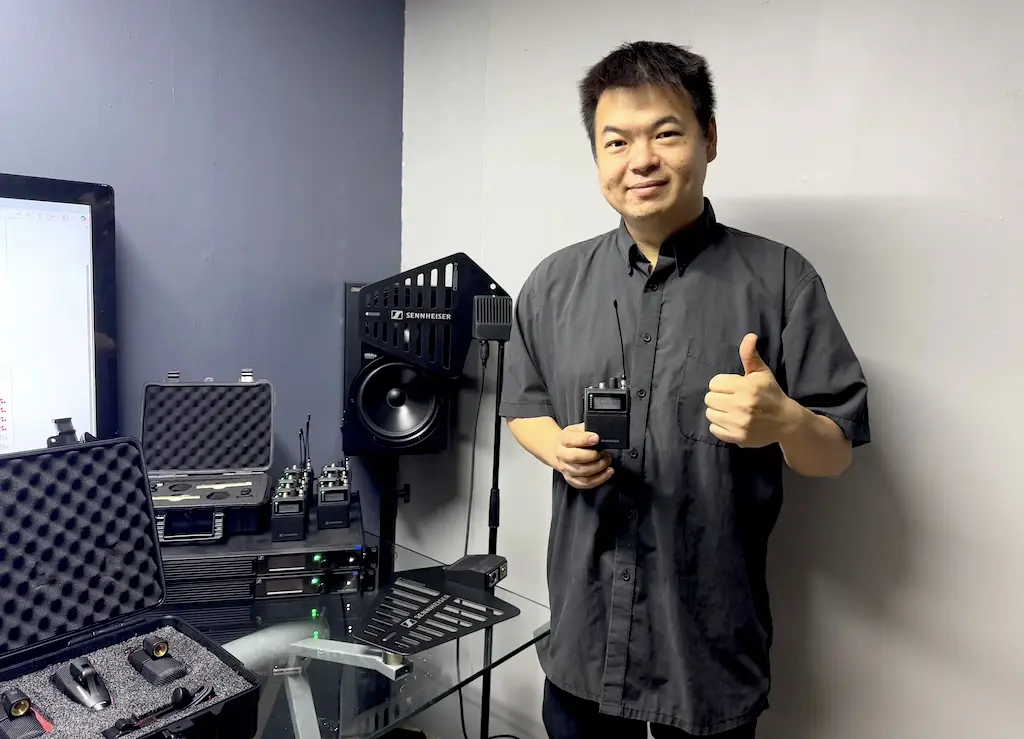
AV Production (AVP), a Singapore-based production company specializing in organizing concerts and festivals, uses the Spectera system of Sennheiser with WMAS technology as an essential tool in your large-scale live productions with high radio frequency complexity (RF).
Beyond event services, the founder of AVP, Favian Ngan, He is also an active touring monitor engineer and works with many top Asian artists.. He is currently working as a monitor engineer on an important international world tour with more than 70 completed concerts, and Ngan operates in some of the most demanding live sound environments. From large covered venues to open-air stadiums with large stages and walkways, Providing stable and consistent in-ear monitoring has become increasingly complex, especially as the RF spectrum becomes more congested and often unpredictable on international touring circuits.
Like many touring engineers, Ngan's workflow used to rely heavily on industry-standard analog IEM systems. Although they have been reliable for years, These systems were increasingly limited by the demands of modern production..
Favian Ngan explains that “in many venues, the RF environment has become increasingly complicated, with background noise levels reaching unpredictable levels. A frequency that appears clean during sound check may suddenly become unusable during the show. Modern concerts often incorporate large LED screens, LED light bars, effects lighting and even drone jammers, all of which contribute to this instability”.
Manage a large number of channels in large scenarios used to involve constant problem solving, especially when performers moved freely around the performance area or went into the audience. At the same time, older systems in your inventory needed updating, which led Favian to search for a solution that could overcome the limitations inherent to analog wireless systems.
An advance in the adoption of Spectera
During an industry event, Darryl Tan, Sennheiser business development director, introduced Spectera to Favian Ngan.
“He told me that a powerful new wireless system would be launched soon, and that it would be very suitable for a production company like mine”, remember Favian. “As it meets the requirements of touring productions with a very compact format, felt that it would make a real difference in how we move with the team on the road”.
As part of this early collaboration, Ngan became one of the clients of the Program Spectera Pioneer. Before the official launch, Darryl brought a demo kit to Favian and gave him hands-on demonstrations, technical briefings and on-site support to ensure the system could be deployed with confidence in such a demanding touring environment. “Spectera uses WMAS technology and it was something completely new to me”, Affirma Ngan. "Besides, It was positioned as a very different system, so I wanted to listen to it and try it for myself”.
The listening tests immediately revealed a remarkable improvement in audio quality. However, The true measure of performance lay in the RF stability and ease of use, factors that could only be validated under the demanding conditions of a live tour. The first implementation of the system took place at an important tour stop, in an Olympic stadium with capacity 80 000 spectators, starting with rehearsals and culminating with its use during the live performance itself.
One of the most immediate advantages of Spectera was its multi-antenna capability. Unlike analog systems, which typically rely on a single antenna for IEMs, Spectera allows up to four antennas to operate simultaneously.
“Our scenarios can have more than 120 meters wide with central walkways”, explain Ngan. “With analog systems, there is no perfect position for the antenna. You always have to make concessions”.
Con Spectera, Antennas could be placed strategically throughout the stage, even along the walkway, providing consistent RF performance across the entire operating area. He passage of BNC wiring to CAT6 made setup even simpler, allowing long cable runs without signal loss, an important advantage in large pavilions and stadiums.
A new level of control
Beyond RF stability, Spectera transformed Ngan's daily monitoring workflow. The system provides real-time information from each transmitter from flask, including battery status, RF levels and connection status.
“With analog systems, if something goes wrong on stage, You spend your days guessing and solving endless problems.”, states. “There is no easy way to deduce if it is the battery, from the transmitter or simply from RF interference”.
Frequency coordination has never been so simple, recognize. Spectera only requires a bandwidth of 6 MHz to work. On the contrary, Traditional analog systems constantly face challenges related to frequency allocation and intermodulation interference..
“As productions grow in scale and demand, additional wireless channels are often introduced, which increases the risk of intermodulation distortion and complicates the overall coordination process”, underlines.
Spectera, powered by Sennheiser WMAS, overcomes traditional coordination challenges by allowing multiple transceivers operate simultaneously on a single RF channel broadband. This is achieved through a combination of time division multiple access (TDMA), time division duplex (TDD) and orthogonal frequency division multiplexing (OFDM), which maximizes RF efficiency. The result is an optimized solution that meets growing channel requirements without introducing interference or compromising performance..
A feature that quickly became essential was the volume monitoring. During quick costume changes, artist packs may be adjusted unintentionally. Spectera allows Ngan to remotely monitor pack status and adjust levels, ensuring consistency throughout the entire show.
“My artist now feels very confident on stage”, duck. “Know that the volume will always be exactly where it should be”.
For the artists themselves, The most notable change was the sound quality. The move from analog to digital eliminated compression and expansion artifacts, which resulted in a more natural and open sound.
“Stereo image is extremely wide”, explains. “The left and the right are truly independent, allowing me to space my instruments creatively”. This clarity was especially valuable for voice-focused performances.. With instruments clearly distributed throughout the stereo field, voices remained centered and unobstructed, which helped artists hear more clearly and perform more comfortably.
Designed for the reality of touring
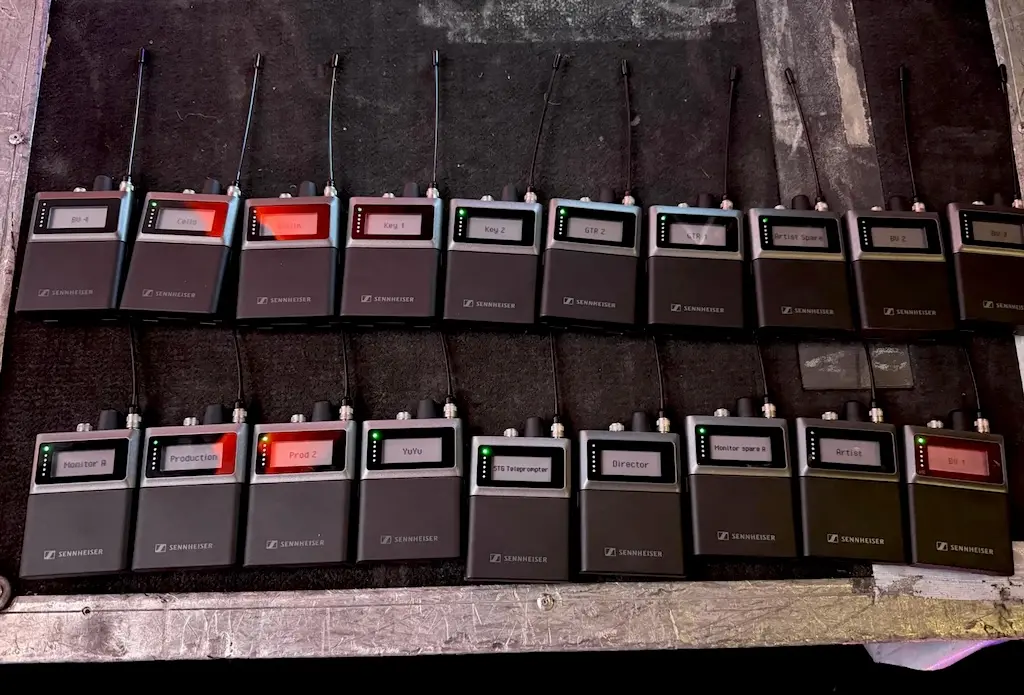
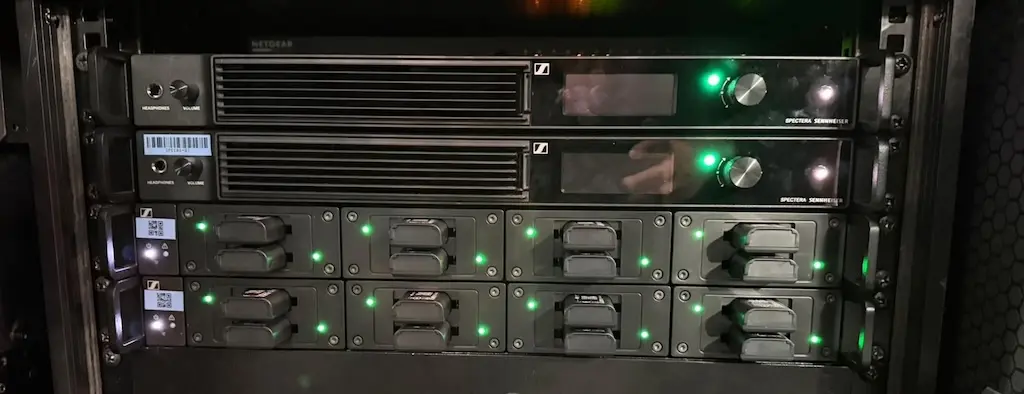
Favian currently uses 22 Spectera bodypack transmitters with two base stations. Different audio modes are used depending on the needs of the interpreters, reserving ultra-low latency for the artist and monitor engineer, while the rest of the musicians and production team operate in low latency or live modes.
“The latency remains a critical factor for interpreters, especially for singers and musicians. Spectera sets a new benchmark with exceptionally low IEM latency of just 0,7 milliseconds, the lowest available in any digital wireless in-ear monitoring system”, Reconoce Ngan. “This latency is vital for vocalists, as it helps minimize bone conduction interference and reduces the risk of comb filter effects.".
From a logistical point of view, he compact size Spectera also speeds up touring. Each system occupies only one rack unit, making transportation significantly more efficient than with traditional systems. Spectera is an IP-based system that allows full control through a web user interface. “The ability to manage Spectera through the Spectera WebUI web interface has been a revolutionary change. I can tour the premises with my iPad, or even just with a phone, and instantly see the status of each unit and antenna”.
A collaboration that evolves
Adopting Spectera early meant working closely with the Sennheiser technical team as the system continued to evolve. Regular firmware updates and hands-on technical support ensured stability and continuous improvement throughout the entire tour. “The support from the Sennheiser team has been very solid”, Favian Ngan's destaca. “They listened to my comments and responded quickly.”.
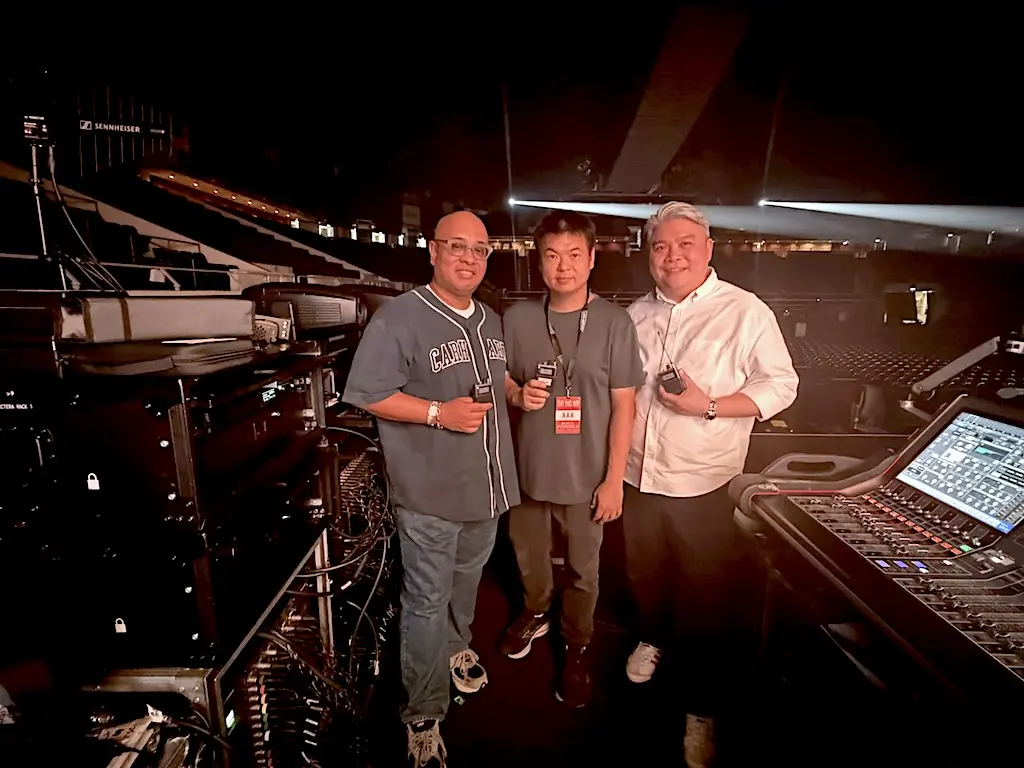
Behind the scenes, The transition to Spectera was supported by close collaboration between AV Production, Sennheiser y Concept Systems, Sennheiser's preferred partner for Spectera in Singapore. From RF planning guidance to workflow optimization and system configuration, the local team played a critical role in accelerating adoption. In combination with direct technical involvement from Sennheiser's technical applications engineering team, The collaboration ensured that AVP not only seamlessly integrated Spectera into its touring setup, but could also maximize its capabilities in increasingly complex international entertainment environments..
“When you compare it directly with other systems, the difference is clearly noticeable. But beyond the sound quality, what stands out is the control, the stability of RF and the confidence it gives you during a show”, concludes.
Did you like this article?
Subscribe to our NEWSLETTER and you won't miss anything.
Related articles
 Spectera's great adventure (Sennheiser) start with DJ BoBo
 Sennheiser Spectera contributes to the revival of Notre Dame de Paris
 Sennheiser boarded an ISE 2026 the possibilities offered by the Spectera API
 Sennheiser Spectera boosts 'Grease' production’ by Secret Cinema
 Panasonic VSS, The all-in-one solution to optimize workflows in complex projection environments
 Sennheiser Spectera transforms worship service at Revolution Church
 Proaudio trusts Sennheiser Spectera for its technical productions
 Magnetron drives investment in Sennheiser Spectera by Mediarent and Rental SP
 Magnetrón sells SRS the first Sennheiser Spectera system in Spain
 Renkus-Heinz: audio demos for complex environments at InfoComm
 Sennheiser Elevates Hybrid Learning Experience at NTU Singapore
 Crestron finds the perfect framework for easier total connectivity in the Internet of Things
 The Spanish audiovisual production company Light Project opens headquarters in Chile with 3D mapping projects
 Street marketing finds a perfect ally in video mapping