


Disguise and Notch sign the visual effects of Radiohead's stellar return in 360º format
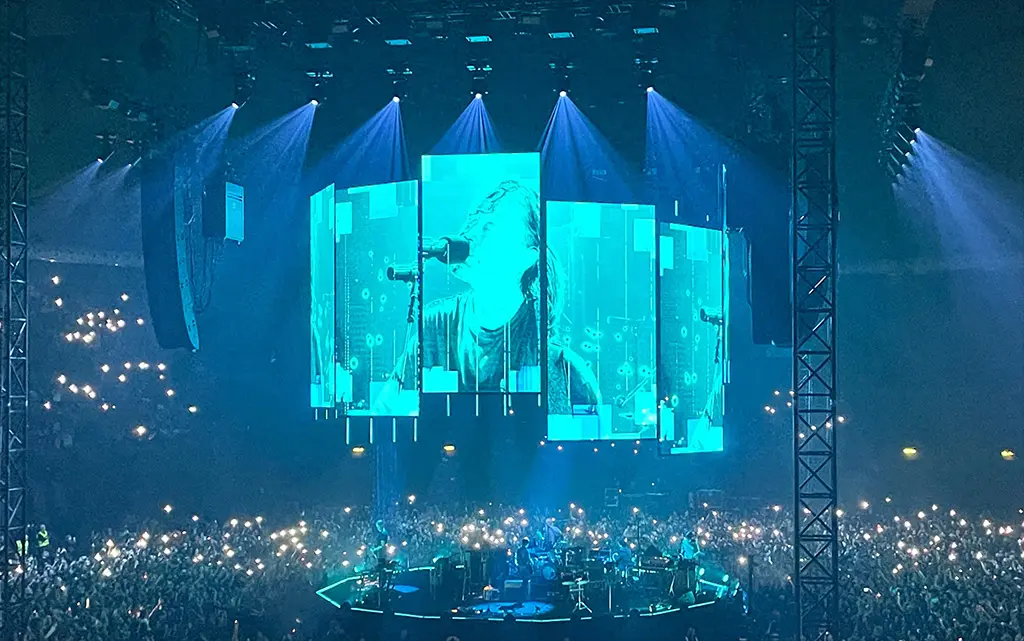
The video solutions provider Universal Pixels, along with video screen director Ellie Clement, were responsible for realizing creative director Sean Evans' vision for Radiohead's comeback tour, which had a staging 360 degrees managed with video servers Disguise.
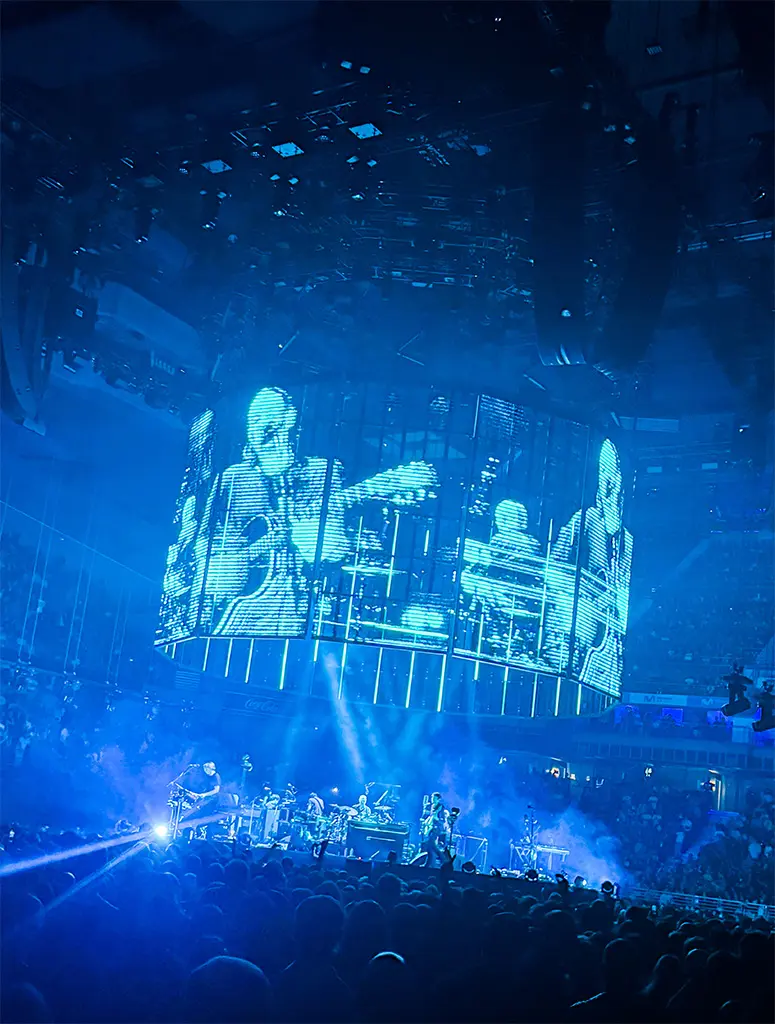
After a seven-year break without touring, the giants of british rock Radiohead They returned with a staging designed by Sean Evans: a stage 360 degrees in which more than 20 Live cameras transmitted images of the band and the audience to a kinetic sculpture of moving LED screens that could commute, twist and reconfigure on the band as a luminous centerpiece.
The project, of course, was characterized by its complexity. The stage design included 12 automated LED panels ROE Visual Vanish arranged in circular formation. These screens could scroll vertically, rotate and engage with each other to form a cylindrical canvas about the band. ROE LED strips ran on the back of each panel, with additional LED strips integrated into the stage's own circular platform for maximum impact.
Hamanshu Patel, technical project manager Universal Pixels, It was clear from the moment he faced the project that the biggest challenge would lie in how the cameras were integrated and would integrate with the system.. “That's where we come in to advise on the best technical solution”, explains, resulting in “the most complex system” that “Universal Pixels has ever implemented”.
 Disguise y Notch, Radiohead video axes
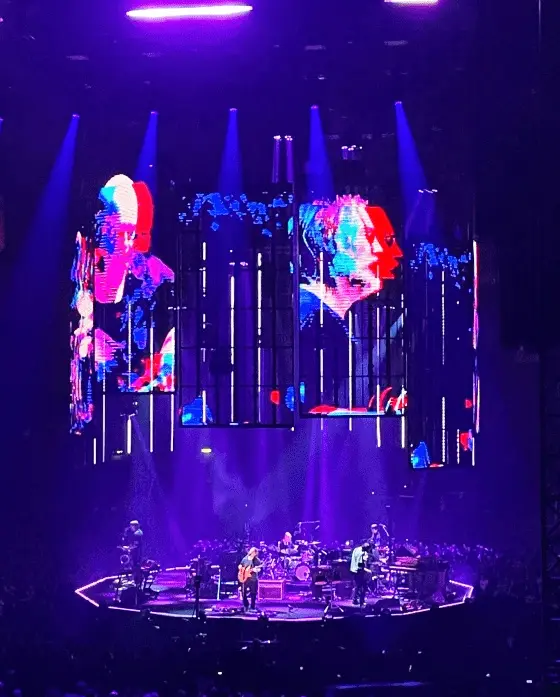
From a creative point of view, The team chose to run the entire show in Notch, with all visual elements generated live and in real time, no pre-rendered content. Ellie Clement chose Disguise specifically to support this workflow, knowing that he GX server 3 would be able to easily manage the numerous 4K camera inputs and Notch integration.
“We tried other servers, but the way Disguise works with Notch was a better fit for this project.”, Clement explains.. The inputs that power the servers include triggers MIDI, SACN, Art-Net, PSN tracking data and more, making this one of the highest signal-dense systems the team has ever built.
On the other hand, the mobile screen architecture required dynamic adaptation of content. When the panels came together, Tracking data resized camera frames to create cohesive images across all surfaces. When they separated, the system enlarged the image to fill the extra space. “The most complicated part is using the tracking data to resize the camera frame based on the location of the screens in space”, comments Clement.
 Designer of Disguise: workflows to solve technical challenges
Real-time resizing of camera layers was achieved using expressions in Designer: an equation that uses incoming tracking data to adjust size parameters, while maintaining the correct aspect ratios of the layers.
Ellie used several different workflows in Designer to solve technical challenges specific to the show.. Using the function “DMX Screen Read”, For example, allowed ROE strip elements to function as both video and lighting devices, while Clement kept a content layer in the timeline for video-based looks.
To accommodate the band's ever-changing setlists, Ellie scheduled 70 clues on the lighting table, each ready to activate the corresponding video states. Thanks to the integration of The sock puppet, any track could be recalled instantly without relying on timecode.
Even the last minute mapping changes could be run live if necessary. Using various Designer workflows in this way allowed Ellie and the team to resolve technical challenges more quickly, freeing up time to dedicate to creative production.
The tour of Radiohead de 2025, with all tickets sold out, It was a resounding success.. Breaking all attendance records at the O2 in London, the entire tour featured 20 intimate Radiohead performances in five cities.
Did you like this article?
Subscribe to our NEWSLETTER and you won't miss anything.
Related articles
 PSY: four hours of concert loaded with visual effects managed with Disguise
 Disguise anticipates in LDI 2025 the future of visual effects in live events
 Absen and Leyard's Led visualization surrounds Oasis' return to the stage
 Avolites debuts its Diamond console 9 at the return of Glastonbury festival
 Barco and RSA Cosmos create a stellar immersive experience at the Brussels Planetarium
 The Bootshaus nightclub accompanies its electronic music sessions with spectacular visual effects
 R5 Band offers spectacular visual effects with Elation Cuepix Panel at their concerts
 Barco provides a star projection solution to the Valladolid digital planetarium
dbn provides lighting and visual effects for Parklife Festival 2013 and Manchester
Barco provides a star projection solution to the Valladolid digital planetarium
dbn provides lighting and visual effects for Parklife Festival 2013 and Manchester
 CITEC-B and Broadcast Multimedia sign a collaboration agreement
 Christie supports 'coming home'’ from Hitchcock's Blackmail
 Vidyo and Exclusive Networks sign distribution agreement
 ADmira and AOpen sign a strategic alliance
 Matrox M9188 Provides Stunning Visuals in Japan's First Digital Art Display