


Christie HD8K projectors bring cinematic realism to Shepperton Studios
Christie's projection technology allows creation for the film 'Last Passenger (The last passenger)' a backdrop that recreates the views from a train to 160 km/h, at Shepperton Studios.
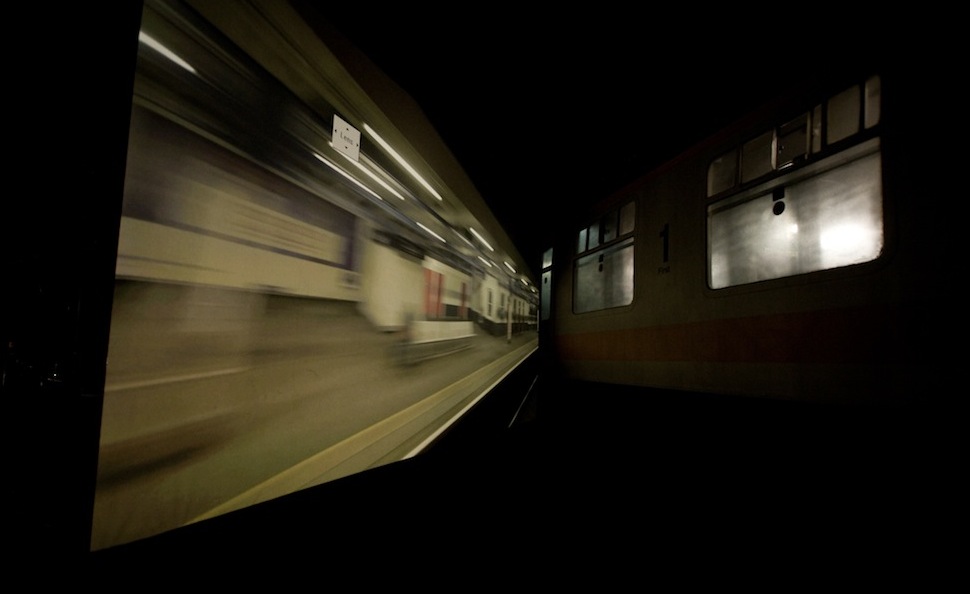
Four projectors 3 chips and high resolution HD8K Christie have contributed more unusual cinematic realism to a set at Shepperton Studios for the filming of Last Passenger (The last passenger), a new British independent film.
The action of this claustrophobic thriller takes place aboard a commuter train, between London Charing Cross station and the town of Hastings; in a ninety-minute journey and terrifying consequences. To create a fast moving background, Zack Winfield, producer alongside Ado Yoshizaki Cassuto of the film, decided to consult IS, a Christie partner dedicated to the rental of performing arts equipment, so as not to resort to the not very convincing cinematographic technique of the 'green screen'.
As Winfield explains, “we wanted to create an environment that gave passengers the possibility to react to it and that represents, in fact, a return to the methods that were used twenty years ago, but with today's technology, managing to make everything you see through the train windows believable for ninety minutes. A feeling of realism that the 'green screen' fails to convey, partly due to the lack of reflections in the window but also because the fake environment is unconvincing for the actors. Besides, the cost of cutting out twenty windows and replacing them with CG moving images (3D computer graphics) would have been prohibitive. “We knew that by resorting to projection we would achieve much greater realism”.
However, The members of the production team did not know very well how to put the idea into practice. The solution came when Angus Hudson, film director of photography, informed them of the celebration of Plasa, a display of technology installed at the Earls Court exhibition grounds. "He, who knew Christie products, He told us that these people know what they are doing., so we contacted them and the UVA processing company, who referred us to QED”, Winfield adds..
Mobile rear projection
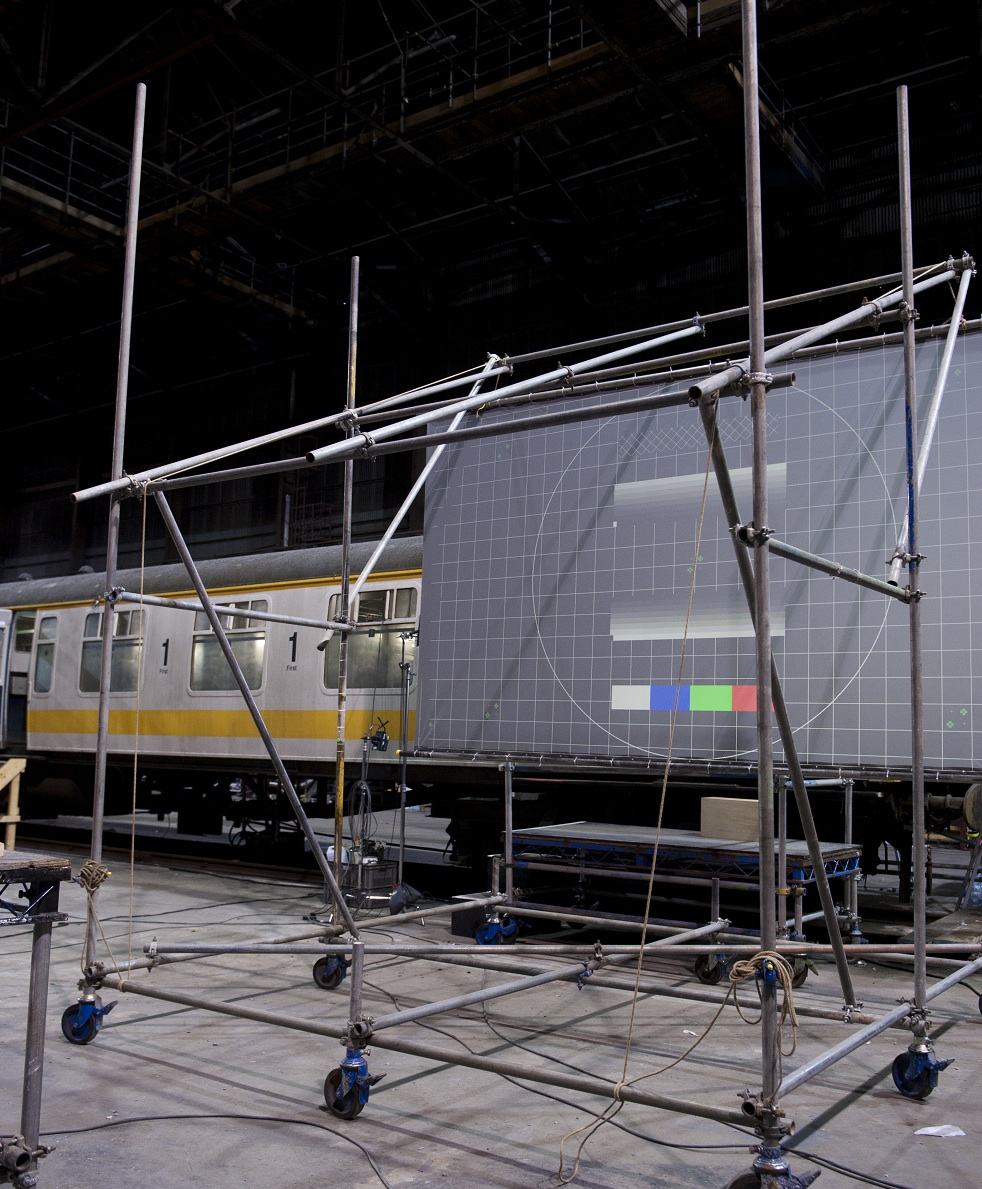
The solution chosen to achieve this cinematic realism is based on four mobile rear-projection devices equipped with 4.8 screens.×2,7 m. (with an aspect ratio of 16:9), designed specifically for Shepperton's H set and powered by fiber optic cables. 150 m, so that the tower could move freely without fear of running out of cable.
Besides, The projectors had to previously pass frequency and image speed compatibility tests with the server; color temperature; contrast ratio and light balance; vital conditions since much of the filming of the film took place at night, and Christie's HD8K systems met all those requirements.
The content of what should be seen through the windows 160 km/hour (and?, starting at Hungerford Bridge and the London Eye along the Thames, included urban and rural landscapes, railway stations and other types of film material) had been shot in advance and incorporated into the server UVA D3, whose four synchronized HD outputs powered the four projectors, each of them equipped with a lens 1.1:1.
The director of QED, Paul Wigfield, He points out that his company was attracted to this project as soon as they saw the trailer online: “Zack Winfield knew he needed a projection of, at least, 8K HD, and we have no hesitation in recommending Christie projectors.. The main criteria were the brightness, contrast and resolution. When working in cinema, “Xenon lamps provide brightness and projectors provide contrast.”.
Film challenges overcome
During the tests it was discovered that the parallax of the projected image failed when a camera angle of 45º was crossed in relation to the window. To try to get, from two stationary cars, a complete sweep, the back plates used in rear projection were shot at three angles on either side of a real moving train.
The result is that the screens and the rolled material adjusted to the shooting requirements of the interior of the train.. So, if a sweep along the train was needed, The screens were placed at a 45º angle on each side of the car, with the material projected on the screen also filmed at 45º, thus managing to cover the spectrum of movement without the parallax failing.
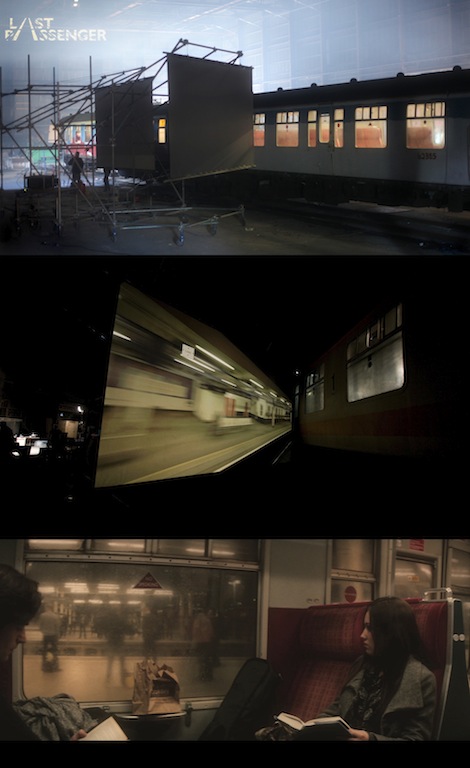 Another challenge for camera angles inside the carriages (some with a length of 20 m.) was the one derived from the existence of the twenty windows. to solve it, two projector screens were placed on each side of the train, with a delay of a couple of images programmed in the D3 between both projectors, achieving the effect that the landscape passed from one window to another and creating an extraordinarily realistic sensation of movement.
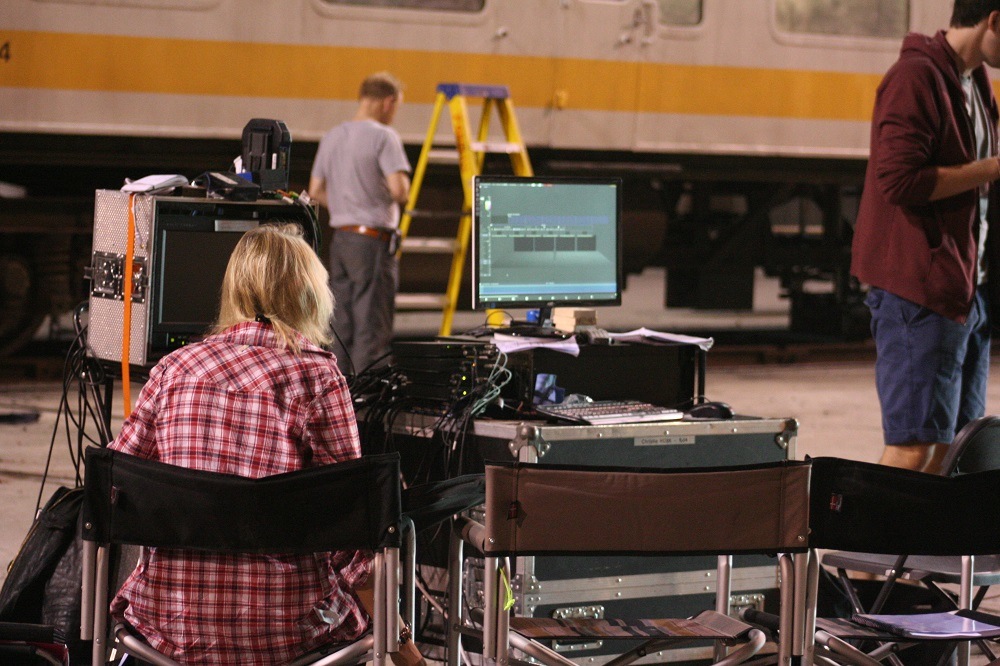
Richard Porter, of QED and responsible for supervising the installation, admits that “the white balance showed 3,200K, a magnitude that we use to carry out the installation and train Hugo Peers, the projection supervisor, who concluded that it was necessary to balance attention to color detail across the four projectors”.
In this sense, Zack Winfield emphasizes that “although we were confident that the projection would hold up to high-speed viewing of urban and rural environments (where the blur resulting from movement helps to achieve a feeling of reality), We were shocked to see the excellent result of a scene in which the train stops in a brightly lit station, with people (projected) waiting on the platform: It was much more than we could expect from this technology”.
All the professionals consulted agree on the impeccable performance of the Christie HD8K projectors, "They are always one of our favorites," says Porter., and on this occasion, with a very dusty environment, They withstood a whole month of adverse conditions without stopping working. Almost every scene has a Christie projector behind it doing the work.”.
In this line, Winfield points out that “without help from Christie, of UVA and, of course, de QED, that were extraordinary, we couldn't have made this movie. We had to learn from scratch, but we never thought we would achieve a result as convincing as the one we have achieved. And what surprised us most was everything that can be achieved with Christie projectors themselves, like electronic lens shift, which was a revelation. We were also impressed by its resistance and the homogeneity of the shine.. In fact, I would like this to be the future solution when shooting low budget films, regarding expensive computer image generation. I see possibilities of massive use for this technology”. Precisely, The company QED has already been commissioned to recreate the same effect in another British film, whose filming is already underway.
[youtube]http://youtu.be/UNM5yzquLUA[/youtube]
Did you like this article?
Subscribe to our NEWSLETTER and you won't miss anything.
Related articles
 Christie's projectors help reinterpret 'fossil culture'’
 Christie expands its Jazz line with two 4K UHD+ projectors
 Christie projectors bring new Incheon experiences to life
 The cinematographic MARC Theater opts for the scalable WPC line array from Martin Audio
 Christie to create realistic visuals for Al Wasl Plaza dome at Expo 2020 from dubai
 Christie and Charmex provide immersive projection technology for the Vila-sana CIM
 Christie bets on 3LCD with the new D Series projectors
 Dnp brings the art of cinema to the London Underground with a film about migration
 Epson 3LCD projectors provide quality and luminosity to the video art works at Mira Festival 2013
 Interactive kiosks to tour Ohio's historic and cinematic Mansfield Reformatory
Christie announces 4K resolution upgrade program for its Christie Series projectors 2
Interactive kiosks to tour Ohio's historic and cinematic Mansfield Reformatory
Christie announces 4K resolution upgrade program for its Christie Series projectors 2
 Christie presents the LHD700 and LX1200 LCD projectors at IBC
 Two new Christie widescreen projectors
Christie's New Line of DCI-Compatible 4K DLP Cinema Projectors
Two new Christie widescreen projectors
Christie's New Line of DCI-Compatible 4K DLP Cinema Projectors