





‘The Walk to Fisterra’: musical documentary along the Camino de Santiago with Mergin and Genelec systems
Merging recording systems and Genelec monitors, brands represented by Lexon in Spain, They have been the protagonists of 'The Walk to Fisterra', a musical pilgrimage along the Camino de Santiago carried out by the prestigious cellist Dane Johansen in 36 churches of the Compostela route.

'The Walk to Fisterra' is the title of the documentary made with Dane Johansen, young and renowned international cellist born in Alaska, in 36 churches of the Camino de Santiago. A multi-award winning documentary production team has collaborated on this musical pilgrimage., a Grammy award-winning sound engineer, as well as a group of collaborators who have walked 965 Km. to record Johansen's performances of Bach suites.
This unique project has been sponsored by the Finnish audio manufacturer Genelec, which has also provided two 1037C monitors, as well as with collaboration and communication systems Merging Technologies, Swiss supplier of high-quality recording equipment, both firms represented in Spain by Reads.
Record inside 36 ancient churches, with very different acoustic behaviors, It's a challenge for any performer., but also an interesting challenge for any sound engineer. Even using the same microphones, different results will be obtained so, as part of the project, Impulse responses were recorded in each of the churches.
An element agreed upon from the beginning was that the recording would be made in DXD format (24 bit/352.8 kHz), since this is the best combination of high resolution audio and provides facilities for post-production.
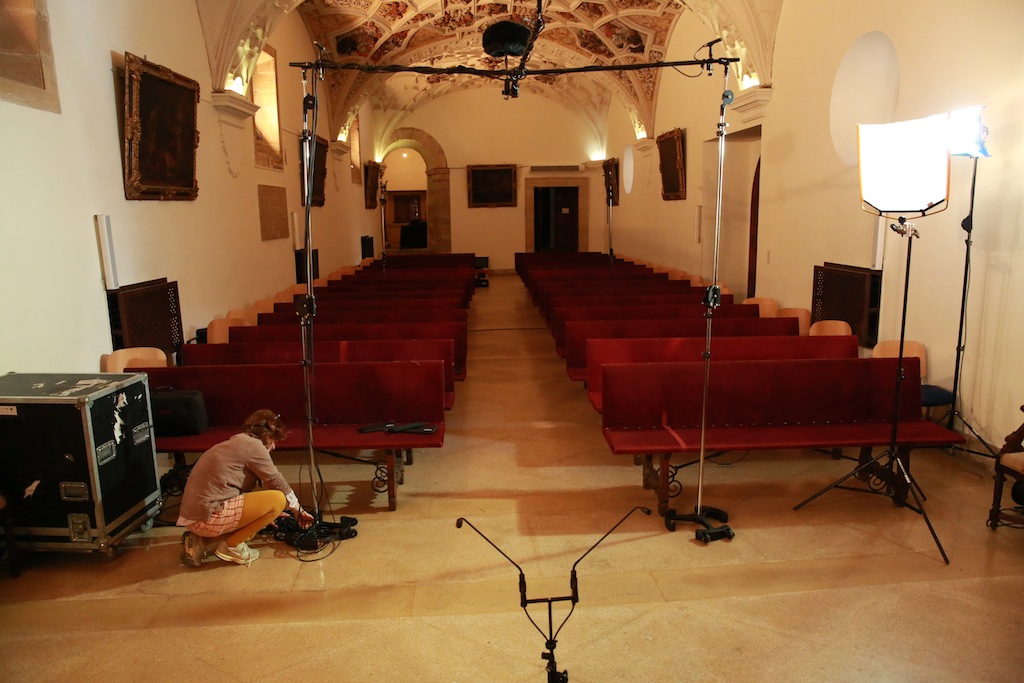
Transfer of equipment
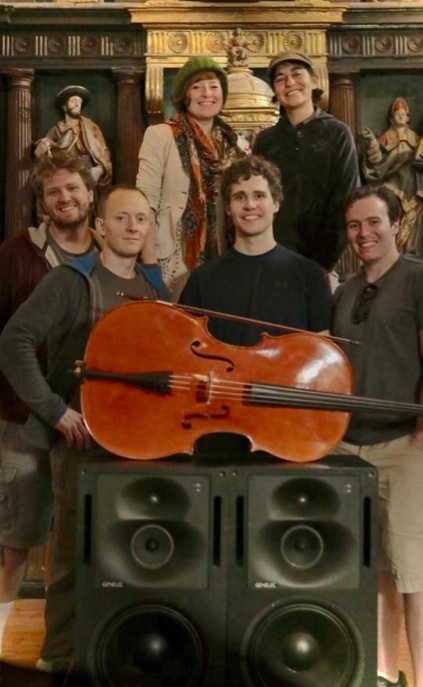
A peculiar aspect of this project has been the transfer of the Merging systems, manufacturer that receives many equipment loan requests for a wide variety of projects and, which obviously, many of them must be rejected. In this case I could have followed the same path, because when a student requests the loan of a Pyramix system and a Horus unit, suspicions are aroused. However, Kyle Pyke is not just a student who is pursuing a master's degree at the Valencia campus of the Berklee College of Music, but he lived in Boston, city where he met Jesse Lewis, Grammy winner at Soundmirror, who introduced him to the project 'The Walk to Fisterra'.
To this was added that, previously, cellist Dane Johansen had asked him to join the team, since they had been classmates at the Cleveland Institute of Music. All of this showed Merging that this was not just your typical student project..
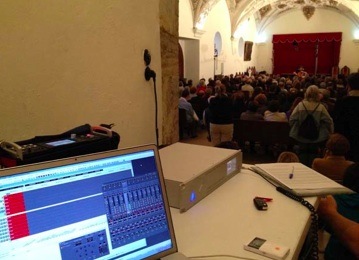
 In this sense, Merging's Horus system was the obvious choice to provide high-quality preamps for the DPA microphones and ensure quality A/D and D/A conversion.. “We used the Horus system as the main recording interface for ‘The Walk to Finisterra’ project as it is incredible and its audio is of exceptional quality,” says Kyle Pyke., in addition to offering great flexibility in terms of entrances and exits”.
One of the great advantages of using Horus is that the project can be saved in DXD to make it as clean as possible. Performances of J.S. Bach's six Cello Suites have attracted large audiences to the historic churches and monasteries along the Camino de Santiago route.. These works were practically missing until they were rediscovered last century by the famous Catalan cellist Pau Casals..
The task of editing and mastering the enormous amount of material relies on the recording of Jesse Lewis, who recommended the Merging team because “capturing music is an unsatisfying process; recreate the experience of actually being there, in the place where the recording was made, it's impossible… except with the Pyramix and Horus system from Merging Technologies. DSD256 Sampling Rates, microphone preamplifiers with surprising clarity and transparency, “A/D converters that practically sound analog have been achieved with this incredible production tool”.
Monitores 1037C de Genelec
 Another important collaborator in this project has been Genelec, whose monitors are present in practically all studios in the world. As Kyle Pyke points out, “Knowing that we had an industry-standard loudspeaker to analyze the frequency sweeps has given me confidence that we have captured the response of each cabinet with maximum fidelity”.
Para ‘The Walk to Finisterra’, Genelec has supplied a pair of units of its 1037C three-way active monitor, a system that includes speakers, the enclosure, various amplifiers and active crossovers. Its Directivity Control WaveguideTM technology (DCW) Provides excellent stereo imaging and frequency balance, even in complex acoustic environments.
Pair Lars-Olof Janflod, marketing director of Genelec, “This is a very innovative project and we are very proud to have collaborated on it.”. In each of the churches, the team performed an impulse response test with our 1037C monitors to take readings on the sonic behavior of each space, that can be recreated for future audiences”.
The speaker sends a signal for thirty seconds, that starts in 20 Hz and increases progressively until reaching the 20.000 Hz. This signal bounces off the walls of the church and returns to be captured by an array of microphones.. “We use the information collected to create a three-dimensional sound map of the acoustic space, which will allow us to recreate that acoustic space in the future for other audiences”, underlines cellist Dane Johansen.
Did you like this article?
Subscribe to our NEWSLETTER and you won't miss anything.
Related articles
 MSA supplies automation systems for the musical 'Cinderella'
 Visyon creates an immersive Els coffee documentary experience 4 Gats
 The Roma Musical Theater in Warsaw is renovated with Meyer Sound systems
 Deneva digital signage helps the EMT on the path to deconfinement
 Genelec G SongLab enhances musical creativity in young people
 El musical ‘We Will Rock You’ had Kinesys automation systems
 Sharp paves the way for the industry's transition from 2K to 4K
 Laser projection marks the path of audiovisual transformation in the DCU
 InMediaStudio brings virtual and mixed reality to the documentary 'Return to Mars'
 Santander will screen the documentary videomapping '1941' next Saturday: Year 0'
 Lexon Distribution shows the sound performance of the new Genelec systems
 Robe Systems, Vari-Lite and Robert Juliat illuminate the musical 'Priscilla, queen of the desert
 A digital LED path guides children on their way to the operating room
 The video conference, safe path to the future