


Callao City Lights launches the largest large-format digital circuit in an urban environment in Spain
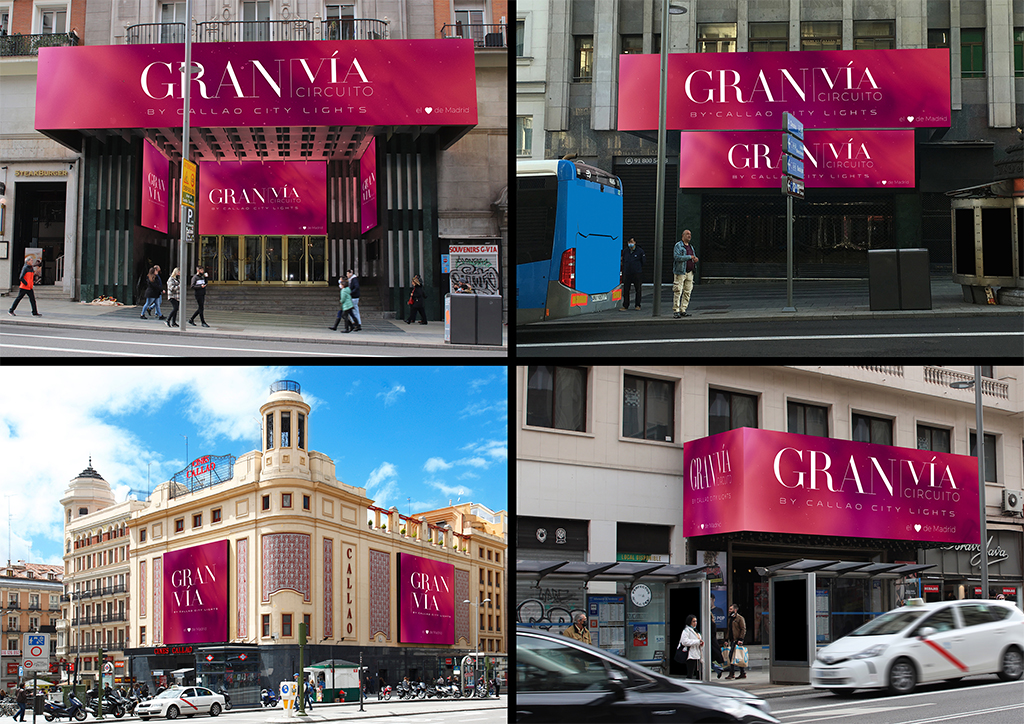
Gran Vía Circuit is a project that allows Callao City Lights assume the marketing of digital advertising screens of 4 of the 7 cinemas/theaters that are currently still active in that area of Madrid.
Callao City Lights, brand under which the outdoor screens of Madrid's Callao cinemas are marketed, has launched Gran Via Circuit, the largest large format digital circuit in urban environments in Spain.
Gran Vía Circuit was born after the agreement reached with Stage Entertainment, company responsible for the Lope de Vega and Coliseum theaters, y Immersive Recreations, responsible for the operation of the Rialto theater marquee, for the marketing of their respective digital screens. In the case of the Rialto, They have just been installed in your entrance, replacing existing advertising posters.
This way, Callao City Lights assumes the marketing of the digital advertising screens of 4 of the 7 cinemas/theaters that are currently still active on Gran Vía in Madrid.
This means going from managing 2 screens (those of the Callao Cinemas) a 15, with a total area of 460 square meters. It makes new locations available to brands that will allow them to reach the public that usually travels along the Callao/Plaza de España axis., especially popular for its tourist attraction, commercial and entertainment.
The Rialto theater has just replaced the advertising signage, that until now was on its façade, by three high resolution digital screens. The Coliseum theater has 3 on the façade and one that presides over the entrance; while Lope de Vega has 3 in access and 3 on the outside canopy.
This project is presented as a new commitment to the large cinemas and theaters that are still open on Madrid's Gran Vía..
“With this marketing we want to help theaters last.”. We continue to focus on innovation and focus on, through our initiatives, to Madrid's Gran Vía”, points out Joshua Reyzábal, CEO of Grupo Empresarial RDE, company that owns the Callao Cinemas.
Callao City Lights already took a first step with the placement of the two large digital screens on the facades of the Callao Cinemas in the year 2011, replacing the old posters that until then advertised the films shown. Screens that were renewed by others with higher image quality in 2019 and to which since then new features have been incorporated to improve their exploitation., like 3D creativity, augmented reality, interactivity with social networks, el retargeting mobile, live broadcasts or synchronization with other media in the square.
“Under the Circuito Gran Vía brand we are going to market some of the most emblematic theaters in the capital, in the middle of Madrid's golden mile of outdoor advertising, between Primark and the largest Zara in Europe. A movement that will allow us to multiply the 5 millions of weekly impacts that are currently recorded by the Callao City Lights screens”, dice Gorka Pagazatundua, commercial director of Callao City Lights.
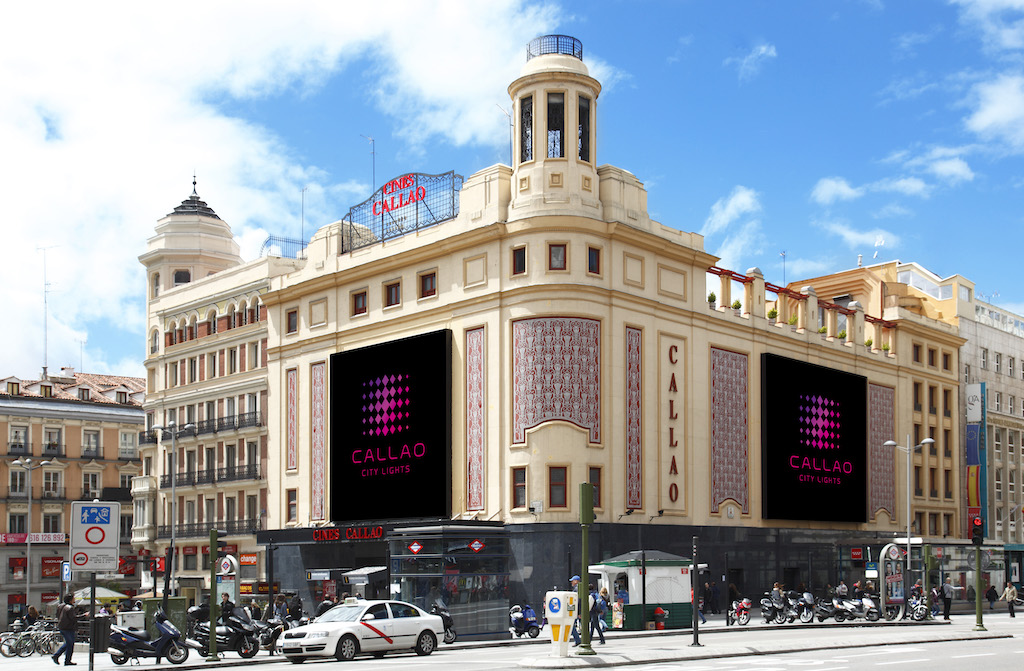
Callao Cinemas
The Callado cinemas have the largest viewing surface in the area with the installation of two screens, one in Plaza del Callao and another in Gran Vía.
built in 1926 by Luis Gutiérrez Soto, The historic Cines Callao building is one of the greatest exponents of art deco architecture in the capital. It was inaugurated as a movie theater on 11 December of that same year, with the broadcast of the film 'Luis Candelas, the bandit of Madrid'.
Its location is in one of the most commercial areas and with the greatest leisure activity in the center of Madrid.; in the Plaza del Callao, the most visited in Spain and the third busiest in Europe (150 million people a year), behind Piccadilly Circus (London) and the Louvre square (Paris).
At the moment, in addition to offering cinema in its two rooms, The building is the scene of major events and film premieres.
Lope de Vega
The Lope de Vega theater has six screens. Three of them are located at the entrance to the theater (one at the back and two on the sides) and the others, bordering the outside canopy.
Inaugurated on 16 April 1949, specialized in musical shows. In 1954 a movie screen was installed, becoming the Cinema Lope de Vega theater, inaugurated on 12 December of that same year.
Located at number 57 of Madrid's Gran Vía, It has currently recovered its original name and since 1997 It is a benchmark of musical theater on Gran Vía.
Coliseum
The Tearo Coliseum offers 4 screens, three in the façade marquee and one presiding over the entrance.
It was conceived in 1931 to be a venue where all kinds of shows could be held, however, It was finally opened as a cinema in 1932. Located on Gran Vía, 78, during the Civil War, served as a military warehouse, but immediately afterward it would return to its origins to schedule first-run movies again.
In the years 90 became the property of Bautista Soler, who decides to recover the space as a theater room, but it's not until a year 2000 when it undergoes a reform and becomes one of the leading theaters of the musical genre. The Coliseum Theater is considered an 'asset of cultural interest' and has special protection.
In 2014, The theater closes its doors until March 2017 in which the curtain rises again completely renewed, after a few months before Stage Entertainment assumed its management.
Rialto
Finally, in the Rialto theater are located 3 screens that wrap around the exterior canopy.
Located at number 54 of the Gran Vía of Madrid, This theater was built between 1926 y 1930, by the architects José de Aragón and José María Mendoza Ussía, and founded by Antonio Ramos Espejo in 1930 like the Rialto Cinemas (between the years 1932 y 1934 It was called Astoria Cinema).
Did you like this article?
Subscribe to our NEWSLETTER and you won't miss anything.
Related articles
 Concept launches FutureLED Rubin large format panels in Spain
 Callao City Lights and BCN Visuals promote outdoor digital media in Spain with 3D technology
 Super 8 extends its DooH large-format digital screen circuit to Seville
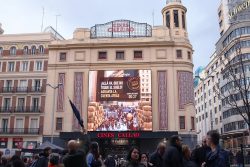 Mahou promotes its new beer with the augmented reality of Callao City Lights
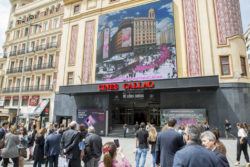 Callao City Lights and Wildbytes bring augmented reality permanently to the Plaza del Callao
 Callao City Lights sells Platea Madrid's digital screens
 Clevertouch Plus Lux: large format touch monitors for the educational environment
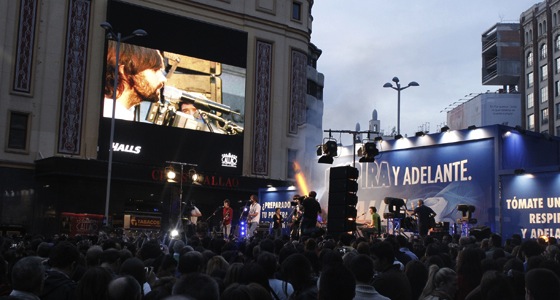 Callao City Lights: a profitable example of digital outdoor advertising analyzed in BIT Broadcast 2014
 Large-format outdoor digital advertising provokes a greater emotional reaction in people
Callao City Lights joins the reading of 'Don Quixote'’ on Book Day
Large-format outdoor digital advertising provokes a greater emotional reaction in people
Callao City Lights joins the reading of 'Don Quixote'’ on Book Day
 PromPerú invites the largest interactive toast in history with Callao City Lights
 The screens of Callao City Lights, exceptional witnesses of the premiere of the video game 'Halo 4'’ in Madrid
 Panasonic launches the new TH-70LF50 and TH-80LF50 large format LCD screens
 Samsung launches its new large format monitors for digital signage