


Meyer Sound supports the 'Make Listening Safe' initiative’ (‘Listen safely’) from the World Health Organization
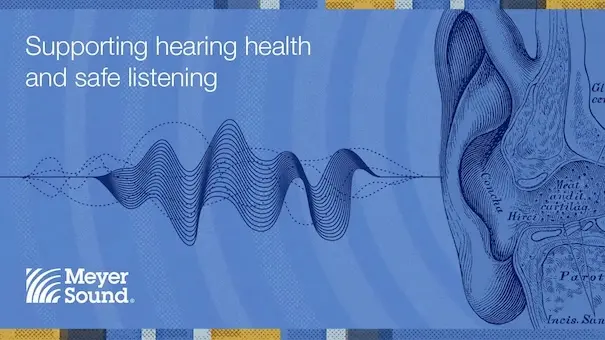
Hearing health has long been a recognized challenge in the field of live sound by engineers, artists, room staff and public. Although before efforts were focused on individual responsibility, Now the debate is moving towards common standards, education and responsibility of the entire sector.
On the occasion of World Hearing Day, which is celebrated on 3 March, Meyer Sound highlights its commitment to this change through participation in global standardization initiatives, educational efforts and partnerships focused on safer listening practices in live sound environments.
A key factor in this evolution is the initiative Make Listening Safe (Listen safely) from the World Health Organization, that targets venues and live events. The standard rethinks the hearing health as a systems level issue, determined by the design of the sound systems, the acoustics of the rooms, monitoring practices and education.
John Meyer, President and CEO of Meyer Sound, Hearing health is inseparable from sound quality and listener perception. “Sound is only successful if people can hear it comfortably and clearly over time.", states. «Hearing health is a responsibility that must be integrated into the design and experience of sound”.
Jessica Borowski, senior acoustic engineer at Meyer Sound, participate in the initiative Make Listening Safe of the WHO, providing professional expertise as the framework for venues and live events is refined. Borowski couple, The norm represents a change from isolated personal decisions to shared responsibility. “For many years, hearing health in live sound depended almost entirely on individual behavior, while the WHO framework recognizes that safe listening is influenced by the entire environment: how systems are designed, how sound is distributed in a space and how informed the people who work in those environments are”, explains.
As the WHO framework evolves, Education has become the bridge between norms and practice. One answer is HELA (Healthy Ears, Limited Annoyance), a certification and training program developed by an international group of audio professionals, researchers and educators, and sponsored by the University of Derby in the United Kingdom. HELA translates WHO-based research into practical guidance for engineers, venue operators and event staff, addressing both hearing health and the impact of noise on the community.
Meyer Sound is a founding member of the HELA initiative and has HELA-certified personnel in both the United States and Europe. HELA's emphasis on education and best practices fits perfectly with Meyer Sound's traditional approach to system design, coverage consistency and acoustic optimization, factors that promote both sound quality and the safety of listening environments.
Meyer Sound has also been a long-standing CEID collaborator (Early Intervention Center for Deafness) de Berkeley, California, a specialized center that offers early education, audiology and therapy for children who are deaf or hard of hearing. Collaboration reflects common prevention goals, early intervention and long-term hearing health.
As awareness grows and standards gain ground, Meyer Sound has been committed from the beginning, supporting education, participating in research-based initiatives and providing technical expertise to help translate hearing health principles into real-world practice.
“Once these conversations start taking place in different forums (standardization bodies, training programs, sector events), hearing health no longer seems like an exception. That normalization is what makes real change possible.”, concludes Borowski.
Did you like this article?
Subscribe to our NEWSLETTER and you won't miss anything.
Related articles
 Meyer Sound GEN-1 brings digital processing directly to the speaker
 Meyer Sound brings innovative sound to Arena Wien
 The Filene Center renews its sound infrastructure with Meyer Sound
 Area15 achieves immersive sound system with Meyer Sound
 Ingram Micro convenes its global ecosystem at ONE Experience and a new way of doing business
 Crestron ONE controls and manages the room, safely, from the mobile
 Meyer Sound debuts Spacemap Go with the work of Bill Fontana
 Sony helps customers safely return to offices with TEOS 2.2
 Meyer Sound gives a webinar on its Compass control software
 Sennheiser joins the World Organization of In-ear Monitoring Professionals
 Stanford University renews its sports centers with Meyer Sound
 Zytronic and Cryptera integrate PIN into PCT touch screens to interact securely
Portland Art Museum reinforces its sound structure with Meyer Sound
EES will teach how to safely use truss systems on its Prolyte Campus
Zytronic and Cryptera integrate PIN into PCT touch screens to interact securely
Portland Art Museum reinforces its sound structure with Meyer Sound
EES will teach how to safely use truss systems on its Prolyte Campus