





Spectera (Sennheiser) simplifies RF management on Ed Sheeran's “The Loop” tour

The Spectera wireless audio system from Sennheiser plays a central role in Ed Sheeran's new “The Loop” tour, reducing RF setup time, simplifying workflows and, according to monitor engineer Dave White, offering a “clear improvement in audio quality”.
White has been working with Sheeran since 2014. when it started, Ed was alone on stage with his guitars and a pedal. loops. Nevertheless, the musician's stage proposal has varied: the sets have grown, and the number of instrumentalists has increased. This translates into more audio channels and a increased RF management.
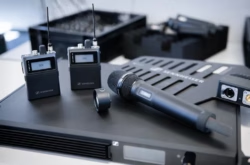
Having deployed Sennheiser solutions such as the SK 6012, elSKM 6000 one to the series 2000, White has decided to make the leap to Spectera. On paper, the system met all their needs: not only reduces the number of transmitters and receivers needed on the tables, but also solves problems arising from changes in scenery.
“We had seen some small demonstrations and knew, with the stage design of “The Loop”, that Spectera would be perfect for us. We cover such a large area; Ed is on the main stage and then seamlessly transitions to stage B. If we managed it with standard analog IEMs, It would be quite a complicated system with many changes and amplifiers with excessive gain to achieve uniform coverage. It can be done, but with Spectera, everything is standard and designed for the job”, explains the engineer.

The Spectera integration process
“Integrate new technology, especially if it is brand new, requires a process of evidence, so for the change to Spectera, “We spent a lot of time comparing IEMs and tuning the system for handheld microphones and guitar packs.”, explica White. The big difference with the Sennheiser system is that, although on paper the dynamic range and volume response should be the same, “they are not”: “There is undoubtedly a depth and clarity that we didn't have before.".
The change to Spectera has also been noticed on the mixing board, where sound transparency, dynamic range and consistency are key in a show built almost entirely around Sheeran's live guitar and vocal performance. Simon Kemp, FOH engineer, confirms that “working with Spectera has been great so far. Pass from 6000 Spectera has brought about a real sound improvement. The sound of Ed's guitars has become even more transparent, and the dynamic range has helped him a lot to go from very calm and soft songs to powerful and forceful moments”.
Under the rain and against the clock
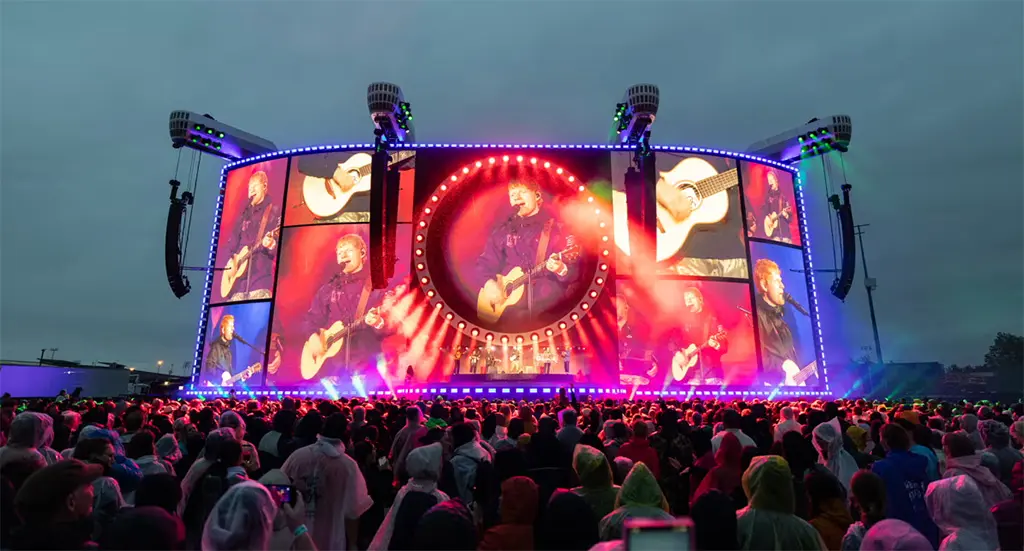
Las rainy conditions usually be especially complex for the deployment of RF systems. Not only because of the entry of liquid and its effect on the electronics, but also because humidity can affect the strength of RF signals between transmitters and receivers. White discovered that, con Spectera, this was not a problem: “The transmitters have been extremely resistant. We started this tour in Auckland and the only way I can describe it is that the rain was apocalyptic; it just didn't stop. This is the first time I've seen Ed perform in a raincoat.. We had no failures in any of the handheld microphones or transmitters. Five of our guitars were damaged just because of the entry of water, which seemed logical, but we didn't have any RF problems”.
Another challenge for the RF is the LED screens in stage design. Para la gira “The Loop”, use the Spectera DAD antennas: “We are using 11 antennas. We have a setup on the left side of the stage, another on the right side and one in scenario B for each resource. We have a video screen 50 by 18 metros; in fact, the entire stage is a large video screen, and we have a set of antennas at the back of the stage just to cover that area. Uses virtually every port on every Spectera unit, but that means we have a perfect transition and coverage from the back of the stage to the middle of the stadium.”.
When designing the system, Spectera workflow helped reduce White's workload. The software offers remote access and virtual configuration for Windows and Mac OS, while the 1U base station offers up to 32 Simultaneous I/O and a totally flexible configuration: “Con Spectera, you select a center frequency and it takes care of everything for you. You don't have to worry about intermodulation or trying to insert 30 canales: you just say: “This block of 6 u 8 “MHz is for me” I think it will make wireless technology much more accessible to people who may have been wary of RF before.”.
White MONITORING Spectera with WebUI, Sennheiser's web-based monitoring interface. The system offers access to essential functions such as battery status, the volume of the IEMs, RF status and much more. As White explains, is tools are essential for a production of this type.

The Spectera handheld microphone
White has been beta testing the new Spectera handheld microphone during the last tour of Ed Sheeran. for him, This was “the missing piece of his puzzle.”.
White and his team have been in close contact with the development teams of Sennheiser, contributing comments directly on both hardware and software as the system continues to evolve under real touring conditions. Marcus Blight, Sennheiser Applications Technical Engineer, has been the White's key contact throughout the entire process, with the additional support of Peter Craig y Pierre Morant, of the department of Sennheiser Relationship Management.
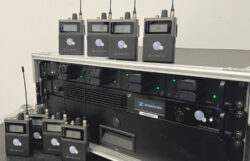
“Spectera has really made my life with RF a lot easier and more manageable.”, in addition to reducing transportation costs. On the last tour, our RF rack for all in-ears, the combiners and amplifiers were a 32U rack. I completely got rid of that rack and put three Spectera units in, with all chargers, within our existing monitoring team. It has reduced transportation costs and is much more agile, which is exactly the direction the sector should take. It is a very good system”, concludes White, summarizing the advantages of the Sennheiser system in the daily life of “The Loop”.
Did you like this article?
Subscribe to our NEWSLETTER and you won't miss anything.
Related articles
 BlackTrax: tracking to coordinate light, video and set design on Ed Sheeran's last tour
 Spectera's great adventure (Sennheiser) start with DJ BoBo
 “Loop” by Ed Sheeran: the challenge of integrating LED and unprecedented engineering in a world tour
 Sennheiser Spectera contributes to the revival of Notre Dame de Paris
 Sennheiser boarded an ISE 2026 the possibilities offered by the Spectera API
 Sennheiser Spectera transforms worship service at Revolution Church
 Magnetron drives investment in Sennheiser Spectera by Mediarent and Rental SP
 d&b audio provided the sound for Ed Sheeran's Mathematics tour in India
 Ecler and Sennheiser create a solution that simplifies meetings and improves communication
 Extron HC 403 Simplifies management of AV systems in meeting rooms
 Crestron DM XiO Director Simplifies AV Network Management with DMX NVX Systems
 ArrayProcessing Simplifies Audio Rigging and Teardown on ColdPlay Tour
 AMX simplifies technology management on university campuses with new collaboration and control systems
Synology simplifies the management and navigation of its video surveillance program Surveillance Station in its version 6.1
AMX simplifies technology management on university campuses with new collaboration and control systems
Synology simplifies the management and navigation of its video surveillance program Surveillance Station in its version 6.1