


Helmet, innovative system that combines virtual reality and head tracking
El departamento de I+D de la cadena británica BBC está trabajando en el proyecto ‘Holohelmet’, una especie de casco de realidad virtual capaz de proyectar mundos inmersivos en 3D que combina el seguimiento de cabeza con uno o más pico-proyectores portátiles.
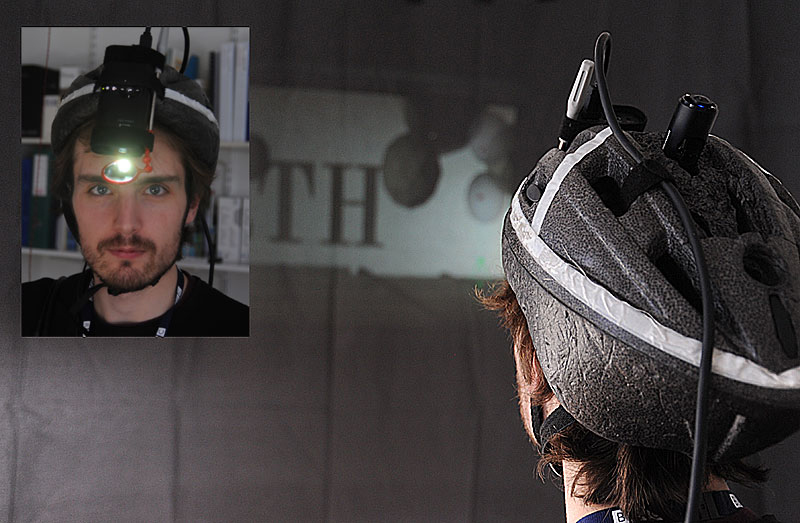
Los dispositivos de realidad virtual montados sobre la cabeza llevan bastante tiempo en el mercado proporcionando a los usuarios un método de inmersión en un entorno virtual. Los espacios físicos que proporcionan entornos holográficos inmersivos sin el uso de estos dispositivos se han visto hasta ahora limitados a la esfera de las películas de ciencia ficción. Con el objetivo de permitir a los usuarios experimentar una forma completamente inmersiva de explorar mundos tridimensionales, la BBC ha desarrollado el Holohelmet, que combina un sistema de seguimiento de cabeza con uno (or more) pico-proyectores portátiles montados sobre un casco mínimamente invasivo.
A diferencia de los HDMs de realidad virtual del pasado, que encierran al espectador en un ambiente cerrado, la BBC está adoptando un enfoque diferente mediante la proyección de la imagen en una pared en frente al usuario, permitiendo la visión a varias personas.
How it works
En el prototipo desarrollado por la BBC, el casco incorpora una cámara web dirigida hacia arriba, aparejada con una serie de marcadores LED infrarrojos LED montados en el techo. La webcam detecta la posición de los marcadores cuando el usuario mueve su cabeza y el software de seguimiento traduce estos datos y es capaz de determinar la posición exacta y la orientación del casco.
Con esta información se crea una escena 3D y se proyecta desde el pico-proyector del usuario (montado también en el casco) sobre una pantalla. En este experimento se ha utilizado un material especial retro-reflectante, colocado sobre la pared, que permite que la imagen proyectada sea sólo visible por el usuario en un ángulo estrecho desde el proyector.
El usuario puede moverse libremente en el espacio disponible. Sus movimientos están vinculados a la escena virtual que se proyecta y se puede mover alrededor de los objetos virtuales y verlos desde cualquier lado, mientras que otras personas pueden ver su propia perspectiva individual en la misma pantalla. Ellos son libres de moverse y mirar a su alrededor una escena desde diferentes ángulos.
La BBC asegura que “actualmente estamos investigando qué tipo de soporte o escenas son las más adecuadas para el dispositivo y estamos desarrollando nuevas formas de interactuar con la escena, incluyendo las interacciones bidireccionales a través de la detección de profundidad del usuario.”
Did you like this article?
Subscribe to our NEWSLETTER and you won't miss anything.
Related articles
 AIDA Imaging incorporates an automatic tracking system into its PTZ cameras
 Christie introduces its new Mirage SST-6P 6P dual-head 3D projection system
 The Gregorio Marañón Hospital creates a surgical solution that combines augmented reality with 3D printing
 Kabel HoloSitum combines virtual reality with indoor positioning
Virtual reality allows you to see the ventilation system of a parking lot in an immersive way
Kabel HoloSitum combines virtual reality with indoor positioning
Virtual reality allows you to see the ventilation system of a parking lot in an immersive way
 VRGo combines immersive virtual reality with positioning through visible light
 Virtual Playground brings the immersive experience of virtual reality to all audiences
The Cajasol Foundation celebrates Christmas with an innovative and immersive nativity scene with virtual reality
Virtual Playground brings the immersive experience of virtual reality to all audiences
The Cajasol Foundation celebrates Christmas with an innovative and immersive nativity scene with virtual reality
 A virtual reality system allows users to feel the vibrations of water being poured into a cup
 Barco incorporates the MCM-400 system for its range of 4k virtual reality projectors
 A virtual reality system helps distract patients from fear of pain
 Volfoni presents its 3D glasses with ART head tracking technology
 They develop a system that combines virtual and augmented reality technologies for ceramic products
 A new virtual reality system will help train people with autism