


Seville once again opts for an audiovisual show that shows 3D images of the city and Christmas
The plateresque façade of the Seville City Hall becomes for the second consecutive year an immense screen on which significant scenes from the history and culture of the city are projected in three dimensions through the video mapping show 'The Adventure of Innovation', dedicated to talent and innovation as the door to a future in constant evolution.
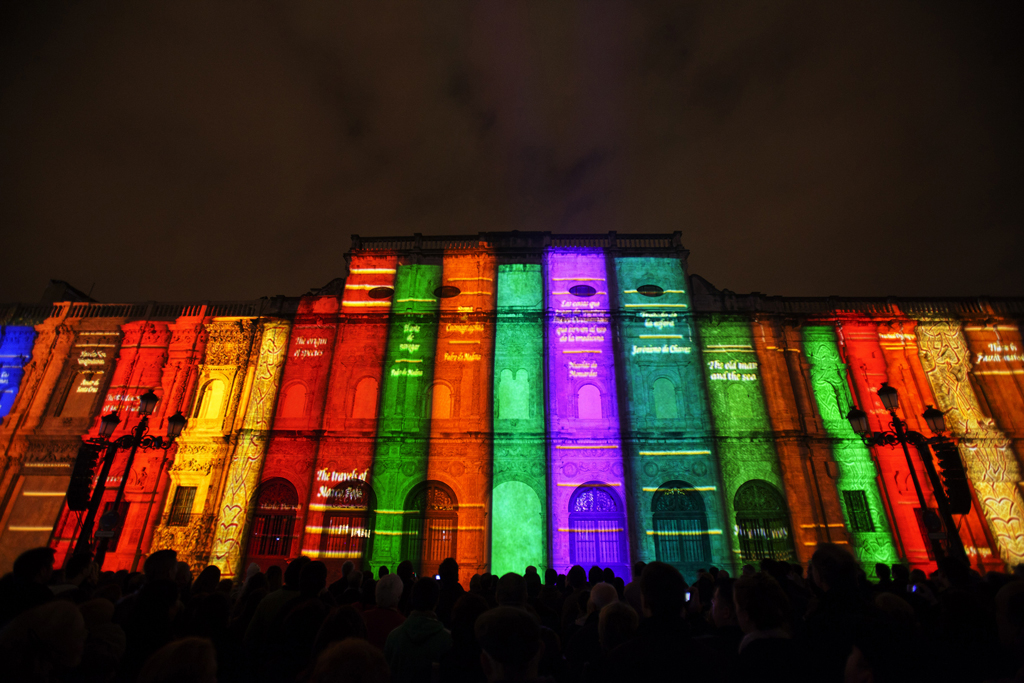
The Seville City Council projects until next 5 January on the façade of the Town Hall that overlooks the Plaza de San Francisco the three-dimensional show titled 'The Adventure of Innovation', of 13 minutes long. The show will be shown every day, in passes of the 19:00 hours, 20:00 hours and 21:00 hours on weekdays and weekends with one more pass at 22:00 hours.
As explained in a statement by the delegate councilor for Urban Planning, Maximiliano Vilchez, “it's about 13 minutes of projected images in three dimensions, accompanied by music and special effects, as a window to the history of the city and its Christmas traditions”. The Sevillian company GPD (General of Productions and Design) is responsible for this light and sound montage that serves “as a Christmas greeting for the people of Seville and as a pole of attraction for tourists”.
Focused on science
The screening begins with a tribute to the talent and scientific innovation that have accompanied Seville since past centuries.. In this sense, Vílchez has pointed out that “We move away from lyrical Seville to delve into the facet of science and its advances”. “An exciting visual map is drawn that brings together fields such as astronomy, cartography, transoceanic navigation, botany or medicine. Treated from the level of adventure, This sequence becomes something very attractive for all audiences”, says the councilor.
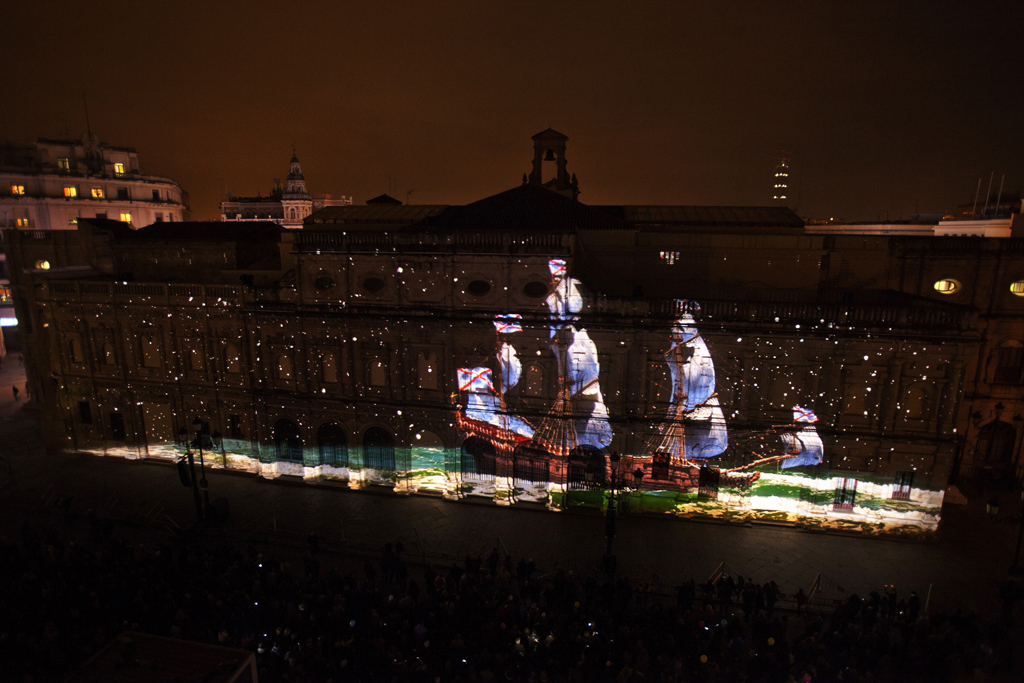
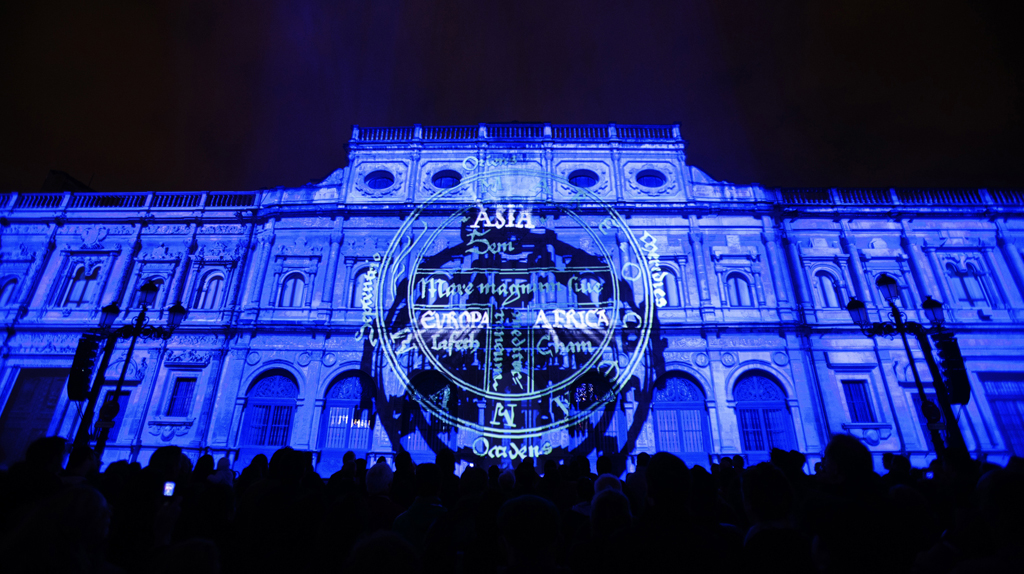
The show begins with a parenthesis to the past to introduce us to one of the most important figures that Seville has had and who has also been represented on the façade of the City Hall: Saint Isidore. Saint Isidore was a Hispano-Roman scholar and archbishop of Seville for more than three decades (599-636). Next, The map disappears to show the North Star, guide to navigators in the Middle Ages. As if it were an astronomical map, the show forms different identifiable constellations. After, the show shows an islet and then, A huge galleon bursts onto the scene, making the building disappear in its wake..
This representation of the discovery of the New World opens the way to a view of Seville in the 16th century, when the city becomes a universal port, Well then a prolific scientific activity begins, partly due to discoveries and exchanges with the new continent. This part of the show features Sevillian historical figures such as the doctor and botanist Nicolás de Monardes., the mathematician, cosmographer and astrologer Jerónimo de Chaves or Antonio de Ulloa, scientific, naturalist and discoverer of platinum.
Snowfall simulation
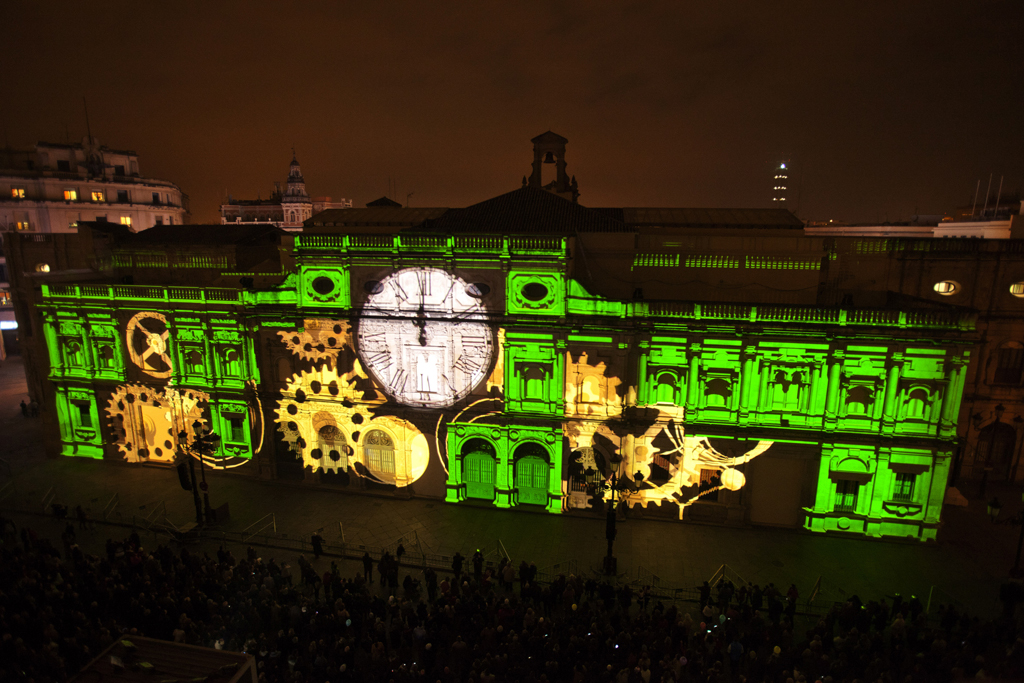
In the Christmas chapter, dedicated entirely to these festivals and their traditions, The sequence opens with the image of an ancient stone clock that, after the sound of some bells, goes into the “magic hour, the moment of dreams, the illusion and magic of Christmas”. Through several Christmas scenes and the simulation of a snowfall in the square, The show closes with great visual effects “impact” as a finishing touch.
For this three-dimensional show, Ten projectors are used 22.000 lumens each and work over 40 personas. have been generated 20.000 frames at 4K resolution. After the Christmas multimedia show, An audiovisual piece is also projected whose objective is to commemorate the 25th Anniversary of the declaration of the Cathedral, the Archive of the Indies and the Reales Alcázares as a World Heritage Site by UNESCO.
[youtube]https://www.youtube.com/watch?v=SrtccYX_jEA[/youtube]
Did you like this article?
Subscribe to our NEWSLETTER and you won't miss anything.
Related articles
 The Artaleku pavilion once again opts for Mondo for its display systems
 The Bellevue Theater once again opts for Robe to expand its lighting
 Cabal Esports once again opts for Alfalite LED panels for its studio in Alcobendas
 Kazakh University once again opts for Arec for its Law Department
 Badenova once again opts for Optoma for its largest boardroom
 Calgary's Jack Singer Concert Hall once again opts for Meyer Sound
 The Hotel Rival once again opts for Genelec for its new leisure area
 Shuttle once again bets on AMD for its barebone offer
 G Livelab once again opts for Genelec Smart IP for its new premises
 Acciona is once again in charge of the audiovisual and pyrotechnic show of the 'Fuegos del Apóstol'
 Acciona will be in charge of executing the audiovisual show 'Toledo, the universal city
 Mango bets on Led again&Go for the new stores in Madrid and London
 Maverick shows his vision of the future of the audiovisual market
 Christmas starts in Madrid with a 4D show projected on the façade of the Cibeles Palace