


3D holographic calls, ever closer to the market
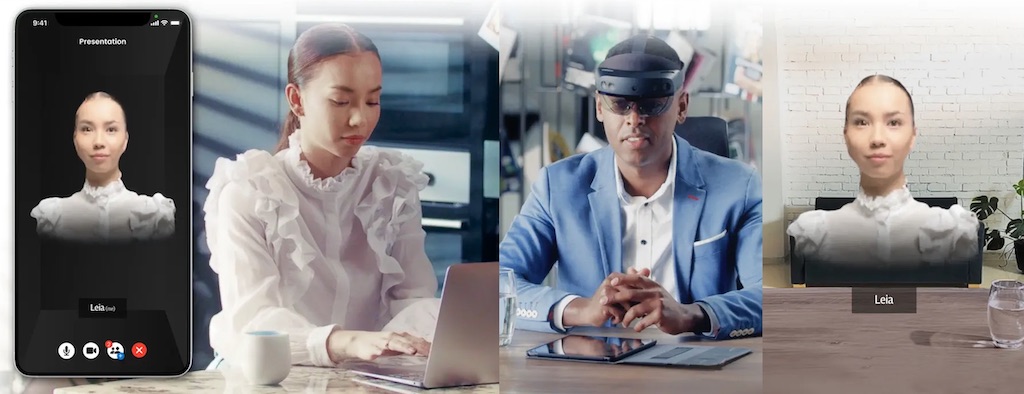
The operators Deutsche Telekom, Orange, Telefónica y Vodafone, together with the technology company Matsuko have successfully tested a solution to make 3D holographic calls that merge the real world with the virtual world.
Provide ease and simplicity to holographic calls has been the objective of the pilot test carried out successfully by European operators Deutsche Telekom, Orange, Telefónica y Vodafone, along with Matsuko.
These companies are also developing a platform that will combine the real and virtual worlds, through a mobile connection, using a mobile phone camera to generate a 2D video that is then rendered into 3D holograms in the cloud and can be streamed to viewers in an AR/VR/MR environment with clarity and sharpness never before possible.
The test platform uses the advantages of 5G connectivity (high speed, high bandwidth and low latency) to overcome some of the challenges of creating realistic 3D images that existed until now.
Holograms are created using the camera selfie of a mobile phone to capture and transmit a real-time three-dimensional holographic image of a person, before processing it through an advanced 3D rendering engine. "Next, “It offers a virtual immersive experience and displays it in a virtual environment or superimposes it on a real one using virtual reality or augmented reality glasses”, according to the statement.
Once the first phase of the collaboration has been successfully completed, companies will continue to improve the underlying technology, focusing on service quality. They are currently evaluating the potential for transmission, creating the possibility of entire events or presentations being held virtually with extraordinary realism.
Future applications could include “person-to-person or few-to-few communication.”, improving communication in both consumer and business environments. The key to this realism is the use of technology edge computing mobile -the so-called distributed networks, where network and application intelligence is operational beyond the core of the network., which greatly improves both latency and bandwidth, to ensure the most reliable virtual and mixed reality experience.
Thanks to 5G and the companies' cutting-edge technology, the results have been encouraging, by resolving network-related issues that prevented smooth and natural holographic movement of holograms.
Besides, Matsuko's platform ensures that the final result benefits from better color and texture resolutions, which increases realism when viewed in a smartphone or other mobile device
Sven von Aschwege, XR topic lead global devices partnerships de Deutsche Telekom, emphasizes that “we are in an exciting phase. Making phone calls as if the person I'm talking to is in front of me is one of those dreams that is now closer to reality.. We are testing these holographic calls together with other mobile communications companies, since they only make sense if they work with everyone and not just with a company's clients.".
To Karine Dussert-Sarthe, vp. marketing and design executive at Orange Innovation, emphasizes that “thanks to this unique collaboration between operators, we are preparing the infrastructure to offer open holographic communication services, interoperable and easy to use. A first but significant step towards the metaverse, a world in which we will support our clients with new experiences and possibilities of interaction”.
In this line, Daniel Hernandez, vp. Telefónica IoT devices and consumer, adds that “we are sure that in the near future we will offer our customers a new way to communicate using this new holographic technology to offer a more immersive 'virtually there' experience.. Our cross-carrier collaboration with Matsuko will help accelerate this innovation and ensure it works regardless of which carrier they choose.”.
In the words of Alex Froment-Curtil, commercial director of Vodafone, “the metaverse brings a new dimension to the future of connectivity, with exciting experiences to communicate with friends and family, or even for companies to connect with their interest groups. “This proof of concept takes holographic communications dramatically from science fiction to real life on smartphones.”.
As the general director of Matsuko assures, Matus Kirchmayer, “The goal of the initial pilot was to offer a ‘one-to-many’ holographic experience.”, with a virtualized broadcast approach that would allow the audience to see an individual present virtually - like a hologram- with astonishing realism”.
Did you like this article?
Subscribe to our NEWSLETTER and you won't miss anything.
Related articles
 Biamp guarantees calls and announcements at Ascot Racecourse in Perth
 Telefónica, Ericsson and Matsuko integrate holographic calls into smartphones
 Looking Glass features two holographic displays of 16 y 32 inches
 Nearly 300 Prolights equipment illuminates the Madame Tussauds museum in Budapest
 Telefónica and Matsuko bring spatial computing to holographic meetings
 Planar Luminate Ultra: High-brightness video wall for close-up outdoor viewing
 Live! Philadelphia casino installs near 750 Martin Audio speakers
 Adif will expand its digital signage network with around 200 information screens
 The largest bookstore in Finland opens its stores near 200 altavoces Genelec 4000
 Sono equips Fira de Barcelona with nearly seventy large format monitors
 Vogel’s Ibérica moves its headquarters to the center of Barcelona to be closer to its customers
 Lifesize offers multipoint video conferencing calling with its renewed MCU software
 New holographic rear projection screens from Kontroltek
 The media market continues its reconversion towards an increasingly digital future