


Hyparschale begins its activity as a multipurpose center with WSDG audio
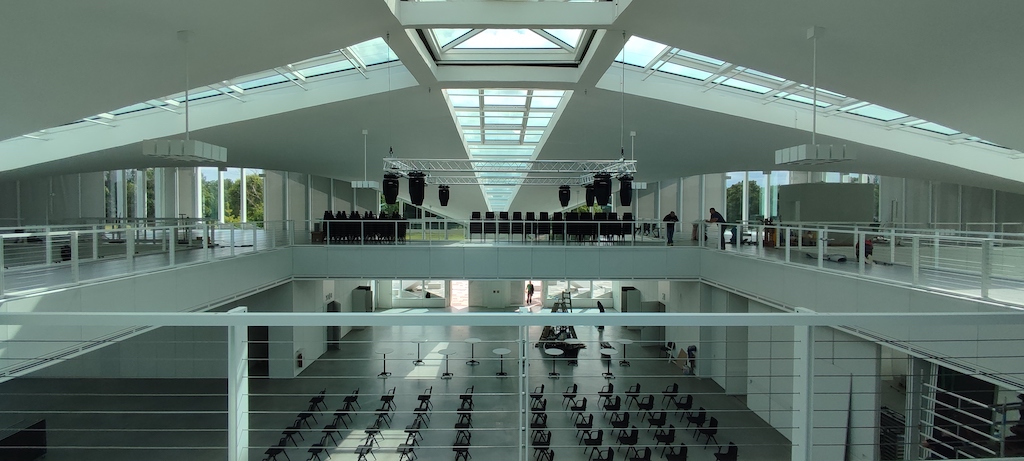
ADA Acoustics & Media Consultants, company WSDG, has optimized the acoustics of this historic building by German engineer Ulrich Müther, transforming it into a versatile venue for events and music.
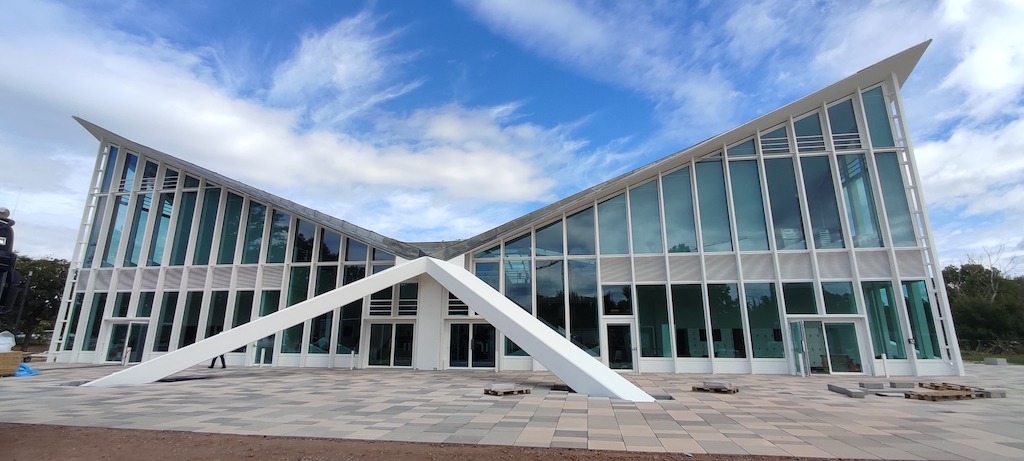
Considered one of the largest concrete shell constructions and part of the fifty buildings with this laminar structure that remain standing., created and designed by engineer Ulrich Müther, Hyparschale was inaugurated in 1974 in Magdeburg as a cultural institution of the German Democratic Republic but, after reunification, fell into disuse as the integrity of the cover was a concern and was closed.
After making the decision to restore in 2017 the building and transform it into a functional space and multipurpose for the entire community of the German city of Magdeburg, A complex and ambitious project was started that ended just a few months ago.
A fundamental element in this project has been the acoustic space design, for which he was hired ADA Acoustics & Media Consultants (ADA-AMC), a company of WSDG, who after numerous visits to the field began the first reports.
The scope of the project covered the sound field control, not only the main volume of 17.000 m³, but from the newly built cubes, supervised by Tobias Behrens, at ADA-AMC, in addition to the electroacoustic design, the noise dampening of the equipment and ventilation systems.
The term Hyparschale (hypar-peel) was coined by Müther to describe the hyperbolic paraboloid curves that characterize the design of many of its buildings. The limitations of the techniques and materials at the time of its construction meant that it did not live up to the original vision of its creator., as the large swath of light provided by the linear skylights was blocked when leaks forced the windows to be covered with roofing materials.

Located on the banks of the Elbe River, This unique building has become an icon for the local community, that prevented it from being demolished and a slow and complex restoration process from starting, since both the size and shape of the roof meant that turning it into a multipurpose and acoustically suitable center for its purposes has been a great challenge..
“The structure of the building was surprisingly solid, even after not having been used for years 90 -explains Behrens-. All space has a volume of 20.000 m3, so a lot of material is needed to reduce reverb times. Traditionally, the ceiling would be a very useful place to start adding absorbent materials, but for this space, It couldn't be".

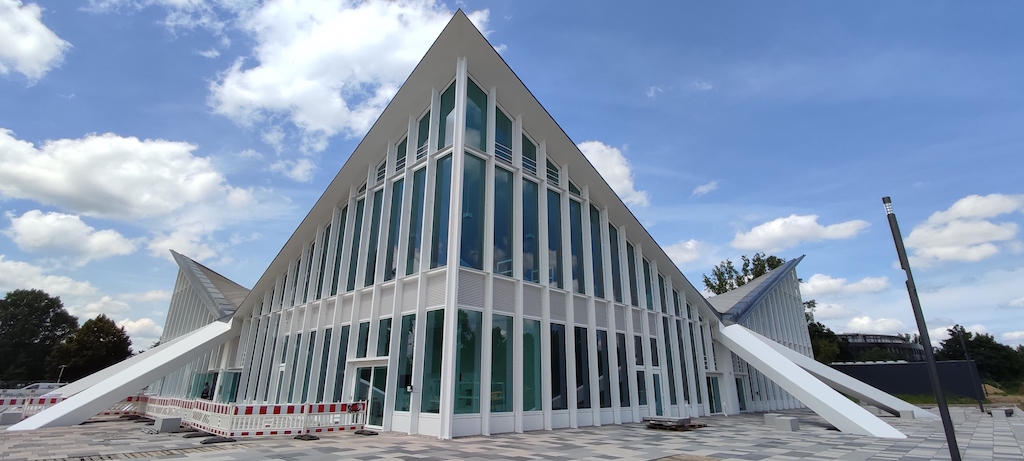
Formed by four deck surfaces hyperbolic paraboloids, Hyparschale covers a total area of 48×48 metros, with glass facades on all four sides, with the highest point of the curves at 16 m. Internally there are no supports, and the result is a uninterrupted space, unique and open. Skylights reinstalled, discovered after years hidden under the asphalt fabric, They divide the roof into quarters and accentuate the curve of the roof on the inside.
So that the space could have multiple uses, gmp Architects added cubes in each corner, in a grid layout following Müther's design, of which two of them have been designed as seminar rooms, that can accommodate up to 127 people sitting each.
The four cubes are connected by walkways that cross the space on the first floors., dedicated to exhibitions, although the lower ones have different purposes: one of them houses facilities such as toilets and cloakroom, the second a cafeteria and the two subsequent multipurpose rooms for conferences and training.
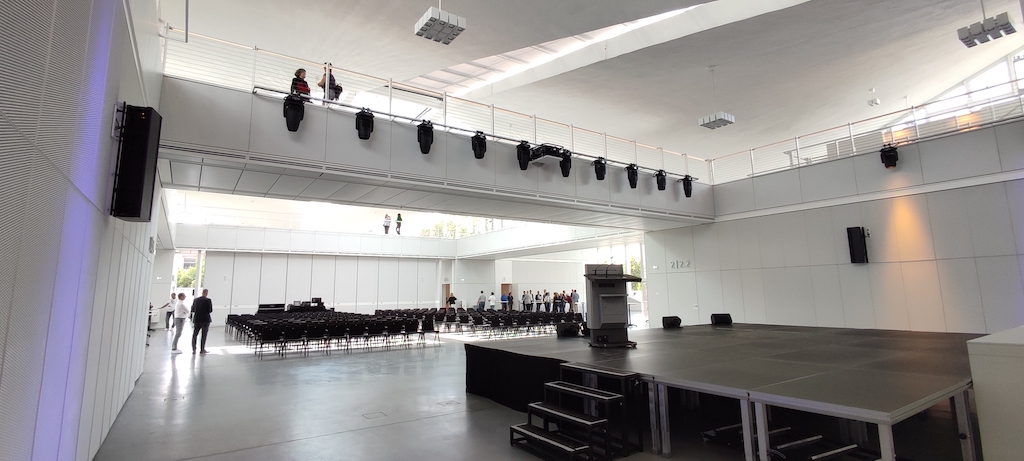
The remaining central area retains its open design and can be used as auditorium, with capacity for five hundred people seated. The reverb times of this space are too long, even for concerts or orchestras, which prevented acceptable speech intelligibility without absorbent treatments.
Due to the roof structure, traditional methods, as an absorption layer to ceilings, were not available. The roof could not be altered or added weight due to the complex mathematical balance that keeps the enormous curve upright without support.. Lines of sight could not be altered either., so curtains or acoustic baffles were not appropriate for the space, All of this made the acoustic project a challenge..
The large glass windows are also very reflective and, as space is almost square, the walls are parallel, which produces flatter echoes that negatively affect intelligibility. Controlling room reverb times helps control these echoes and blinds., that are placed in the windows to provide shade, offer limited sound absorption, thus controlling the flat echoes in the auditorium.
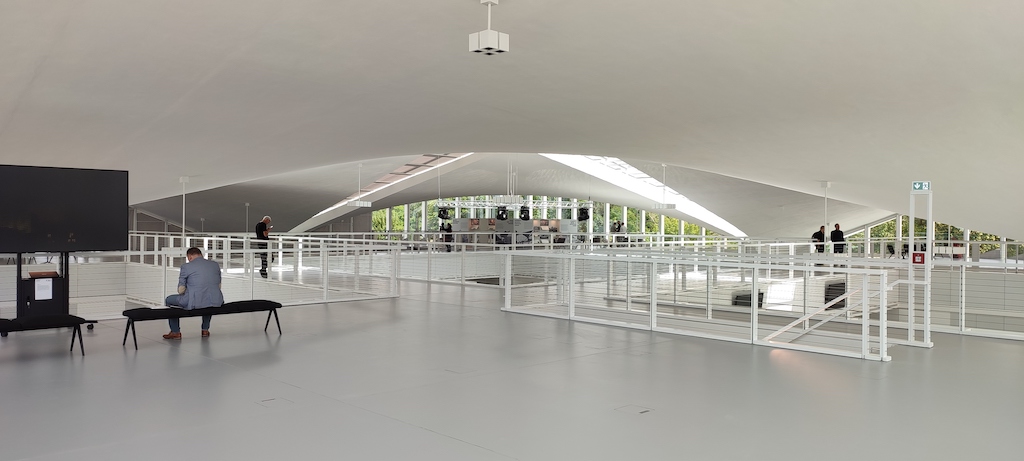
The main solution to control the acoustics of the room were the four cubes and the interconnecting bridges. These spaces are acoustically treated, not only internally with absorption materials on the walls, but with special five-layer curtains that allow 20 dB of acoustic difference on each side.
They are also treated externally, with all possible surfaces covered with shock-absorbing materials, including bridge soffits and wall facings. Lateral reflections have remained to ensure that the acoustics matched the sound expected from such an open space..
“Hyparschale requires a unique approach to provide the right response from the room. as a spectator, if you don't have lateral reflexes, "You don't feel good because there is no auditory interaction with what you see," Behrens points out.. That's why we leave some reflective faces. The walls look the same, but there is no absorbent material behind the sheet, so the original acoustics are not as muffled by these surfaces”.
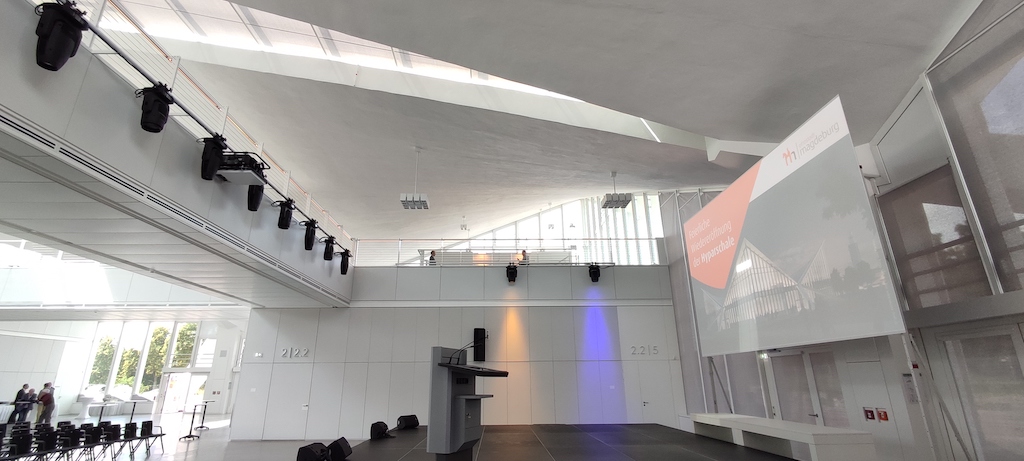
The central performance area and the auditorium are fully equipped, with a Vida-L system of Kling & Friday Sound Systems, specified by ADA-AMC (WSDG), and a specialist lighting system Light vision design.
He speaker system Kling & Friday it and scalable line array, controllable and full range which ensures that sound energy is directed exactly where it is needed, which has the double advantage of avoiding sending energy to the large reverberant room and allowing the audience to absorb most of the sound.
“It has been a special challenge to achieve adequate acoustics for multifunctional uses, even with acoustic reflections from the cover. In close coordination with the specialized acoustic planner and other people, we managed to preserve the characteristics of the building's surfaces and, at the same time, meet the new requirements for reverberation time and speech intelligibility”, concludes Christian Hellmund, de gmp Architects.
Did you like this article?
Subscribe to our NEWSLETTER and you won't miss anything.
Related articles
 WSDG designs the sound of the new Assembly performance center
 Coruña Estudio Immersivo begins its activity with Alfalite VP XR Led screens
 Belgrade Cultural Center promotes its activity with Sony laser projection
 Extron NAV facilitates activity at the Euro Auctions auction center
 Pexip begins its activity in the professional Spanish market with its collaboration proposal
 Tech Data, as an 'essential services' company, will continue its activity during the Covid-19 crisis
 Beabloo begins its new stage with Enric Quintero as general director
 Clear Channel Outdoor begins its activity as an independent company at Cannes Lions 2019
 The new Movistar Arena Coliseum in Bogotá begins its entertainment activity
 The Roselli gym is committed to AV technology as support for physical activity
 Audio-Technica Iberia begins its activity to be a reference in professional audio in Spain
 Charmex begins its expansion process in Latin America with activity in Peru and Colombia
Tecniológica DS begins internationalization with Gonzalo Marcos as new Development Director
Charmex begins its expansion process in Latin America with activity in Peru and Colombia
Tecniológica DS begins internationalization with Gonzalo Marcos as new Development Director
 AMX begins its consolidation strategy in Europe with Mark Jenkins as director of operations