


Dante AV and NFGD materialize the future of learning with immersive classrooms
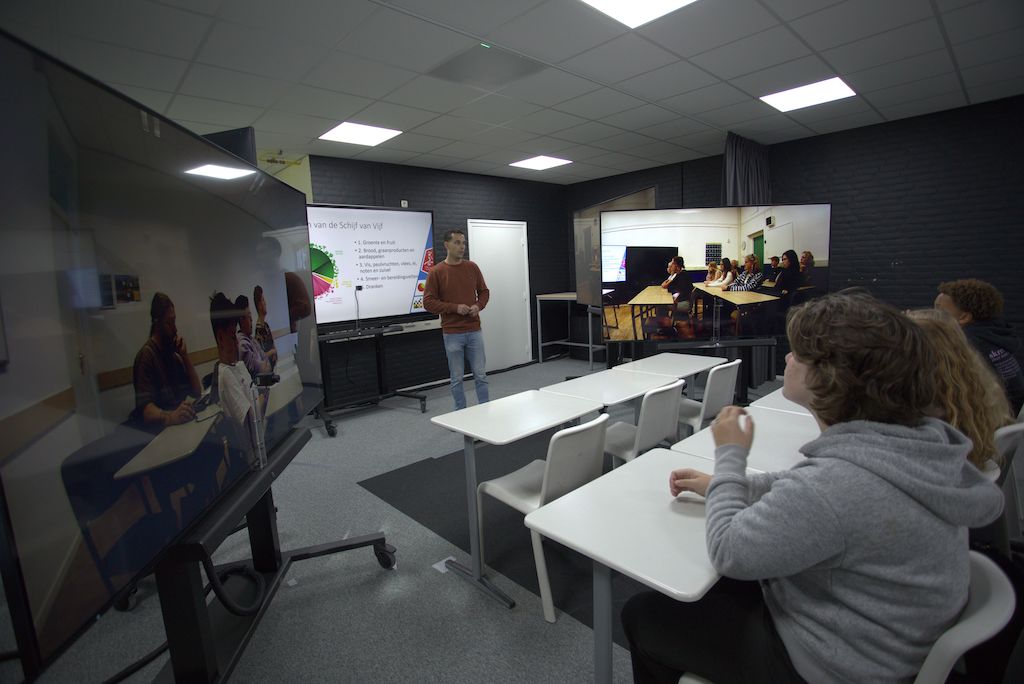
The solution of NFGD Audiovisual con Audinate Dante AV Ultra has transformed the teaching model with the launch of immersive virtual classrooms, operational in three schools in Sneek (Netherlands), to address the lack of teachers and students and that other centers are already replicating.
Like many rural school districts around the world, Education systems in certain areas of the Netherlands face significant challenges, like the lack of teachers y, at the same time, to one decrease in the number of students due to population movement towards urban areas.
Compulsory subjects are well supported, but specialized courses often lack the number of students necessary to justify their offering, which means that schools cannot offer them viably.
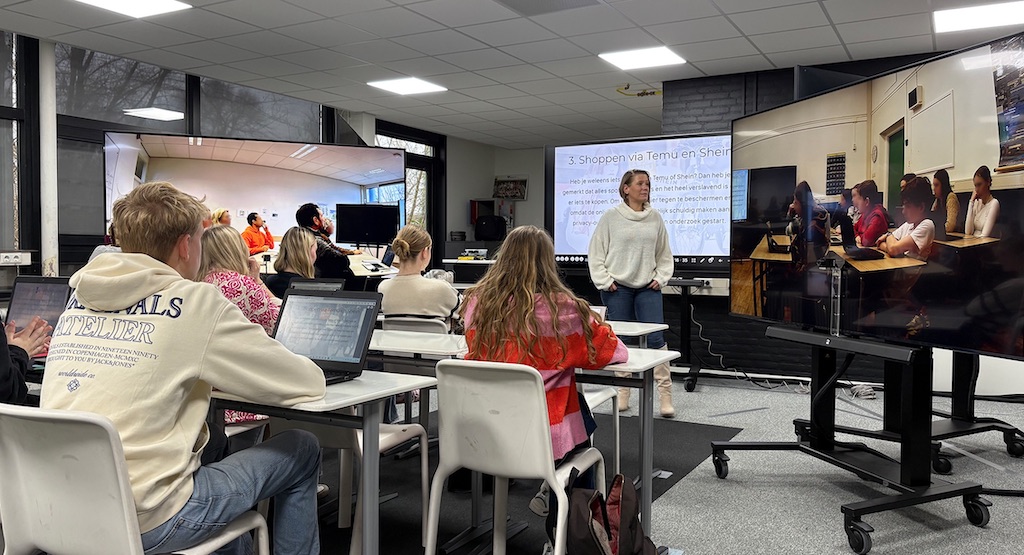
All this has recently changed in a rural district of the Netherlands, specifically in the city of Sneek, thanks to the decision of the teachers of three schools in the area to find a new way to face this challenge.
School educators RSG Magister Alvinus, Aeres VMBO y CVO Bogerman They wanted to find a way to cShare resources between the three schools without altering schedules and without students having to travel to different campuses.
“We were trying to figure out how to bring together different groups of students from different schools in one big virtual classroom,” he explains. Mart Mojet, professor of STEM and RSG Magister Alvinus-. From our experience during the pandemic, we knew we could teach using something like Zoom. However, It was not a good experience for either the teachers or the students.. “We all wanted something more immersive”.
Push the limits of AV
The teachers imagined a virtual campus with an immersive classroom design, capable of transforming the traditional distance learning experience, consisting of a flat interaction through the computer, that connects both students and teachers naturally.
As stated Thorba Wierstra, Geography teacher and IT policy manager at Bogerman School, “we wanted find a new technology to use it, but without feeling it or being aware of it, finding a better way for our students to learn, to be better teachers and to make things possible that were not possible before”.
The teachers contacted professionals in the audiovisual sector about how to create what they had in mind. “We work for two years with many failed attempts, as we continually ran into the technical limitations of what is possible with modern AV equipment.”, remember Mojet.
The first breakthrough came when they met Rene Simmers, business development manager NFGD Audiovisual, who was able to understand the problem and knew what the right technology was to solve it.
Design for immersion
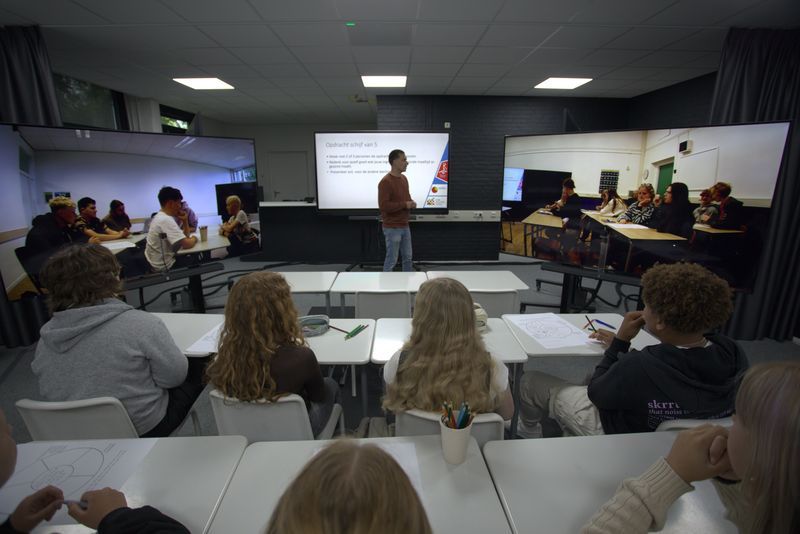
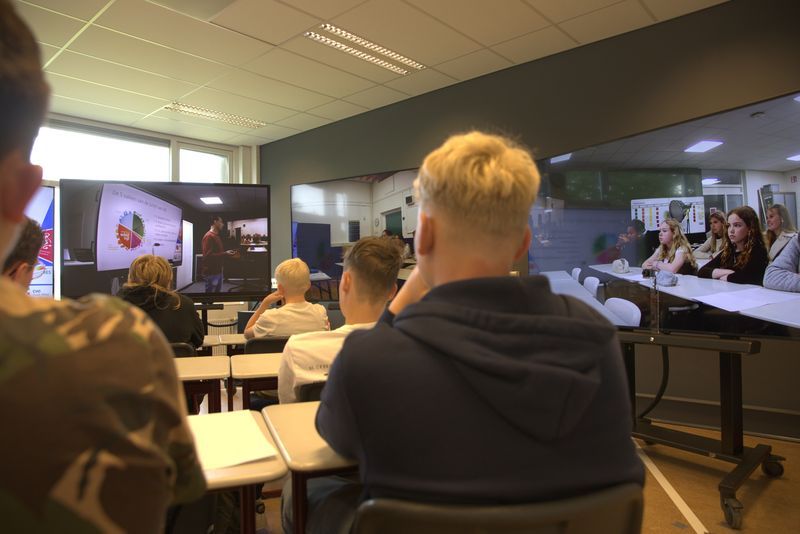
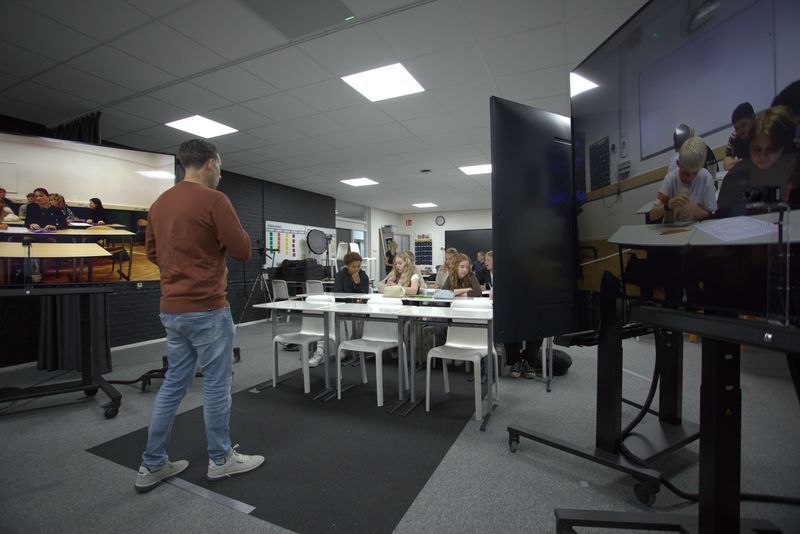
The idea was that each of the three classrooms was equipped with interconnected screens, all placed according to the perspective of each classroom, to give the impression that it was a single joint space for everyone.
This configuration would allow students to see their teacher and classmates in multiple locations, as if everyone were in the same room, breaking the barriers of physical distance and allowing them collaborate and interact in real time.
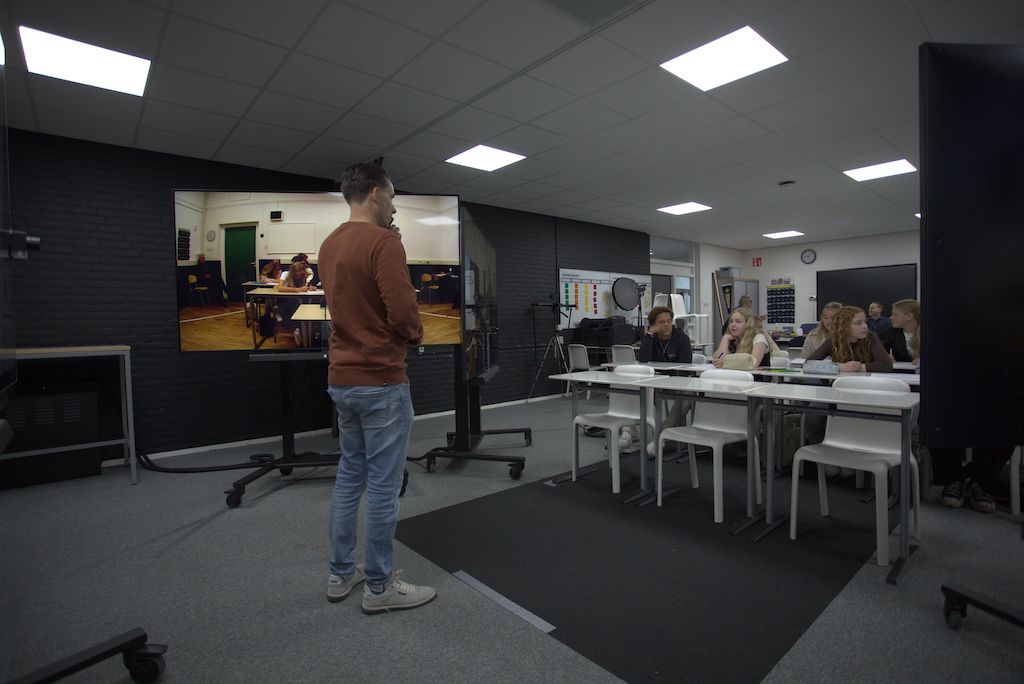
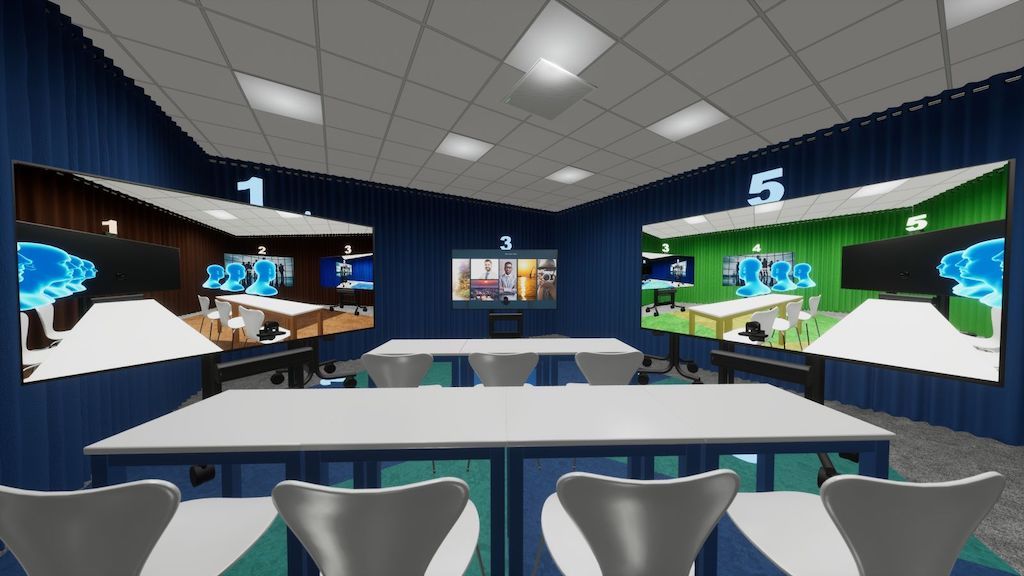
NFGD and educators worked collaboratively to explore how to create a sense of shared presence in a virtual environment. The final design was based on the installation of five screens in a classroom, whose arrangement varied depending on the location of the teacher.
Two screens are placed in front of the teacher, to the left and right of the in-person students, representing the positions of the other two classrooms and allowing you to look at the non-face-to-face students.
The rest of the visual equipment is arranged so that the students also look directly at the teacher, with his non-face-to-face colleagues to his left or right, like in a traditional classroom. With this configuration, all participants share the feeling of being together in the same space.
To achieve the sensation of immersion, los ceiling microphones Shure capture sound in every location, while the small cameras Aida Imaging view students from different locations at the appropriate physical angle, and the sound bars Audac, placed under each screen, provide directional and localized sound.
The 'fraction of a second'
To offer a immersive classroom experience With this technological structure it was essential that the design had a precise audio and video synchronization and imperceptible latency.
“One of the biggest problems that can arise with a video transmission - says Douwe Hummeling, IT support manager at the Aeres VMBO school- "It's just that a single second of delay can ruin the entire experience.".
This had been a long-term challenge for the project: the real-time interaction through cameras, microphones and screens it had to be fluid and natural, especially given the distance between the schools in which each of the classrooms were located.
NFGD faced the challenge of offering a system that could achieve a latency less than 4 milliseconds, the level of performance essential to maintaining the flow of conversation and collaboration in a classroom environment, where even the slightest delays can disrupt learning. The decision was clear: Dante AV Ultra.
“It was the right choice for this project for multiple reasons - underlines Wim van Dijk, general director of Netchange, AVoIP partner and distributor who participated in the project-. The most important thing was synchronization and clock. With Dante AV Ultra you have a single reference point where you can synchronize audio and video, and you know that on the other end it will look really good”.
Dante AV Ultra, the high fidelity video encoding developed by Audinate for one less than one frame latency, with image quality without visual loss, guarantees a natural communication, fluid and perfectly synchronized between different locations.
This precision of audio and video transmissions ensures that teachers' voices and movements are perfectly aligned, regardless of distance between locations.
“This technology is magnificent because it is in real time, so there is no type of delay -Hummeling emphasizes-. It's like you're in a class with everyone else.. The goal of this entire operation is to make you feel as realistic as possible. The technology is present, but it is not noticeable”.
Easy-to-use technology
In this project, A fundamental element was that the technology was easy to use for teachers, As Wierstra points out: “as a teacher, I don't want to worry about the solution, It just has to work.”.
This requirement meant that NFGD had to design a simple system so that teachers could Start and stop sessions with the push of a button. “We achieve this by combining different equipment with the knowledge and experience of our engineers”, underlines affirms Francois Hobma, CEO of NFGD.
Specifically, The company achieved this thanks to a control interface Q-SYS driven by Dante Domain Manager. This center of software based management protect devices, manage users, organize rooms and functions, and run Dante AV over routed networks.
“You don't want your teacher to have to be an AV technician,” he says. Rene Simmers, at NFGD-. “Dante Domain Manager helped us in this case because it connects all types of systems and devices behind the scenes”.
Audiovisual data is shared between the three centers through encoders and decoders Bolin D20H Dante AV Ultra, all of them connected to one standard network 1 Gbps that uses switches Netgear; a complex interconnected system of devices, data and infrastructure that teachers never have to learn to manage.
Make the impossible possible
With the virtual campus operational in the three schools and the shared classes that are taught regularly, The project has been a total success. “It was not possible to justify supporting a curriculum or paying a teacher when only five or six students were enrolled in a district,” Wierstra clarifies.. Once we connect them and join them, We can now offer a smaller course, expand it to twenty or more students and have a single teacher who teaches them all”.
They are modular design allows flexible configurations that adapt to the needs of different educational institutions. The system scalability Ensures you can add more schools and classrooms without compromising performance or quality.
The success achieved with this learning setup has attracted the attention of other schools in the area, and recently three more have joined the network. Besides, NFGD designed this solution to be replicated, allowing other educational organizations to benefit from the advantages of expanding access to distant locations.
Did you like this article?
Subscribe to our NEWSLETTER and you won't miss anything.
Related articles
 PureLink shows the future of immersive experiences with PureSpace
 Dante boosts learning at Beijing university
 Vogel’s shows how to create and equip the classrooms of the future with its Rise series
 Dante Domain Manager encourages learning at Sonic College
 Powersoft helps create the learning space of the future for Monash University
 Smart Classroom Project rethinks the design and digital learning of traditional classrooms
 Vivitek series D770: ultra-short throw projectors to improve classroom learning
 What is the future of collaborative learning?
 BenQ brings interactive learning to classrooms with new RP flat panels
 Drones take classrooms as a learning tool at Brains International Schools
 HP Inc transforms classrooms with collaborative and immersive solutions at BETT 2016
 Epson and SMART join technologies to promote collaborative learning in classrooms
Hitachi StarCloud brings interactive and collaborative learning to classrooms from the cloud
The Zientia platform facilitates learning in classrooms using augmented reality
Epson and SMART join technologies to promote collaborative learning in classrooms
Hitachi StarCloud brings interactive and collaborative learning to classrooms from the cloud
The Zientia platform facilitates learning in classrooms using augmented reality