


A window to infinity: that's Oculus, the gigantic LED installation at the Houston Airport
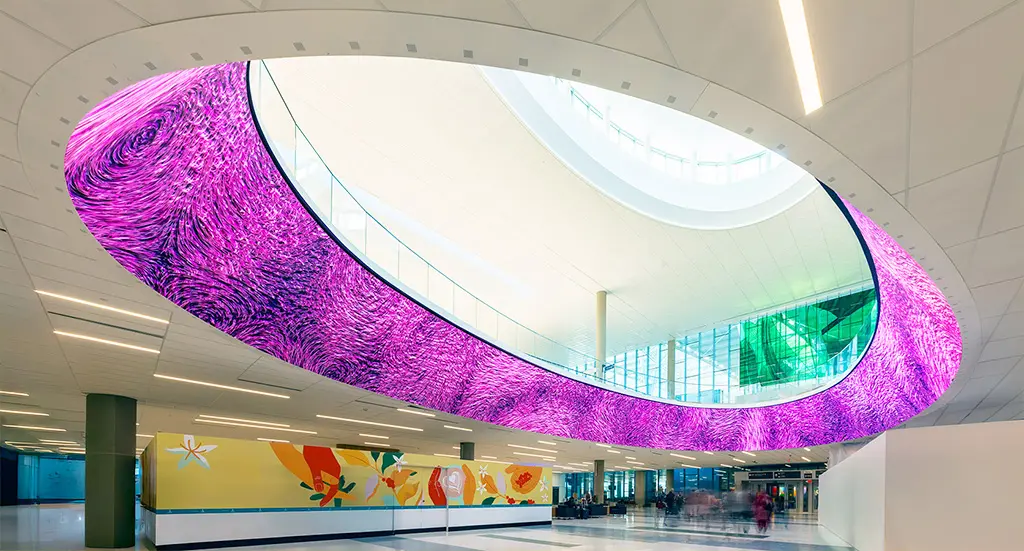
Ford AV carries out the creation and integration of the spectacular Oculus, an installation based on curved LED screens 67 meters in length that greets travelers upon arrival at terminal E of the George Bush Intercontinental Airport in Houston (IAH).
This unique installation redefines the possibilities of LED screens in airports by combining architectural innovation, complex engineering and real-time content. Unlike traditional LED screens, that use uniform rectangular panels, each of the more than 2000 LED modules had to be custom made and placed individually with a tolerance of just millimeters. In this way, the panel is slightly trapezoidal to maintain the oval shape of the structure and the perfectly curved radii.
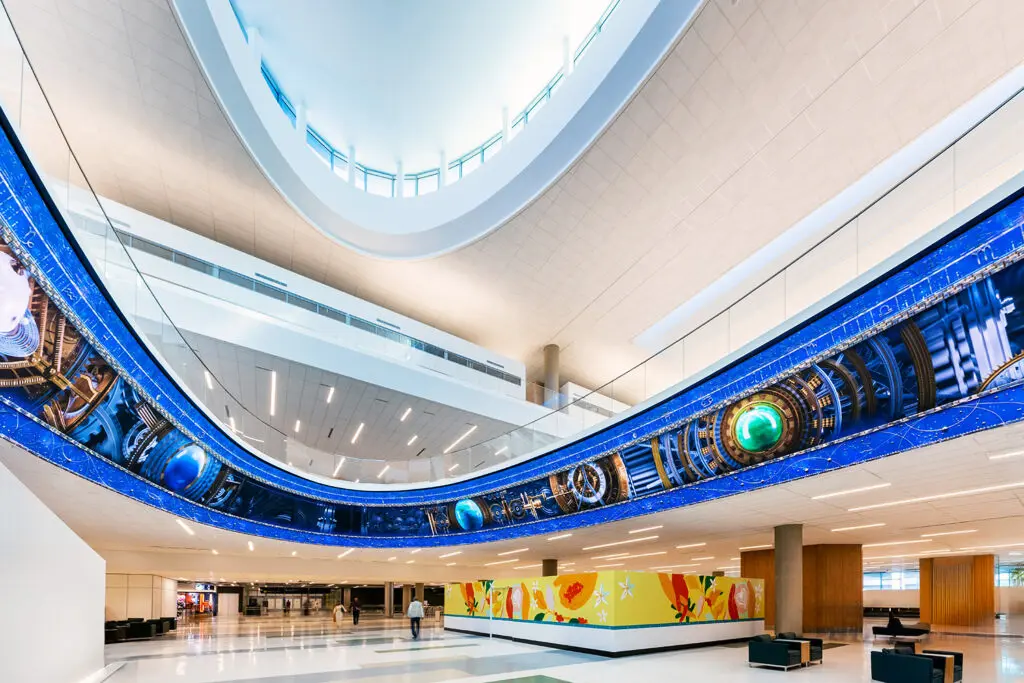 Behind the elegant surface, composed of curved LED honeycombs NanoLumens, one of the “most sophisticated” content management ecosystems ever implemented in an airport. Ford AV design, built and installed the equipment racks and devices that power the experience, including six Pixera video playback servers high end, and procesador Analog Way Aquilon to manage non-standard resolutions, Novastar solutions and the Smart Monkeys' ISAAC platform for content management and programming.
The system is supported by more than 400 Cat6 data cables, each one of them finished, Tested and certified by installation teams Ford AV. Redundant cabling ensures continuous uptime; if a route fails, playback is automatically redirected to backup systems.
Creating Oculus content
To take advantage of the potential of this facility, Gentleman Studio, an immersive multimedia studio based in Montreal, conducted extensive on-the-ground immersion to authentically understand and celebrate Houston. Gentilhomme designed and produced a Complete and multi-layered content ecosystem Integrated with advanced Ford AV systems.
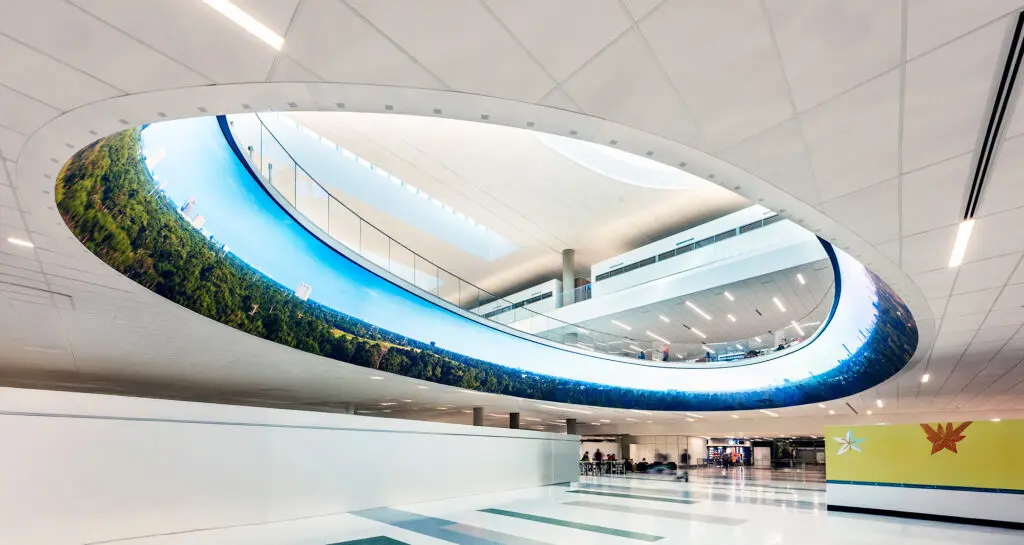
The content includes content from 360 city degrees, capsules Custom CGI (showing unique scenes, as space-related content developed in collaboration with NASA) y dynamic visual pieces and based on real-time data that uses live images of the city to consistently reflect Houston. Gentleman propuso, besides, the inclusion of interactive experiences, which led us to integrate sensors into Oculus hardware to engage passengers and transform the time spent enjoying the infrastructure.
In fact, as travelers pass beneath the Oculus, Your motion data is captured by occupancy sensors, processed through Pixera's real-time rendering engine and streamed to the huge curved LED surface, creating images that respond to the movement of passengers. The result is dynamic content that changes throughout the day and reflects the identity, the setting and energy of Houston as travelers pass below.
Challenges of a unique project
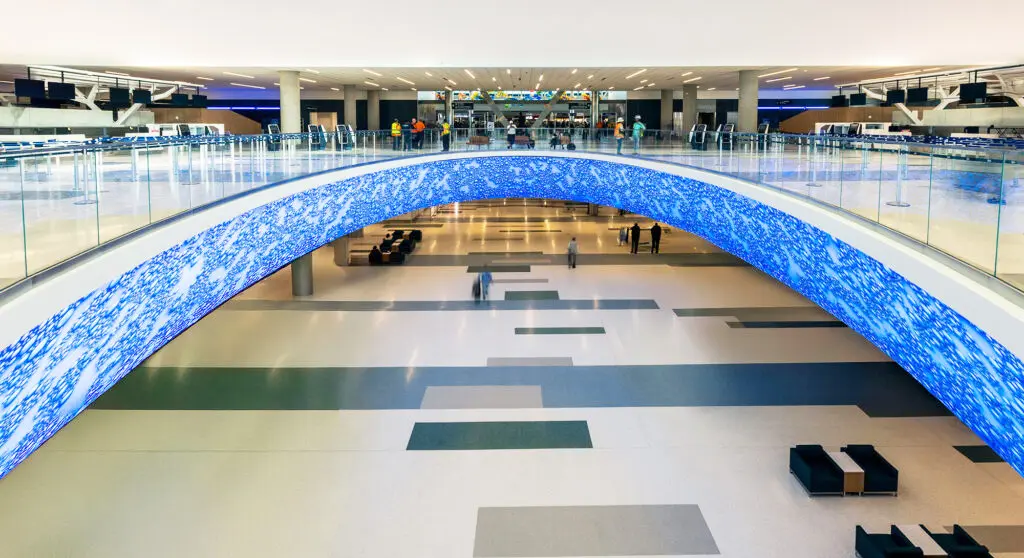
From the first design phases, the Oculus raised formidable structural and technical challenges. The project team quickly discovered that the initial steel structure did not fit the required geometry. It took seven major structure reviews and months of coordination before the structure was ready. Finally, Ford AV installed the wall at full height on scaffolding.
Later, during start-up, The integration team faced synchronization issues between Unreal Engine and Pixera rendering systems, causing frame drops and sync mismatches on all six playback servers. Ford AV and Smart Monkeys Collaborated to Develop Frame-Locking Solution to Harmonize Server Outputs, ensuring every pixel remained perfectly aligned in motion.
Did you like this article?
Subscribe to our NEWSLETTER and you won't miss anything.
Related articles
 FBT redefines audio monitoring and control with Infinito Suite
 MMMAD will turn Madrid's urban space into a great window for digital art
 Resorts World Las Vegas lights up the giant LED screen in its West tower
 Christie Widget Designer gave life to the gigantic Vivid Sydney puppet 2018
 NanoLumens and Float4 create a dynamic and interactive installation at Vancouver Airport
 "WHEREAS 2018 “It has been the global window that has given us image and visibility”, Santiago Verdu, CEO of Charmex
 The city of Harrogate captures the attention of passers-by from a gigantic LED screen
 ‘Big Hoss’, Panasonic's gigantic flat screen, enters the Guinness Records
GCR installs kiosks for passport control and digital signage at George Bush Airport in Houston
‘Big Hoss’, Panasonic's gigantic flat screen, enters the Guinness Records
GCR installs kiosks for passport control and digital signage at George Bush Airport in Houston
 Christie covers with a gigantic screen of 108 MicroTiles the lobby of its California headquarters
 An interactive augmented reality window that makes train trips more entertaining
 BMW opens a window to the near future of the automotive industry in New York
 An interactive window allows Bloomingdale's customers to design their own Havaianas
 Sharp launches a giant interactive touch whiteboard 80 inches