


The UFV tests the Wi-Fi Halow protocol in a pioneering project
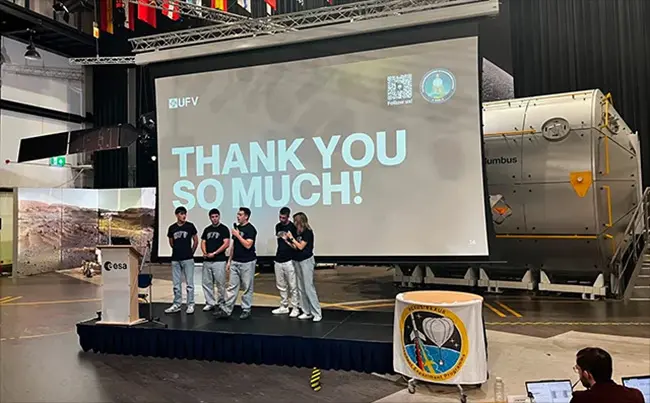
The European Space Agency has selected the Francisco de Vitoria University (UFV) to be part of the Bless Bexus program, which prepares a crucial test for the promising Wi-Fi Halow protocol (IEEE 802.11ah).
The program REXUS/BEXUS, fruit of the collaboration between the German Space Agency (DLR), the Swedish Space Agency (SNSA) and the European Space Agency (ESA), offers European university students a plataforma experimental top level to develop and validate technology in conditions close to those of a space mission. In the case of BEXUS, The experiments travel aboard a stratospheric balloon capable of ascending to the 30 kilometers of altitude, subjecting payloads to extreme pressure and temperature conditions.
The project with which UFV has been selected is called BLESS (BEXUS HaLow Evaluation in Stratospheric Systems). Its objective is to carry out the first in-flight characterization of the protocol Wi-Fi HaLow (IEEE 802.11ah) in the stratosphere, in order to analyze how this technology behaves during the ascend y Assess resiliency of commercial hardware in extreme environmental conditions.
The experiment seeks to fill a relevant technological gap: although he Internet of Things requires reliable communication standards that connect terrestrial and non-terrestrial networks, the Wi-Fi HaLow protocol, especially promising for its length range, does not yet have validation in aerospace environments. The mission of BLESS is to provide this knowledge and establish a reference for vertical link quality with potential future application in high altitude platforms and satellites.
After this selection, The project now faces a schedule of reviews and validation phases that will culminate with the flight campaign scheduled for october 2026 in sweden. The team that will carry out this project is made up of students from the Francisco de Vitoria University with different engineering profiles., among them Computer Engineering, mechanical Engineering, Industrial Engineering and Artificial Intelligence Systems.
Did you like this article?
Subscribe to our NEWSLETTER and you won't miss anything.
Related articles
 Jimmy Carr tests voice intelligibility in large venues with Coda Audio
 From Metallica to the NFL: 4Wall tests the limits of Brompton's Tessera LED processors
 Jamie Hickey puts Sennheiser Spectera to the test at Wembley Stadium
 The Francisco de Vitoria University carries out a pioneering universal guidance project
 The coronavirus tests the networks in Spain in response to growing traffic
 La Paz implements a pioneering virtual reality therapeutic project for pediatric transplants
 'Adele Live 2016' puts beyerdynamic's new TG MM1w microphone to the test
 Allen&Heath puts the dLive console to the test during his roadshow 2016
 Absen tests its 'oriented Led solutions' in its ninth participation at ISE 2016
 Samsung Techwin tests the resistance of all its indoor IP domes
 Indra coordinates the first test of the European R&D project Perseus for maritime control and video surveillance
 SafeCity tests technology for detecting crimes and risk situations in Madrid
 Deusto presents a pioneering telecare project for those affected by rare diseases
 Kronomav tests its automatic zoom calibration for 3D