


Informe Cisco VNI: el consumo de vídeo en UHD y el IoE triplicarán el tráfico por Internet en 2018
El tráfico IP global se multiplicará casi por tres en los próximos cuatro años debido al crecimiento de usuarios y dispositivos de Internet, a la mayor velocidad de la banda ancha y al creciente consumo de vídeo en Ultra Alta Definición, como señala el informe Cisco VNI.
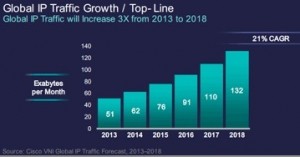
Los datos del informe Cisco Visual Networking Index Global Forecast and Service Adoption 2013-2018 ponen de relieve que el tráfico anual de Internet se multiplicará casi por tres alcanzando 1,6 Zettabytes (more than 1,5 billones de GB) en el año 2018, generado principalmente por las conexiones fijas y móviles, lo que supone una tasa de incremento interanual del 21% in the period analyzed.
En España, el tráfico IP se multiplicará por dos entre 2013 y 2018, hasta alcanzar 14,6 Exabytes anuales (1,2 Exabytes mensuales) respecto a los 7 Exabytes anuales registrados en 2013, con una tasa de crecimiento interanual del 16%.
In this sense, la composición del tráfico IP cambiará enormemente en los próximos años, según se desprende de este informe, hasta el punto de que en 2018, y por primera vez en la historia de Internet, la mayoría del tráfico se originará desde dispositivos distintos al PC, al tiempo queel tráfico WiFi superará al cableado y el vídeo en HD generará más cantidad de tráfico que el vídeo con definición estándar.
In 2018 el tráfico que cruzará las redes a escala global será mayor que la suma de todo el tráfico de años anteriores. Entre 1984 y 2013 se generaron 1,3 Zettabytes de tráfico IP a escala global, while in 2018 este volumen será de unos 1,6 Zettabytes.
Internet of Everything y la Copa Mundial de Fútbol 2014
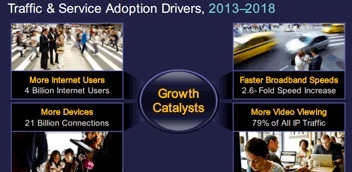 El informe Cisco VNI también desvela que el Internet of Everything (IoE) está creciendo exponencialmente y que en 2018 habrá casi tantas conexiones máquina-a-máquina (M2M) como habitantes en la Tierra. So, For example, los coches inteligentes (smart cars) tendrán casi cuatro módulos M2M por vehículo.
Coincidiendo con el comienzo de la Copa Mundial FIFA 2014 en Brasil el próximo 12 June, se espera que millones de personas vean los partidos y/o sus resúmenes a través de Internet, lo que supondrá que el vídeo en streaming y las emisiones IP del campeonato generen 4,3 Exabytes de tráfico, tres veces la cantidad de tráfico IP generado en Brasil en un mes.
Besides, el tráfico de Internet generado por los 60.000 espectadores del estadio y las personas que asistan al evento superará previsiblemente al tráfico generado en las horas punta por todos los smartphones de Brasil.
Como explica Doug Webster, vicepresidente de marketing de productos y soluciones en Cisco, “hace nueve años, el primer Cisco Visual Networking Index predijo que el tráfico IP global alcanzaría la ‘Era Zettabyte’ con un billón de GB anuales. El informe actual consolida esta afirmación al predecir una tasa de 1,6 Zettabytes anuales en 2018, más de trece veces todo el tráfico IP generado en 2008. Nos aproximamos rápidamente a la nueva ‘Era Yottabyte,’ que implica enormes oportunidades para aquellos proveedores de servicios y organizaciones que estén preparados para aprovechar las ventajas del Internet of Everything”.
Evolución por regiones
 In 2018 la región Asia-Pacífico generará la mayor parte del tráfico IP, con 47,6 Exabytes mensuales (36% de todo el tráfico IP global). Con la mayor población del mundo y la mayoría de dispositivos/conexiones, mantendrá el liderazgo en generación de tráfico hasta 2018.
La región en la que el tráfico IP crecerá más rápidamente durante el periodo analizado seguirá siendo Oriente Medio y África (multiplicándose por cinco, con una tasa de crecimiento interanual del 38%).
Los mayores generadores de tráfico IP serán Estados Unidos (37 Exabytes mensuales) y China (18 Exabytes mensuales) in 2018, mientras que India será el país donde el tráfico IP crezca más rápidamente, con una tasa de incremento interanual del 39% between 2013 y 2018, seguido por Indonesia (37%).
Implicaciones para proveedores de servicios
Las redes de los proveedores de servicios deberán adaptarse al creciente número de dispositivos -como tablets, smartphones y conexiones M2M- con sistemas de autentificación para acceder a las redes fijas y móviles con mayor seguridad e inteligencia.
La evolución de los servicios de vídeo avanzados(en HD y UHD) puede incrementar los requisitos de ancho de banda y escalabilidad debido a la fuerte de manda de consumidores residenciales, empresariales y móviles a través de todos los tipos de red y de dispositivo, siendo la calidad de servicio, la facilidad de uso y el precio los principales factores para el éxito de las ofertas.
La creciente adopción de vídeo empresarial -como la conferencia web y la basada en vídeo de alta definición y el vídeo bajo demanda- puede suponer un mayor incremento de la virtualización de red, así como del aprovechamiento de Internet para la transmisión de vídeo por parte tanto de proveedores de servicios como de proveedores over-the-top (OTP).
Las redes IP deberán ser lo suficientemente flexibles e inteligentes como para soportar el creciente número de aplicaciones nuevas o actualizadas diseñadas para redes fijas y móviles. Muchos proveedores de servicios están colaborando activamente con los desarrolladores de aplicaciones para diferenciar sus servicios.
El informe Cisco VNI 2013-2018 se basa en análisis y datos reales sobre el uso de datos móviles, elaborados por analistas independientes, con los que esta compañía realiza sus propias estimaciones sobre el tráfico IP global y la adopción de servicios.
Did you like this article?
Subscribe to our NEWSLETTER and you won't miss anything.
Related articles
 Matrox Video ofrece control de KVM a través de Internet con Extio 3
 Informe IAB Spain: la inversión publicitaria en medios digitales creció un 13,5% in 2018
 En España, el vídeo supondrá el 78% de todo el tráfico IP en 2020
 Dispositivos móviles y TV conectada protagonizan el crecimiento de consumo de vídeo
 Cisco Live! 2015 planteó todo un reto audiovisual a XL Video
 Cisco lleva su propuesta del Internet of Everything a Smart City Expo 2014
Internet of Everything atrae a Cisco Connect 2014 more than 1.900 profesionales de TI
Cisco Connect 2014 girará alrededor de las nuevas tecnologías que harán posible el Internet de todas las cosas
Cisco lleva su propuesta del Internet of Everything a Smart City Expo 2014
Internet of Everything atrae a Cisco Connect 2014 more than 1.900 profesionales de TI
Cisco Connect 2014 girará alrededor de las nuevas tecnologías que harán posible el Internet de todas las cosas
 Internet of Everything, redes y cloud protagonizarán Cisco Connect 2014
 Cisco acude a Smart City Expo World Congres 2013 con sus soluciones para el Internet of Everything
La plataforma Cisco NCS facilita la migración al Internet of Everything
Cisco acude a Smart City Expo World Congres 2013 con sus soluciones para el Internet of Everything
La plataforma Cisco NCS facilita la migración al Internet of Everything
 Techno Trends obtiene la nueva certificación “Cisco Telepresence Video Master ATP”
 Cisco Prosumer Video o cómo optimizar la productividad empresarial con ayuda del vídeo
 El vídeo en Internet supone más de un tercio de todo el tráfico generado por los consumidores