


Micro LED Market Will Grow by 100 % interannual, according to Omdia

The Latest ‘Micro LED Display Market Tracker’ of Omdia Micro LED display revenue is expected to grow by 100 % interannual, passing from 52,4 millions of dollars in 2025 a 105,4 millions in 2026.
Although Micro LED screens for public use, ultra large televisions, smart watches and smart glasses remain limited, Rapid maturation of manufacturing capabilities and adoption of new products expected to drive significant shipment and revenue growth in the near term.
until recently, large-scale marketing was faced with important obstacles, among them the variability of electro-optical characteristics, the limitations of technologies mass transfer, the challenges of motherboard performance y, what is more important, los high manufacturing costs. By addressing these challenges, display manufacturers have now started the mass production of Micro LED based displays.
It is worth highlighting the rapid growth of LEDs (Micro LED on Silicon), a field that was previously difficult for existing display manufacturers to enter. LEDs allows you to create ultra-small screens through electrical integration of micro LED chips, each a few nanometers wide, on a semiconductor substrate. As a result, LEDoS manufacturing is typically more aligned with semiconductor processes than conventional panel manufacturers.
A typical LEDoS display may have a diagonal length of 0,1 a 0,2 inches and a resolution in the range of 4000 a 6000 pixels per inch (PPI), which makes it very suitable for AR applications, RV, MRI and near-eye screens. More and more global brands are expanding their AI services through smart glasses and plan to adopt LEDoS as their solution laptop screen, since it offers greater brightness and resolution than LCoS or OLEDoS.
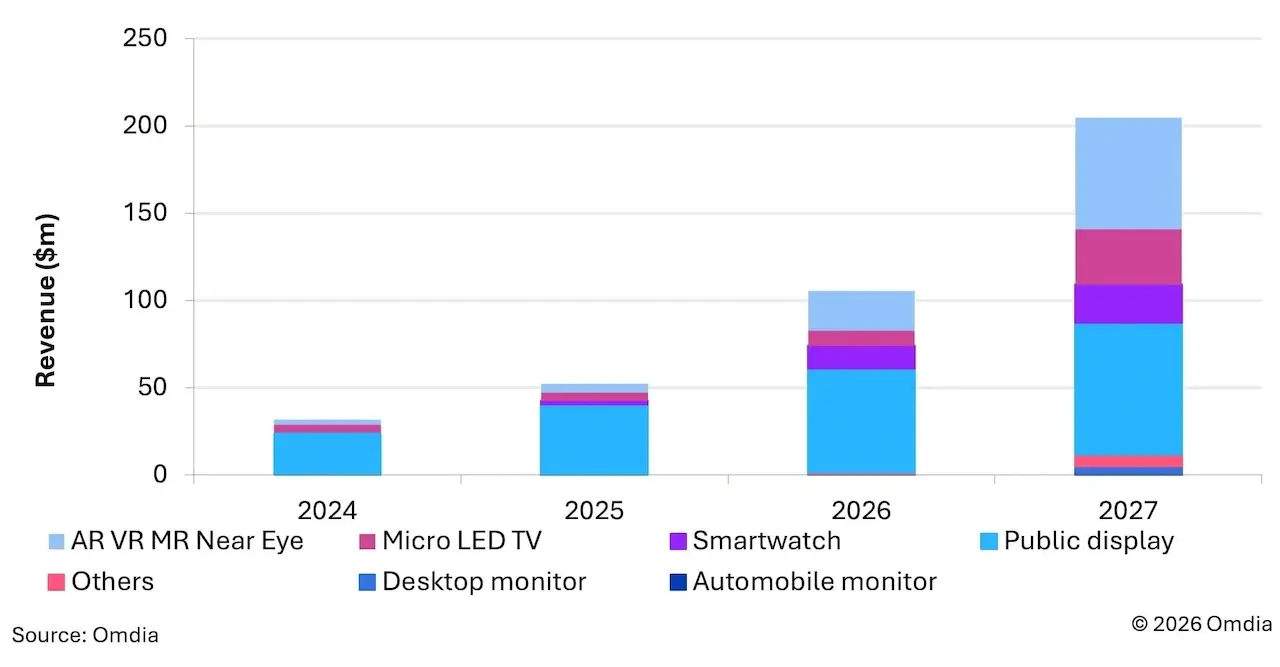
MicroLED revenue doubles
Jerry Kang, OLED practice director, flexible, micro LED and emerging technologies from Omdia, states that “the method of mass transfer of tens or even millions of micro LED chips, depending on size and resolution, It differs significantly from the methods used by existing panel manufacturers to inject liquid crystals or patterned OLEDs.. Besides, the design, the acquisition, The transfer and modularization of micro LED chips of different specifications depending on the specifications of the final product requires significant resources”.
From Omdia's point of view, micro LED displays are best positioned to grow first in specialized application markets where competing technologies cannot meet performance requirements. These include the ultra-large displays with low PPI (high transfer frequency but relatively low precision), las ultra-small screens with high PPI (high precision but relatively low transfer rate), automotive displays that require exceptionally high brightness (to improve outdoor visibility compared to LCD/OLED), transparent screens that require both high brightness and high aperture ratio, and elastic screens that adapt to irregular surfaces. We expect these innovative applications to be the main drivers of the adoption of micro LED displays in the future.".
Looking to the future, Omdia anticipates that micro LED display revenue will double approximately, passing from 52,4 millions of dollars in 2025 a 105,4 millions in 2026, and will reach approximately 6800 millions of dollars in 2032, what it represents around the 4,4 % of the total flat screen market.
Did you like this article?
Subscribe to our NEWSLETTER and you won't miss anything.
Related articles
 The ProAV sector will grow around 6% year-on-year between now and 2030
 Omdia places Samsung at the head of the global digital signage market
 The professional AV sector will grow by 5,6% annual, according to Avixa IOTA report
 Economic uncertainty slows down the sale of dvLed screens, according to Omdia
 Samsung once again leads sales in the global digital signage market, according to IHS Markit
 Samsung covers the 33,9% of the global digital signage market in 2Q18, according to IDC
 IoT technology will revolutionize the retail market according to a report from Zebra Technologies
 Spanish investment in digital signage will grow 9,1% this year, according to DBCI
 The demand for large format screens will grow by 32% in 2018, according to Sony and FutureSource
Advertising investment in Spain will grow by 5% this year, according to Zenith Vigía
The digital signage market looks optimistic 2015, according to Ovab Europe
The demand for large format screens will grow by 32% in 2018, according to Sony and FutureSource
Advertising investment in Spain will grow by 5% this year, according to Zenith Vigía
The digital signage market looks optimistic 2015, according to Ovab Europe
 The convergence between digital signage and IoT will energize the market worldwide, according to IDC
The market for large format screens for public spaces is beginning to recover and is expected to grow in 2014
The convergence between digital signage and IoT will energize the market worldwide, according to IDC
The market for large format screens for public spaces is beginning to recover and is expected to grow in 2014
 NEC holds the largest share of the global PBX/IP PBX market, according to the consulting firm MZA