


This is how 'Breathe' was conceived, the immersive installation created by Instronic that surprised at ISE 2026
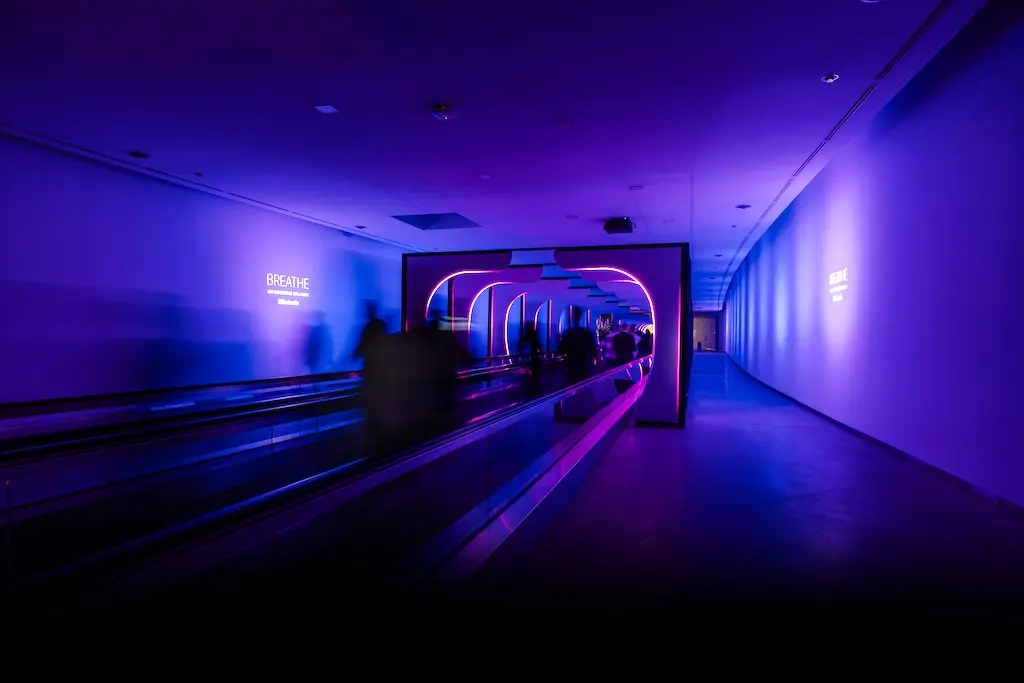
Instronic, a multimedia design studio based in Barcelona dedicated to the design and development of multimedia projects adapted to physical spaces, was in charge of the immersive installation 'Breathe’ that surprised visitors to Integrated Systems Europe (WHEREAS).
Conceived within a walkway designed exclusively for transit and efficiency, The project was proposed as an experience that transforms a functional step into a moment of presence without interrupting its flow.. Through an integrated architecture system, luz, sound and digital media, Breathe established a continuous atmospheric environment capable of evolving over time turning the circulation itself into a composite spatial encounter. Technology was thus put at the service of calm, allowing the movement to make sense.
Located between the pavilions 7 y 8.1 from Fira Barcelona, the covered walkway 80 metros improved visibility and flow between pavilions, while creating a transition space to attract and guide visitors. Instead of continuing to be utilitarian, the hallway was to become a destination in its own right, increasing foot traffic to the pavilion 8, a growing area of the fair that ISE intended to activate even more.
Beyond circulation, the facility also supported ISE's evolution toward a more experiential positioning: show what technology can enable when used to transform space, and not just to display products.
In a context highly saturated with technology, Breathe introduced a quiet paradox: technology not as spectacle, but as a means to stillness. The hallway became a living spine shaped like a monumental breath., that unfolded rhythmically through the light synchronization, digital sound and imagess.
Conceptually, Breathe was inspired by the deep parallels between technological and biological systems. Inspired by biomimetics and organic structures, the visual language fuses references to ribs, is coming, cables, stems and petals, blurring the distinctions between the mechanical and the living. The initial development phase embraced abstraction. Initial studies focused on the rhythm, continuity and spatial flow, more than in defined images. These conceptual explorations tested how a hallway could embody breathing through progressive light sequences., Layered digital content and strong linear perspective.
Design process
These studies helped Instronic to establish the structural logic of the project: a path similar to a spinal column, a core expansion and gradual release. By defining the narrative arc before refining the visual language, the team laid the foundation for the immersive system that would eventually take shape.
The design process followed a parametric logic, in which each restriction became a generative contribution. Translating the concept into a built solution required overcoming spatial limitations, budgetary parameters and strict regulatory conditions.
Since the site functions as an evacuation corridor, los security requirements were fundamental to the design. Fire resistant materials were specified, such as steel and certified plastics, to meet compliance standards, what determined the width of the corridor, the free spaces, the structural rhythm and scale of the integrated screen. These parameters perfected the result, resulting in a solution that adapts precisely to its environment.
The process began with a full digital hall twin, which allowed the team to preview and calibrate the lighting, sound and visual sequences before construction. With an extremely compressed installation schedule, This virtual model allowed for precise testing and refinements in advance, which ensured that the final implementation was seamless and fully aligned with the design intent.
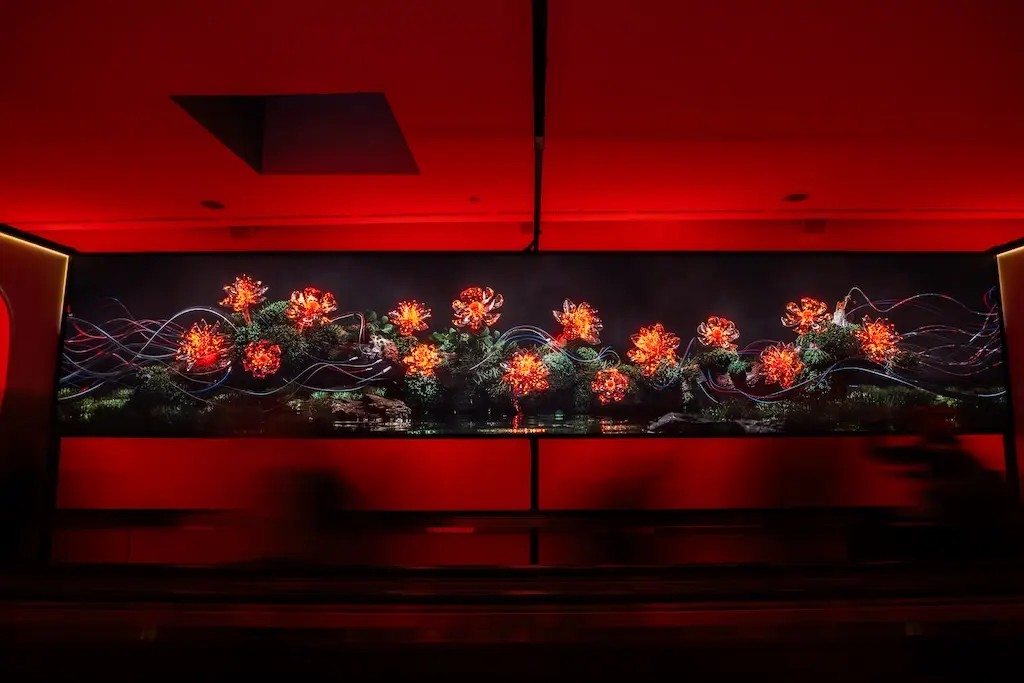
The content was structured as a time based storyboard and built around the inhalation and exhalation. Abstract cable-like flows, Pulses of light and flourishing digital shapes translated breathing into a spatial sequence, with synchronized LED rhythms that intensified until reaching a central peak.
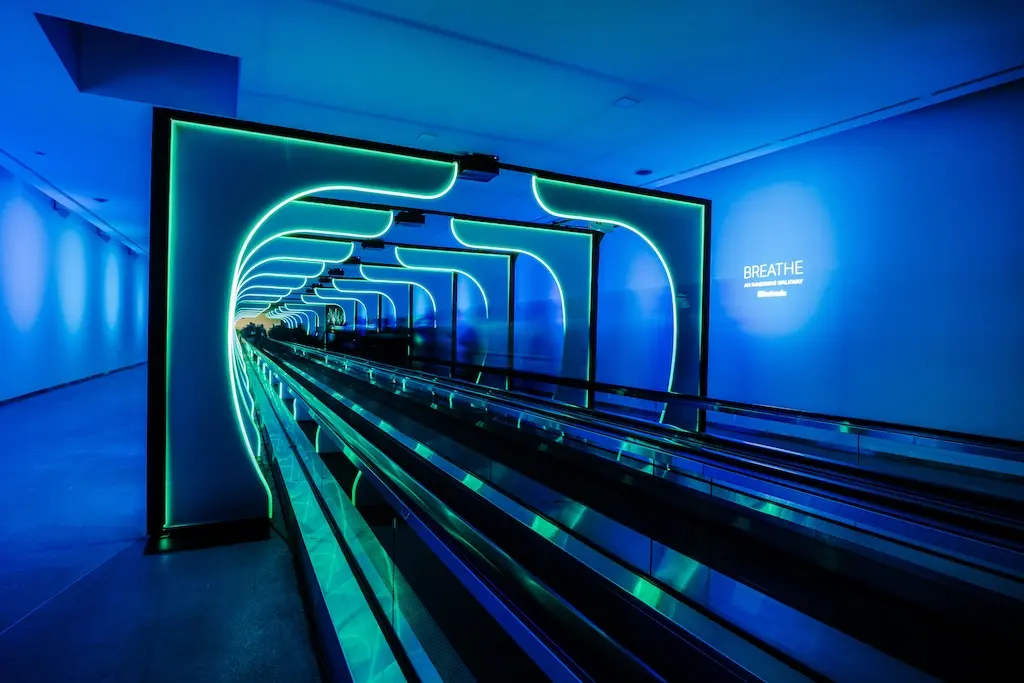
The sound was developed in close collaboration with H1 Sound and followed the same inhalation-expansion-exhalation structure, moving along the hallway to draw visitors inward and soften outward like an invisible architectural layer. The lighting and media functioned as an integrated system, with pixel-mapped devices and displays synchronized in real time to maintain a single, cohesive environment.
Lightning, sound and image
In a space of this scale, lighting and media became both structural and atmospheric elements. Light bath devices defined the volume, point-to-point LED strips articulated the rhythm, gobos reinforced orientation and LED screens conveyed the evolving visual layer. Pixel mapping ensured chromatic consistency in all elements, while a unified data source synchronized the light, sound and content in real time, allowing the hallway to function as a single cohesive system. The installation phase required extreme precision due to time constraints and the operational nature of the venue.
The entire system was pre-designed for rapid implementation. The structural components were modular and prefabricated to minimize on-site intervention. multimedia hardware, Wiring routes and security systems were pre-coordinated through the digital twin to avoid conflicts during installation.
Since the hallway remained a critical circulation and evacuation route, Coordination with the campus authorities was continuous. All components had to comply with the fire regulations, structural load limits and accessibility standards in case of emergency. The installation was carried out during a record edition of ISE, who received more than 92 000 unique visitors and more than 212 000 total visits in four days.
Amid constant movement and visual stimulation, the hallway offered a calibrated moment of presence. The rhythmic light, spatialized sound and evolving images transformed circulation into a shared sensory experience, reframing traffic as something that is felt rather than simply crossed, and confirming that the atmosphere can guide perception without the need for instructions.
Mike Blackman, general director of ISE, highlights that “what Instronic has created is more than an installation, is a subtle reminder that immersive technology doesn't need to attract attention to have impact. It perfectly illustrates how our industry is evolving beyond hardware and infrastructure to create atmospheres, emotions and connection within built spaces”.
Did you like this article?
Subscribe to our NEWSLETTER and you won't miss anything.
Related articles
 Laia believes in ISE 2026 an immersive experience with its new cameras and AI
 Antycip completes TORE technological renewal, the immersive installation of the University of Lille
 WHEREAS 2026 promotes a new stage in immersive learning and exploration
 Epson will create an immersive classroom at Edtech Congress Barcelona 2026
 RCF will promote its proposal for installation and direct at ISE 2026
 The technology of&b Soundscape has made Björk's immersive sound installation possible
 Kinetic Module equips the immersive installation of the Artexplorer museum ship
 Instronic transforms the entrance of the Aqua building into an immersive space
 Planar TVF stars in unique immersive installation at Edmonton Library
 The NBA brings its fans to the stands in a virtual experience created with Microsoft
 Playmodes Studio carries out the immersive AV installation 'Voices of mass creation' in Seville
 Transitions by Panasonic Design commemorates the company's centenary with an immersive installation
 VEO is the new company created for the digital signage market
 Boris Yeltsin Presidential Center: interactive and immersive museum installation around the former Russian president