


IoT platforms will generate business volume 3.000 million euros in 2021
Choose the most platform suitable is becoming in a key decision for companies that want to manage your devices and monitor the continued growth of data volume.
 In 2020 there will be 20.800 millions of connected devices around the world, according to the consultant Gartner. A market with enormous potential in which it is necessary to know how to manage the flow of data, the fleet of connected devices and SIM cards, for which IoT platforms have become essential to control and simplify this ever-increasing volume of data.
For your part, the consultant Berg Insight estimates that IoT platforms will generate a business volume of 3.000 million euros in the world 2021, in front of the 610 million euros of 2015.
Although there are currently different types available on the market, Identifying the most appropriate platform for a specific fleet of devices is becoming a crucial decision for companies. But which platform to choose and why use it??
 Currently there are three types three types of IoT platforms. One is device management, that allows you to control the devices and interact with them remotely thanks to integrated modules or programs installed on these devices.
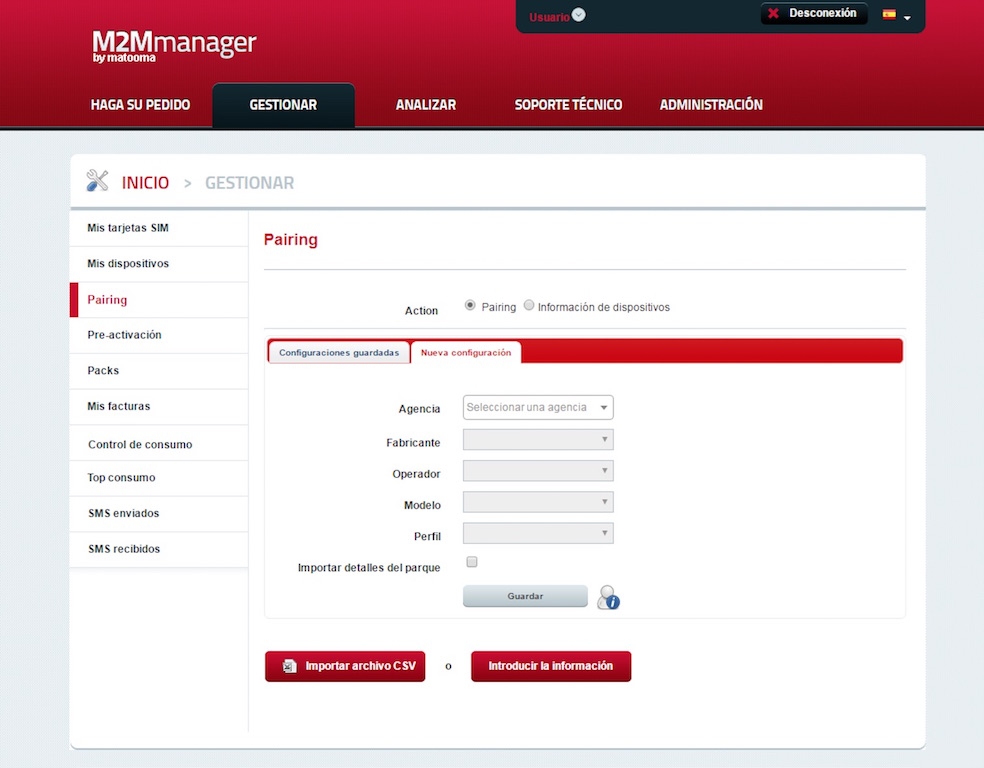
Another is connectivity management, a platform used to manage a fleet of SIM cards, since it offers a centralized view of device consumption and allows you to activate, suspend or terminate a SIM card, expand your connectivity, as well as facilitating the management of different connectivities from a single point.
Finally, The data management platform facilitates the management of data collected by devices, performing an aggregator task and converting the data for analysis and exploitation, in order to create applications.
According to Frédéric Salles, CEO of Matooma, company specialized in the connection and management of connected devices, “our company proposalit is M2M Manager, anda platform SaaS (software as a sservice) specially designed for daily management centralized of devices connected by SIM card”.
Plataformas de connectivity management
 As this manager explains, This option “offers a real-time and remote management of connected devices, immediately centralizing information and with real-time access to tracking the objects”.
Another of its advantages is inventory management, with order functions, activation, suspension or cancellation, which can be managed from the platform interface, with simple management, both globally and individually, by differentiating each connected device.
It also centralizes products and connections. “Un IoT park can be composed of devices with different types of needs in terms of connectivity”, Salles points out. A connectivity management platform like M2M Manager allows you to manage and centralize this. For example, if an object needs a multi-operator SIM card with 5 MB of data and other device required 3 GB with a single operator, both can be controlled from the same platform.
Thanks to real-time data transmission, It is possible to control the direct consumption of the devices from the SIM card. In case of problems, Alerts can be sent to detect device malfunction or poor connectivity. These platforms also allow you to save time in monitoring and managing invoices by centralizing everything in a shared invoice., unique and accessible online from any device with Internet access.
Did you like this article?
Subscribe to our NEWSLETTER and you won't miss anything.
Related articles
 Hikvision increases a 50% your billing on display and reaches 400 million euros
 WHEREAS 2021 will turn Barcelona into the world AV capital and generate 400 million euros
 The Government promotes R&D&i in digital and IS technologies with 80 million euros
 SoftBank enters the capital of Beabloo with 8 million euros
Industry invests 153 million euros in the National Smart Cities Plan
SoftBank enters the capital of Beabloo with 8 million euros
Industry invests 153 million euros in the National Smart Cities Plan
 The benefits of Telefónica in 2014 decrease one 34,7%, reaching the 3.001 million euros
 Vint-Sogeti reports: smart cities will generate an investment of 87.000 million euros
 The Xunta de Galicia receives more than 16 million euros to improve its ICT infrastructure
Advertising investment in digital signage will reach 12 million euros in 2013
The Xunta de Galicia receives more than 16 million euros to improve its ICT infrastructure
Advertising investment in digital signage will reach 12 million euros in 2013
 Investment in dynamic outdoor advertising will reach 2013 los 10,3 million euros
 Wireless video surveillance infrastructures will generate 2017 a business of 705 million dollars
 Advertising investment in digital signage will be around 12 million euros in 2012
 Digital signage will exceed 11 million euros of investment in 2012
 Samsung plans record investment of more than 32.371 million euros