


In London, the rain does not wet
The 3D Barbican Center in London offers an exciting experience called 'Rain Room’ (rain room), an exhibition that combines art, science and technology to make it rain so that the visitor does not get wet. The effect is achieved thanks to a series of sensors and 3D cameras that stop the rain by detecting the proximity of people.
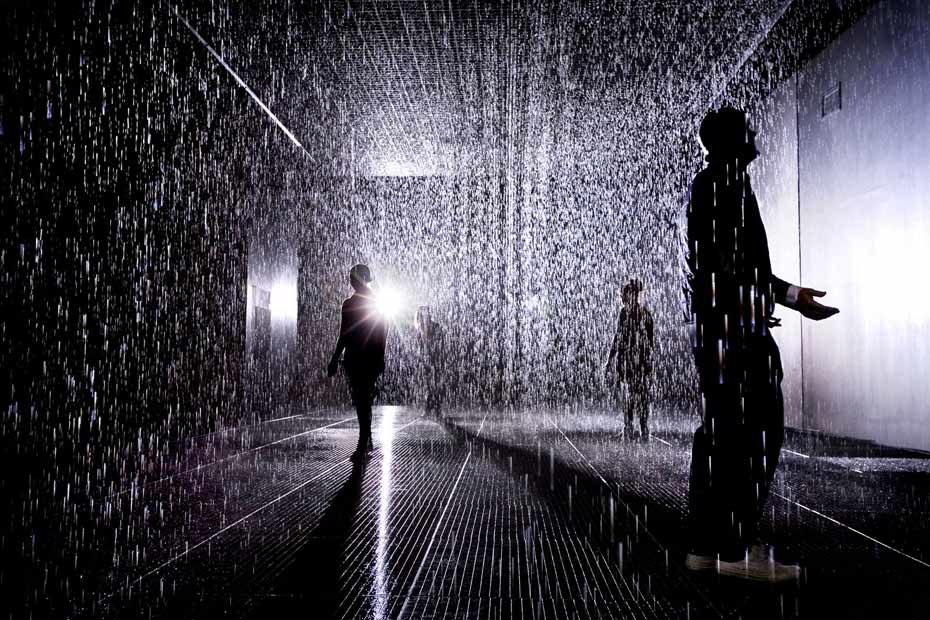
A new installation has been inaugurated at the 3D arts center Barbican Center in London (United Kingdom). Although it is an artistic work, Its greatest attraction lies in the technology it uses. The exhibition allows museum visitors to walk in the rain, but without the inconvenience of getting wet.
‘Rain Room’, name given to the project, consists of a room 100 square meters enabled with motion sensors and 3D cameras that stop the rain by detecting people. Everything works with a system of “impression” water, that stops its production only in those points of the room that are occupied. This peculiar installation has been created by the art studio Random International and use about 1.000 liters of water every minute, which is filtered and reused as soon as it falls.
Those responsible for the assembly are Hannes Koch, Florian Ortkrass y Stuart Wood, three artists who met in 2005 at the Royal College of Art in London and who decided to form the Random International project. Stuart Wood described Rain Room as a “social experiment” with the one they want “offer people an exciting experience and see what their reaction is to this rain that does not wet”.
Through sensors and cameras, people see how the rain falls from the roof above their head, but when they move they are perceived by these devices that reduce the speed of the rain falling and visitors feel as if they were able to stop the rain.. Those responsible for Rain Room hope that people feel a sense of “playful might”. Furthermore, in the room there is no sound other than that of the rain., calming and hypnotic.
[youtube]http://www.youtube.com/watch?v=FslABAyj2OA[/youtube]
Did you like this article?
Subscribe to our NEWSLETTER and you won't miss anything.
Related articles
 ST Engineering Antycip upgrades UCL London VR lab
 L-Acoustics guarantees with Van Damme the operation of its showroom in London
 KV2 brings its technology to two of the highest restaurants in London
 The room 229 of London invests in DiGiCo technology
 Genelec inaugurates its first Experience Center in London
 The London Stadium installs the largest curved LED screen in Europe
Electrosonic helps IWM London explore the world of war films
London's Palladium theater optimizes its public address system with L-Acoustics
The London Stadium installs the largest curved LED screen in Europe
Electrosonic helps IWM London explore the world of war films
London's Palladium theater optimizes its public address system with L-Acoustics
 XL Video holds a spectacular screening for The One Campaign in London
 Sennheiser supports media in London 2012
 Bosch technology guarantees safety in an Olympic London’
 A “false sun” illuminates London's Trafalgar Square
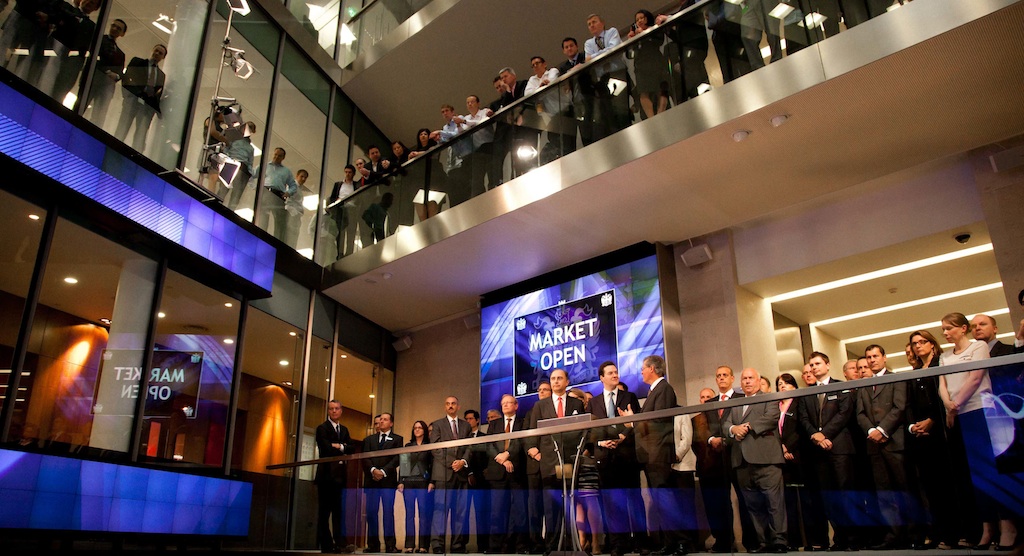 Christie MicroTiles on the London Stock Exchange
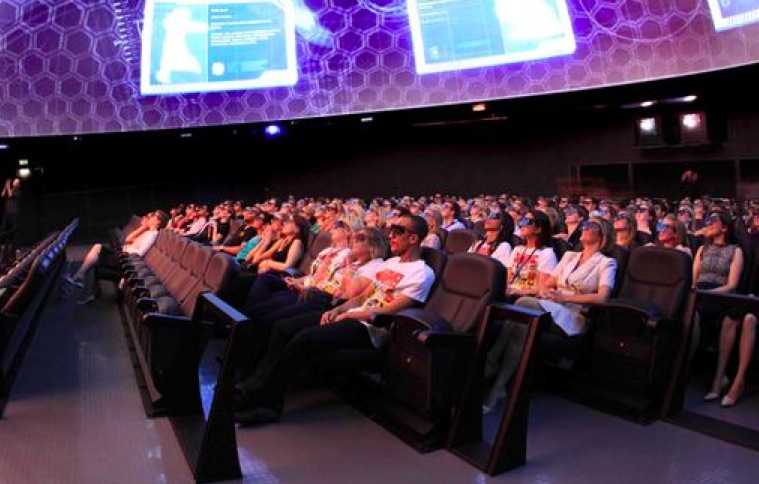 4D experience at Madame Tussauds London