


A robot therapist helps children with mobility problems
Spanish researchers have developed an android, designed for child rehabilitation, que es capaz de interactuar con los pacientes y reconocer sus gestos y movimientos para monitorizar su terapia.

Realizado bajo el marco del proyecto científico Therapist, investigadores españoles han desarrollado un robot terapeuta que facilita la recuperación de los niños que tienen problemas de psicomotricidad.
In this project, en el que participan la Universidad Carlos III de Madrid (UC3M), the Universidad de Málaga, the Universidad de Extremadura and the Hospital Universitario Virgen del Rocío from Seville, se ha conseguido convertir al robot humanoide NAO, of 58 centímetros de alto y poco más de cuatro kilos de peso, en un terapeuta personal que ofrece una gran capacidad de movimiento y, además es social, autónomo e interactivo.
El robot es capaz de percibir las reacciones de los pequeños e interactuar con ellos. En el caso de que el niño no realice los movimientos de forma correcta, el androide se lo indica de forma visual, mediante el color de sus ojos y, gracias a su voz y a su expresión corporal, le muestra cómo hacerlo.
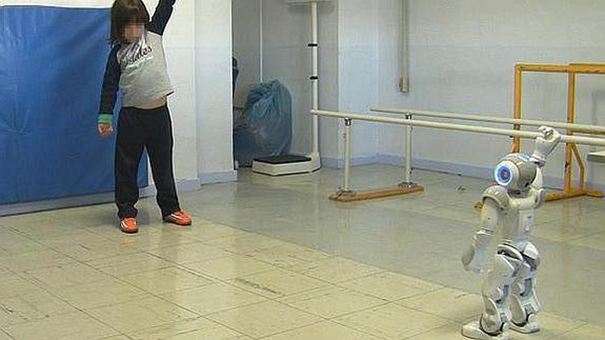
El androide está dotado de la tecnología de reconocimiento para identificar los gestos y los movimientos. Esto lo realiza a través de las cámaras y sensores que integra y cuyos datos son interpretados por un algoritmo que analiza las imágenes para determinar los estados de ánimo del niño. Besides, dispone de autonomía e inteligencia para discernir que es lo que el paciente hace bien y hace mal.
El trabajo de la UC3M se ha centrado en la planificación de tareas y el aprendizaje automático, algo que permite “dar al robot la capacidad de decidir qué acciones ejecutar en cada momento y adaptarse a las características del paciente y la sesión de rehabilitación que se está ejecutando”, explica Fernández Rebollo, responsable del proyecto dentro del grupo de investigación en Planificación y Aprendizaje (PLG) del departamento de Informática de la UC3M.
El robot terapeuta está dotado de una arquitectura de control, denominada Robocog que puede aplicarse a otros robots terapeutas como Ursus, en el que actualmente está trabajando la Universidad de Extremadura dentro de este consorcio.
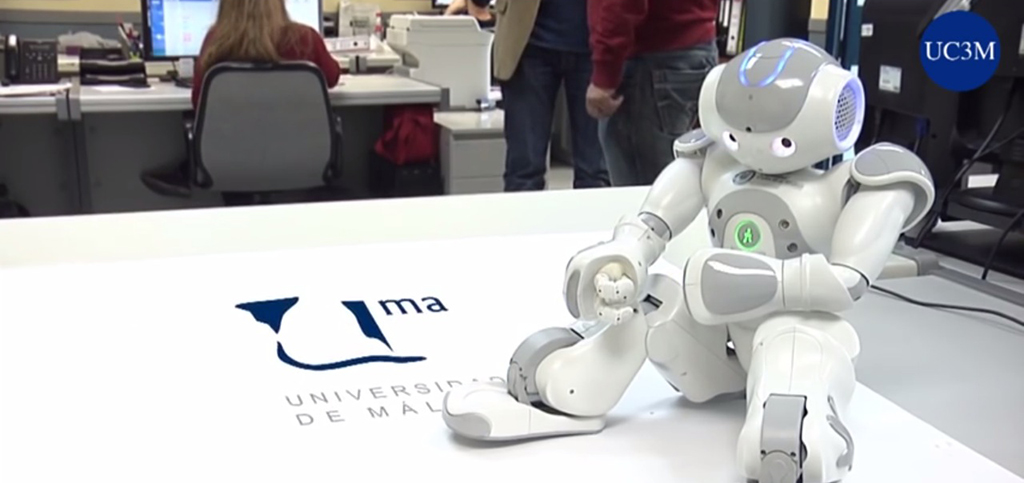
Estos fisioterapeutas robóticos afinarán su comportamiento gracias a los algoritmos que está investigando la Universidad de Málaga que, como señala José Carlos González, investigador en Planificación y Aprendizaje (PLG) de la UC3M, “permiten reconocer gracias a la cámara que incorpora los gestos del niño y determinar cuándo está sonriendo, cuándo se enfada o cuándo le está costando hacer el ejercicio”.
Su aspecto se asemeja a un muñeco con el que los niños se sienten cómodos para realizar su terapia y fomenta la motivación. “Un robot que no parece un robot, que da la sensación al niño de que está vivo y que interactúa socialmente con él”, explica Fernando Fernández Rebollo, responsable del proyecto dentro del grupo de investigación en Planificación y Aprendizaje (PLG) del departamento de Informática de la UC3M.
El objetivo de este programa de investigación es colaborar con los servicios médicos de rehabilitación de los hospitales en la definición de terapias en las que esta herramienta tenga cabida.
Este terapeuta robótico podrá ser una realidad en la medicina española e incluso podría dinamizar dentro de unos años los procesos de rehabilitación de niños con patologías como la parálisis cerebral.
At the moment, es un proyecto que está en fase de desarrollo. Los investigadores señalan que hace falta definir las métricas para evaluar correctamente el grado de éxito de la nueva terapia de rehabilitación y el grado de interacción con el paciente al que puede llegar este robot fisioterapeuta, así como cuál puede ser su aportación en la evaluación y monitorización de las terapias.
[youtube]https://www.youtube.com/watch?v=FBNXp2oDmYQ[/youtube]
Did you like this article?
Subscribe to our NEWSLETTER and you won't miss anything.
Related articles
 Murideo Fox & Hound ayuda a los integradores AV a localizar problemas
 JBL technology solves acoustic problems in sports halls
 El robot ‘Pilar’ ayuda a divulgar la cultura a distancia y en tiempo real en CaixaForum Zaragoza
 Christie's projection helps to humanize the children's time in the operating rooms of Sant Joan de Déu
 NEC BT421: digital signage for space-constrained environments
 Lifesize Share eliminates wiring problems in meeting rooms
Augmented reality helps protect Chilean children on Halloween night
Lifesize Share eliminates wiring problems in meeting rooms
Augmented reality helps protect Chilean children on Halloween night
 OrCam MyEye ayuda a leer a las personas con problemas visuales con algoritmos inteligentes
Atlona da respuesta a los problemas de integración AV en sistemas HDR 4K
OrCam MyEye ayuda a leer a las personas con problemas visuales con algoritmos inteligentes
Atlona da respuesta a los problemas de integración AV en sistemas HDR 4K
 JBL technology solves the audio problems of the Barbastro worship building
 El robot Panasonic Hospi ayuda en la entrega de medicinas en el hospital de Changi
 El robot Panasonic Hospi Rimo ayuda en el transporte de fármacos a los pacientes hospitalizados
 Future Robot idea un kiosco-robot de digital signage
 TRENDnet responde ante los problemas de vulnerabilidad de código en sus cámaras IP